10 Essential Tips for Beating Jet Lag

Whether you are traveling for work, leisure, or visiting family, long-haul flights can be an amazing experience. You board a plane, watch a few movies, and before you know it, you have arrived on the other side of the world.

As exciting as long-distance travel can be, however, the disruption to your body clock can be challenging. Jet lag can leave you exhausted during the day, wide awake at night, and struggling to adjust to your new surroundings.

Fortunately, a little preparation can make a big difference. Here are 10 practical tips to help your body adjust more quickly and get your internal clock back on track.

1. Choose the Right Arrival Time

Choose the Right Arrival Time

Preparing for jet lag can begin as early as the moment you book your flight.

If you find it difficult to sleep on airplanes, consider choosing a flight that arrives at your destination in the evening. After checking into your hotel, you can go to bed at a relatively normal local bedtime.

If you usually sleep well during flights, arriving around midday may be a better choice. You will still have half a day to stay active and remind your body, “It’s time to be awake!”—even if your body thinks it is the middle of the night back home.

2. Break Up a Long Journey

Break Up a Long Journey

Generally, the more time zones you cross at once, the more noticeable jet lag can become.

If your schedule allows, consider breaking up a very long journey with a stopover. Spending a day or two somewhere between your departure point and final destination may give your body a chance to adjust gradually rather than dealing with a dramatic time change all at once.

It can also turn a long trip into an opportunity to explore another destination along the way.

3. Gradually Adjust Your Sleep and Meal Times

Gradually Adjust Your Sleep and Meal Times

A few days before departure, begin gradually shifting your sleeping schedule toward the time zone of your destination.

For example, if you normally go to bed at 11 p.m., try going to bed somewhat earlier or later each day, depending on the direction you are traveling.

You do not necessarily need to completely match your destination’s schedule before leaving. Even a modest adjustment may make the transition easier.

Changing your meal times gradually can also help your body adapt and may reduce the likelihood of becoming hungry in the middle of the night after you arrive.

4. Change Your Clock as Soon as You Board the Plane

Change Your Clock as Soon as You Board the Plane

Don’t wait until the plane lands to start thinking in your destination’s local time.

Once you are on board, change your watch and phone to the time at your destination. This can help you mentally begin adjusting to your new schedule.

If it is nighttime at your destination, try to sleep. An eye mask, earplugs, neck pillow, or other travel accessories may help create a more comfortable sleeping environment.

If it is daytime at your destination, try to remain awake. If you desperately need some rest, take a short nap rather than sleeping for several hours.

5. Try to Stay Awake Until Evening

After a long flight, especially one during which you slept poorly, your first instinct may be to go straight to bed.

However, sleeping for several hours during the daytime can make it more difficult to sleep that night and may prolong your adjustment.

Whenever possible, try to stay awake until a reasonable local bedtime.

If you are extremely tired and really need a nap, keep it relatively short so that you can still fall asleep that evening.

6. Get Plenty of Daylight

Sunlight is one of the most important signals your body uses to regulate its internal clock.

After arriving at your destination, spend some time outdoors during daylight hours. Take a walk, explore the neighborhood, or simply sit outside for a while.

Many travelers find eastward travel particularly challenging because the body often has to adjust to an earlier schedule. Exposure to daylight at appropriate times can help your internal clock begin adapting to the new time zone.

Even if you feel tired during the day, getting outside and staying moderately active can make it easier to adjust.

7. Limit Alcohol and Caffeine

When you are exhausted, it may be tempting to drink coffee to stay awake or alcohol to help you fall asleep. However, both can interfere with the quality of your sleep.

Having some coffee after arrival may be fine if it helps you remain awake during the day, but avoid caffeine too close to bedtime.

Alcohol may make you feel sleepy initially, but it can disrupt your sleep later in the night and may leave you feeling groggy the following morning.

Jet lag is uncomfortable enough on its own—you don’t need a hangover on top of it.

8. Create an Environment for a Good Night’s Sleep

When bedtime finally arrives, you may discover something frustrating: you have been sleepy all day, but suddenly you cannot fall asleep.

Try creating a calm and comfortable sleeping environment.

Put away electronic devices and give yourself 30 to 60 minutes to relax before bed. Consider using earplugs and an eye mask, closing the curtains to keep the room dark, and using a fan or another source of gentle white noise.

A quiet, dark, and comfortable room can make it easier for your body to recognize that it is finally time to sleep.

9. Get Up Early and Explore

Even if you slept for only a few hours, try to resist the temptation to stay in bed until late in the day.

Setting an alarm can help, but giving yourself a reason to get up may work even better.

Book a morning food tour, make a reservation at a popular breakfast or brunch restaurant, take an early walk, or plan a sunrise activity.

Getting outside, seeing daylight, moving your body, and interacting with other people can help reinforce your destination’s daytime schedule and encourage your body clock to adjust.

10. For Very Short Trips, Consider Keeping Your Home Schedule

For Very Short Trips, Consider Keeping Your Home Schedule

Adjusting completely to a new time zone can take several days. If you are traveling abroad for only a short period, completely shifting your body clock may not always be worthwhile—especially if you will have to readjust again immediately after returning home.

Depending on the time difference and your schedule, it may sometimes be more practical to maintain at least part of your normal routine.

For example, you might wake up unusually early at your destination or go to bed much earlier than local residents do. This approach can be particularly useful when your trip lasts only a few days.

Final Thoughts

Jet lag can make the first few days of a trip difficult, but thoughtful preparation can make the adjustment much easier.

Gradually adjusting your schedule before departure, following your destination’s local time once you board the plane, getting plenty of daylight after arrival, avoiding long daytime naps, and maintaining a consistent local bedtime can all help your body adapt.

Most importantly, give your body a little time. Before long, your internal clock should begin catching up with your new surroundings—leaving you free to enjoy your journey.

Link: https://myhappylifestyle.net/2026/09/11/10-essential-tips-for-beating-jet-lag/

#HealthyLifestyle #HealthyLife #Happylifestyle #wellness #JetLag

What Should You Truly Cherish in This Life?

What Should You Truly Cherish in This Life?

There is a thought-provoking story about a king who wanted to reward a servant for his many years of loyal service. The king gave him a special opportunity, saying, “Run as far as you wish. As long as you make a full circle and return here before sunset, all the land you encircle will be yours.”

Overjoyed, the servant began running forward without stopping, almost like a wild beast driven into a frenzy.

He ran and ran with all his might. Finally, just before the sun went down, he completed a vast circle and returned to where he had started. However, exhausted beyond endurance, he collapsed and died.

With great sorrow, the king buried him. In the end, the only land the servant truly obtained was the small plot of ground needed for his grave.

This story reveals a profound truth: People always hope to gain more, yet in the process of pursuing more, they often lose themselves and may even pay for it with their lives. In modern society, we too are often driven by our desires, constantly pursuing greater achievements, greater wealth, and more possessions. Yet amid this endless pursuit, are we not sometimes like that servant, overlooking the true value and meaning of life?

Namo Shakyamuni Buddha said in the Sutra of the Buddha’s Bequeathed Teachings:

“You should know that those with many desires, because they seek much gain, also suffer much distress. Those with few desires, having little seeking and craving, are free from such troubles.”

Excessive desires often bring endless exhaustion and anxiety, causing us to lose ourselves in the flood of material pursuits. Rather than constantly seeking more external possessions, we should stop and reflect: What is truly important? What is the genuine treasure that we should cherish?

In a Dharma discourse, Namo H.H. Dorje Chang Buddha III taught His disciples:

“The most valuable thing in the world is the great Buddha Dharma that can enable you to attain liberation from birth and death! If you can grasp the Buddha Dharma and cultivate yourself in accordance with the Dharma, you will be able to live when you wish to live and die when you wish to die. That is what is truly most valuable.”

Therefore, as long as we have enough food to sustain ourselves and our lives are manageable, we should quickly seize the opportunity to learn the Buddha Dharma well, take worldly matters lightly, cultivate ourselves earnestly, have few desires and be content, never err in matters of cause and effect, and strive to attain liberation from birth and death with certainty in this very lifetime. This is what makes a life truly worthwhile.

Jiangqiu Lunzhu
June 2024

Link: https://myhappylifestyle.net/2026/09/09/dorjechangbuddhaiii-what-should-you-truly-cherish-in-this-life/

#DorjeChangBuddhaIII #Spirituality #Buddha #Buddhism

There Is No Generation Gap—Am I the North Wind or the Sun?

There Is No Generation Gap—Am I the North Wind or the Sun?

There is a saying: “If you have never experienced what others have gone through, do not be quick to judge their faults. If you have never endured their suffering, do not be quick to tell them how they should behave. If you had suffered what I have suffered, you might not have done any better than I did.” Such a simple truth—yet I never realized how poorly I had practiced it in the past.

Ever since I was young, my father had raised me with a strict and authoritative approach. This was very different from my relationship with my mother, with whom I always seemed to have endless things to talk about.

As I grew older, friction between my parents gradually increased, leaving many negative impressions deeply embedded in my mind. My father and I rarely talked. Whenever my parents had a disagreement, I invariably took my mother’s side without trying to view the situation objectively. As a result, my misunderstandings of my father grew deeper and deeper.

During the years when I suffered most severely from illness, my father took care of me tirelessly and without complaint. Although I was deeply moved by everything he did for me, for some reason I could never let go of the memories of his arguments with my mother. Deep inside, I still harbored resentment toward him.

After my mother passed away, my father was overwhelmed with grief. Yet he often pulled himself together to encourage me, simply because he was afraid that remembering my mother would make me sad and bring me to tears.

Now that only my father and I remained to keep each other company, the awkwardness of having so little to talk about became even more apparent. Sometimes when I accompanied him on walks, I would become impatient when he repeatedly talked about things from the past. Although this was his way of expressing his emotions, I failed to recognize the helplessness and loneliness hidden behind his words.

Instead, I behaved almost like a fault-finding inspector. Even as I listened to him, I would contradict or correct him. Our conversations would often end with him saying, “If you don’t like talking to me, at least don’t lose your temper with me!”

I do not know how many times this pattern repeated itself. Then one day, I suddenly became alarmed by my own conduct. I realized what an inconsiderate daughter I had been. I had continued to hold on to the painful memories of my parents’ arguments, and because of that, I had never truly listened to what was in my father’s heart.

I began to think: We can change ourselves without demanding that others change, can’t we? Moreover, how could I possibly understand all the causes and conditions underlying the relationship between my parents?

I therefore resolved to become a gentler and more understanding daughter. I began training myself to truly listen, to let go of the burdens and attachments of the past, and to sincerely fulfill my filial duty toward my father.

It reminded me of Aesop’s famous fable, “The North Wind and the Sun.” I was determined to be the sun!

Gradually, my relationship with my father became more and more harmonious. Whenever I am not by his side, I call him at a regular time each day to see how he is doing. When I return home, I also make an effort to spend more time talking with him. Over time, my father has come to feel that I genuinely care about him.

My father and I had once been almost like strangers, but now we live together in harmony. I deeply understand that this transformation came about through genuinely learning and practicing Buddhism. It is also a result of frequently listening respectfully to the Dharma discourses expounded by Namo H.H. Dorje Chang Buddha III, through which I received purification and blessings.

The Buddha Dharma exists in this world and is inseparable from awakening within this world. There is no knot in life that cannot be untied. What matters is whether we are willing to let go of our attachments and make the change.

Link: https://myhappylifestyle.net/2026/09/08/there-is-no-generation-gap-am-i-the-north-wind-or-the-sun/

#DorjeChangBuddhaIII #Spirituality #Buddha #Buddhism

When I Came to Understand the Pain Deep Within My Mother’s Heart

When I Came to Understand the Pain Deep Within My Mother’s Heart

Through participating in group study, respectfully and deeply listening to the Dharma discourses expounded by my Buddha Master, Namo H.H. Dorje Chang Buddha III, and sharing what I had learned with others, I gradually came to understand and feel the pain deep within my mother’s heart.

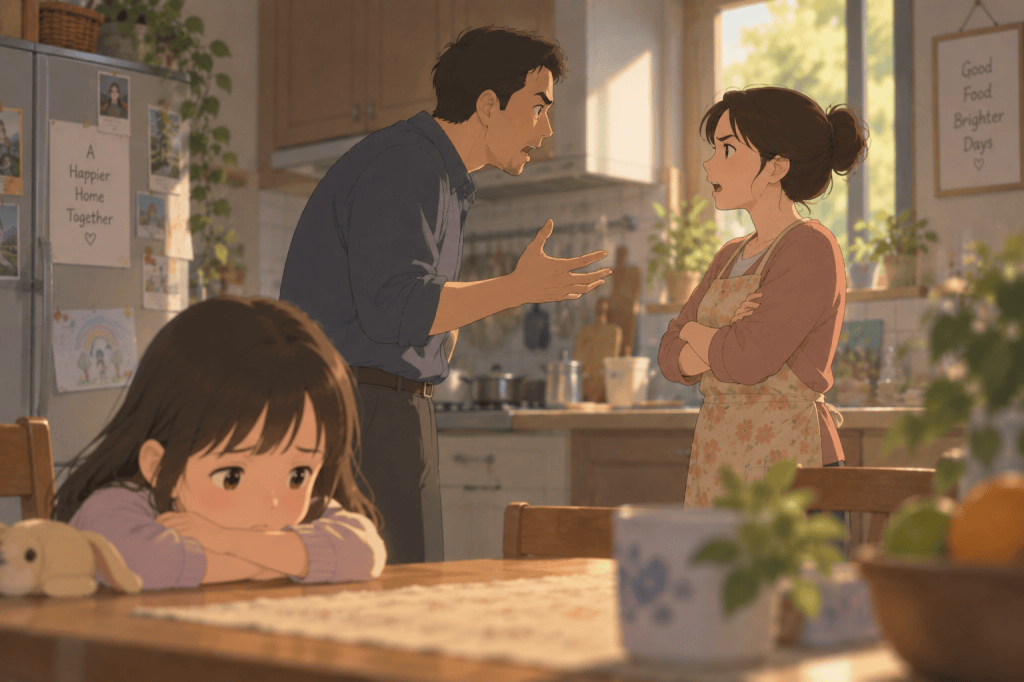
For as long as I can remember, my parents were constantly arguing. During holidays and festivals in particular, our home would become filled with tension. After an argument, my mother would always wear a stern expression and remain silent, while my father would sigh repeatedly, not knowing what to do.

After encountering the Tathagata’s True Dharma taught by H.H. Dorje Chang Buddha III, I wanted to resolve a question that had puzzled me for a long time: My mother had everything she needed in terms of food and clothing and was free from serious illness or misfortune, so why did she complain every day? She would either say that my father did not treat her well or feel that my younger brother and his wife did not treat her well. She would become so upset that she sometimes could not sleep all night.

My mother cared greatly about maintaining appearances, even when doing so caused her hardship. She especially doted on my younger brother, whom she treasured dearly. To ensure that he could hold his head high in front of his wife’s family, my mother used almost all of her savings to buy them a home and a garage.

Whenever there was an important occasion or even a smaller matter involving my sister-in-law’s family, my mother always handled everything generously and properly. She would rather live frugally herself than allow my brother to lose face.

Yet despite all she had done, my brother seldom contacted her. Although they lived in the same city, he rarely checked in on her, much less came to see her. I could feel how deeply my mother missed her son. She would often ask me, “I wonder what your brother has been so busy with lately?”

To tell the truth, seeing my mother like this made my heart ache, and I also felt deeply concerned about my inability to help her. How I wished she could learn the true Dharma of the Tathagata with me! After all, it was through learning the true Dharma of H.H. Dorje Chang Buddha III and developing right understanding and right views that I myself had been able to free myself from the suffering caused by my divorce.

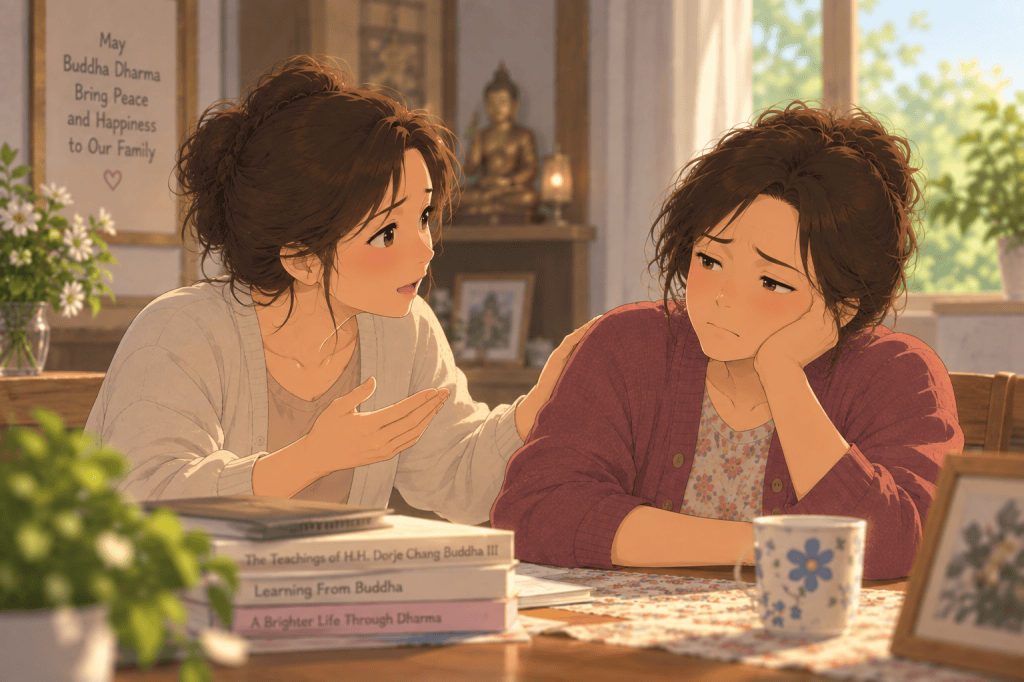
Having personally experienced the benefits of learning Buddhism and cultivating myself, I tried to persuade my mother not to dwell on the things that troubled her. I explained to her that these circumstances were the result of causes, conditions, and karmic forces planted in the past. But she did not agree with what I told her.

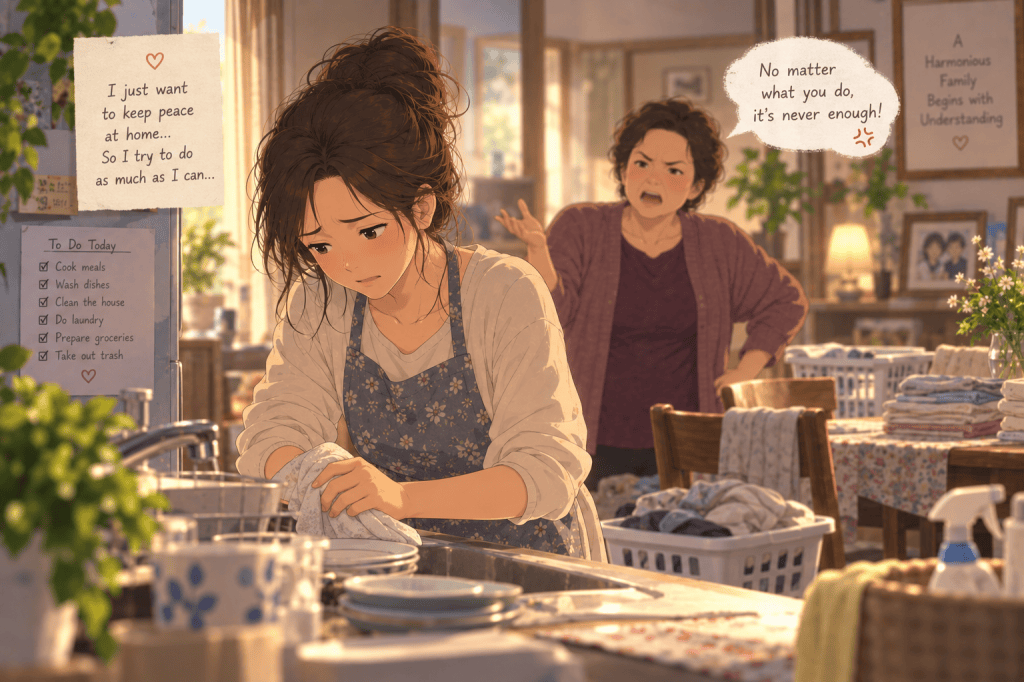
To avoid upsetting my mother, I tried to take care of nearly all the household chores myself so that she would have to do as little as possible for my single-parent household. Yet strangely, the more responsibilities I took upon myself, the more upset she seemed to become. No matter what I did, I could not seem to make her happy.

Back then, I lived very cautiously around her, afraid that something I said or did might cause her to become upset and silently resentful. I also tried communicating with her, but she would often remain silent and keep everything bottled up inside.

Through respectfully studying Expounding the Absolute Truth Through the Heart Sutra, I brought forth right mindfulness and finally came to understand how I should correctly practice the Four Immeasurables of loving-kindness, compassion, empathetic joy, and equanimity. I first needed to begin with equanimity and selfless giving—to be willing to devote my time to considering the needs of my family. Caring for them was not merely about making sure they had enough food, warm clothing, and money to spend. I also needed to learn to recognize and understand the suffering within their hearts.

I began to sincerely spend time with my mother, and gradually I discovered that the ice within her heart was beginning to melt. Instead of telling her, “Don’t be angry anymore” or “Don’t hold on to resentment,” I began placing the responsibility upon myself: I needed to understand the pain within my mother’s heart, listen to what her heart was trying to tell me, help heal her emotional wounds, and help her establish right understanding and right views.

When my mother complained, I became willing to set aside my time and sit quietly beside her, listening attentively. I no longer used the principle of “cause and effect” to argue with her until she had nothing left to say.

When she felt physically tired, I would take the time to massage the acupressure points on her feet and ask her whether the pressure was too light or too strong. When she felt bored, I would willingly spend time with her and chat about everyday family matters instead of lecturing her about principles and doctrines.

The more I tried to understand the pain in my mother’s heart, the more she began saying things like, “Don’t waste your time on me. I don’t need you to keep me company. Go take care of the children. Once you’ve taken care of everything for them, go do whatever you need to do.”

What surprised and delighted me even more was that my mother eventually began reminding me herself, “It’s almost time for your Buddhist group study. Don’t forget to join the meeting. I’ll help you look after the children.”

I had finally gained my mother’s support. And it happened simply because I had learned to recognize the pain within her heart and was willing to devote my time to sincerely being there for her.

This is exactly what the H.H. Dorje Chang Buddha III teaches in the Dharma discourses: we must put our cultivation into actual practice and cultivate ourselves with respect to the three karmas of body, speech, and mind. We must be sincere in our words and actions and in the way we interact with and treat others. Only by putting genuine effort into our conduct in everyday life can we truly touch the hearts of others.

Contributed by: Ji Cheng / Kui Xing

Link: https://myhappylifestyle.net/2026/09/06/dorjechangbuddhaiii-when-i-came-to-understand-the-pain-deep-within-my-mothers-heart/

Caring for Animals Starts with Me

Caring for Animals Starts with Me

Small animals are among the most vulnerable living beings around us. They need our care and protection, and every life deserves to be respected. So, what can we do to better care for and protect animals?

1. Do Not Abuse Animals

Animal abuse is unethical. It not only causes physical harm and suffering to animals but can also negatively affect our own hearts and minds. We should respect all life, treat animals with kindness, and never abuse or harm them.

2. Protect the Environment

The natural environment is the home on which animals depend for survival. We should each do our part to protect the environment, reduce pollution, and provide animals with a safe and healthy habitat.

For example, we can reduce our use of plastic bags, disposable tableware, and other single-use products, while choosing more environmentally friendly ways to travel whenever possible.

3. Care About Animal Welfare

Animal welfare refers to the basic well-being that animals should enjoy in their lives. We should pay attention to their living conditions, respect their natural habits and behaviors, and refrain from arbitrarily hunting, capturing, or trading wild animals. We should also avoid unnecessary interference that may cause animals harm or distress.

4. Adopt Instead of Buying

When considering bringing a pet into our lives, we should consider adoption from a reputable animal shelter or rescue organization and give special care to animals that are sick, vulnerable, or have suffered abuse.

We should also support the rescue and adoption of stray and homeless animals, giving them the opportunity to find a safe, loving, and warm home.

Link: https://myhappylifestyle.net/2026/09/05/caring-for-animals-starts-with-me/

Video Link: https://www.youtube.com/shorts/BV1Jx0gOgNM

#CareForAnimals #AnimalsLovers #CompassionForAnimals #AnimalsProtection

Who Is His Holiness Dorje Chang Buddha III?

Who Is His Holiness Dorje Chang Buddha III?

Five Key Points about the Buddhist Spiritual Leader

Buddhism is among the largest religions in this world. The original founder of Buddhism and the religion’s highest spiritual leader in the universe is Dorje Chang Buddha. He is worshiped by all major sects and schools of Buddhism as the earliest primordial Buddha.

Buddhists belong to a religious belief that understands the universe’s nature of no-birth and no-annihilation and human beings’ original nature of true such-ness are one and the same. They believe in the cycle of transmigration driven by the law of cause and effect. They believe that after one’s biological death, the spirit or soul will incarnate and be reborn into a new being. In the case of the primordial Buddha, He has now incarnated to this world for the third time as His Holiness Dorje Chang Buddha III. The highest spiritual leader in Buddhism alive today currently lives in the United States of America.

His Holiness Dorje Chang Buddha III is not one who seeks publicity. Even when awarded the Presidential Gold Award, the Dr. Martin Luther King Legacy Award for International Service and Leadership, and many other prestigious prizes, He did not attend the award ceremonies to receive the prizes in person. He is well known for loving-kindness and compassion, and has made a vow of only helping others and never accepting any offerings from anyone.

However, His accomplishments and accolades are widely-reported. The following are five of the most interesting things that you may not have known about His Holiness the Buddha:

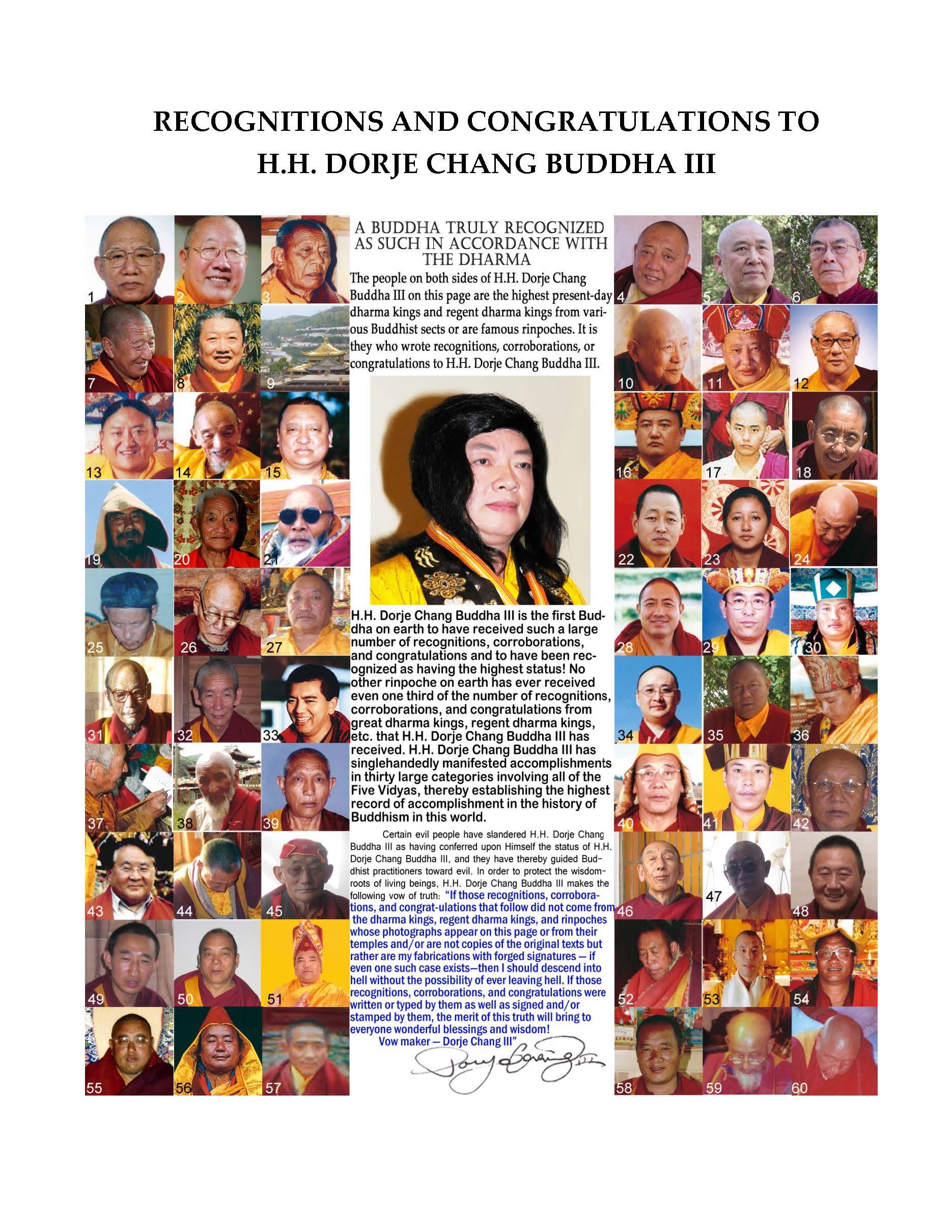
Recognitions & Congratulations to H.H. Dorje Chang Buddha III

International Buddhism Sangha Association

1. Buddhism classifies all material and spiritual matters and knowledge in the universe into five aspects. Complete mastery of these five aspects is called having realized the Five Vidyas (vidya is a Sanskrit word meaning brightness). Buddhas and Bodhisattvas must possess the Five Vidyas. The Five Vidyas include: the Vidya of Causality, the Vidya of Healing, the Vidya of Sound, the Vidya of Craftsmanship, and the Vidya of Inner Realization. Looking through the entire history of Buddhism, His Holiness Dorje Chang Buddha III is the first holy one to perfectly manifest real accomplishments in the Five Vidyas, meeting the highest standard of Buddhism. For this reason and more, His Holiness Dorje Chang Buddha III is the one and only individual in history to receive recognitions and corroborating recognitions from over 60 of the highest present-day dharma kings and regent dharma kings from various Buddhist sects.


2. His Holiness Dorje Chang Buddha III was awarded the Top Honor Prize during the World Peace Prize Ceremony at the U.S. Capitol on June 14, 2011. The World Peace Prize is an initiative to promote world peace and understanding between different nations, ethnicities, cultures and religions. His Holiness Dorje Chang Buddha III was recognized for receiving this Top Honor Prize by the 112th Congress in U.S. Senate Res. 614, commending His Holiness the Buddha for his role in advancing peace, justice and inter-religious collaboration.

3. His Holiness Dorje Chang Buddha III has long been an internationally renowned artist. His paintings are not limited by subject or themes and are of many types, from water-ink paintings to oil paintings. Specifically, the subject matters include human figures, animals, flowers and birds, mountain and water scenes, fish, insects, and so on. Within the wide range of styles, there is fine brushwork, drawing with lines and strings, splash-ink, bold freehand brushwork, small freehand brushwork, and others. Altogether, He created 16 unique painting styles or schools, representing an unprecedented pioneering achievement in the history of art. His paintings are on permanent exhibition at the International Art Museum of America in San Francisco, the H.H. Dorje Chang Buddha III Cultural and Art Museum in Los Angeles County, and other art museums. His Holiness Dorje Chang Buddha III’s paintings are extremely valuable and rare. As early as in 2000, His artworks were sold for more than two million U.S. dollars each. He became the artist whose paintings commanded the highest prices compared to the prices for paintings created by all ancient and modern Chinese artists. Last March, an ink painting of His was sold at the New York Spring Auction for $16.5 million, which was the highest price realized at the 2015 Spring Auction of all artworks by ancient and modern artists worldwide. He is the world’s first inventor to create a class of artworks that cannot be duplicated by anyone or with any method — Yun Sculpture. Only after that, the world now has un-duplicable artworks. Experts predict that His paintings will become increasingly valuable as His Holiness plans to focus solely on Buddhist activities.

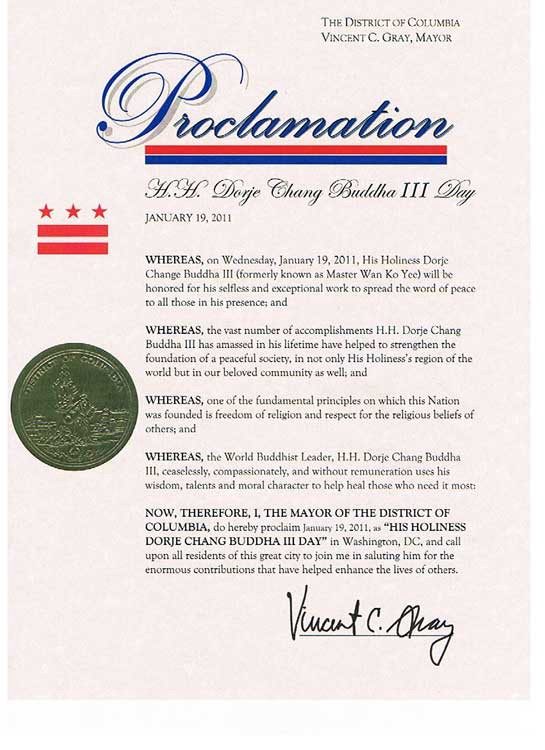
Proclamation of H.H. Dorje Chang Buddha III Day

4. In 2011, the then Mayor of Washington, D.C., Vincent Gray, proclaimed January 19th as “H.H. Dorje Chang Buddha III Day.” The mayor called on D.C. residents to join him in saluting “His selfless and exceptional work to spread the word of peace to all those in His presence.” The Unites States Postal Service also issued a commemorative cover in celebration of “His Holiness Dorje Chang Buddha III Day.”

5. His Holiness Dorje Chang Buddha is a Fellow of Britain’s Royal Academy of Arts, making Him the first internationally distinguished artist appointed to a Fellowship in the Academy’s history of more than 200 years. The title of Fellow was awarded by the Academy’s President, Phillip King, at a ceremony in the British Embassy in Washington.

Unless you are an astute follower of Buddhism, you may not have known that His Holiness Dorje Chang Buddha III has been recognized as the third incarnation of the original Buddha. His accomplishments clearly transcend religion, healing, art, philosophy, and literature. He continues to devote His time to a wide scope of cultural, religious, and various other domains directed at helping people in communities across the globe. His Holiness Dorje Chang Buddha III has made the following vow: “I will bear all of the karmic offenses committed by living beings, and I will give everyone all of the good karma and merit that I plant.” His Holiness the Buddha has been executing it exactly as is.

Steven Meyers received his bachelor’s degree in Chinese language from Brown University, where he graduated magna cum laude. After graduating, Mr. Meyers spent a year at the Stanford Center in Taiwan furthering his study of the Chinese language. Later, he received a Juris Doctor degree from the University of Michigan and is now an attorney licensed to practice law in the state of California. He has been providing legal advice to California non-profit corporations since 1996. His current focus is translating Buddhist material from Chinese into English.


Who Is His Holiness Dorje Chang Buddha III?


Source: https://dharma-hhdorjechangbuddhaiii.org/who-is-his-holiness-dorje-chang-buddha-iii/

Link: https://myhappylifestyle.net/2026/09/04/who-is-his-holiness-dorje-chang-buddha-iii/
 

#DorjeChangBuddhaIII #Buddha # Buddhism

How I Improved My Relationship with My Sister-in-Law

How I Improved My Relationship with My Sister-in-Law

I used to envy families in which a sister-in-law was filial toward her parents-in-law and the sisters-in-law got along so harmoniously. Yet, although I was a Buddhist practitioner, my relationship with my younger brother’s wife was so distant that we were practically strangers.

Whenever our family gathered, I would unconsciously take on the role of a “judge.” This was especially true when it came to my sister-in-law. I could always find something she had failed to do thoughtfully enough for her mother-in-law—my mother. In my view, being filial meant that the younger generation should unconditionally respect, obey, and care for their elders. Somehow, I always felt that my sister-in-law fell a little short. She would also argue with my mother over trivial matters, and all of this became evidence, in my eyes, for judging her.

I would often reveal my dissatisfaction with her in front of other family members without even realizing it. My words carried a tone of reproach, and sometimes I even relied on my position as her husband’s elder sister to criticize her. Whenever my mother complained to me about her daughter-in-law, I would immediately take my mother’s side without considering the situation carefully and would find fault with my sister-in-law. As a result, I only intensified the conflict between them.

One day, I once again respectfully studied the Treasury book Learning From Buddha, in which the H.H. Dorje Chang Buddha III expounded the Dharma. When I came to the specific teachings on “examining oneself three times a day,” I began to reflect upon and examine myself.

Suddenly, I realized: Wasn’t everything I had been doing at home precisely an example of becoming entangled in the rights and wrongs of worldly affairs?

I was constantly noticing other people’s faults and criticizing them, openly or indirectly, while completely forgetting to examine myself.

H.H. Dorje Chang Buddha III teaches us not to focus on the faults of others. We should regard another person’s faults as our own. When we see shortcomings in others, we should regard them as a diminishment of ourselves; when we see goodness in others, we should regard it as our own good fortune.

Looking back at myself, I realized how often I had focused on other people’s faults. Whenever I complained about and criticized my sister-in-law in front of our family, saying that this or that about her was wrong, I had already become entangled in right and wrong, trapped in attachment to self, and caught up in thoughts such as, “You are wrong,” “What you are doing is not right,” and “I don’t like the way you do things.”

I was truly full of bad habits, a person deeply burdened by attachment to self. I had forgotten the H.H. Dorje Chang Buddha III’s teachings. I had forgotten that with each passing day, there is one less day left in my life and that every day brings me closer to the crematorium. Every day, dark karma was accumulating upon me. How could I possibly attain accomplishment this way? And how could I guide others to learn Buddhism?

After recognizing the errors in my behavior, I immediately changed the way I treated my sister-in-law.

I began taking the initiative to help drive her children to and from school. I helped her with farm work. When she came home late from work, I would prepare meals and invite her and my mother to eat together. To help ease the tension between my mother and sister-in-law, I also began praising my sister-in-law during holiday family gatherings, telling everyone how hardworking and capable she was.

Just as a gentle rain quietly nourishes the earth, changes gradually began to take place. A smile slowly returned to my sister-in-law’s face, and our relationship became increasingly harmonious. Sometimes, she would even initiate conversations with me and talk about stories concerning cause and effect.

Her attitude toward my mother also underwent a remarkable transformation.

On one occasion, my mother was hospitalized and needed someone to care for her. At this critical time, my sister-in-law not only voluntarily took on the responsibility of caring for her mother-in-law, but also looked after her with great thoughtfulness. From preparing her meals and attending to her daily needs to comforting her emotionally, everything she did reflected patience and loving care.

Every day, she prepared nutritious meals for my mother and patiently kept her company, chatting with her to relieve her boredom. Even late at night, when everything was quiet, I would see her gently pulling the blanket over my mother.

Seeing all of this filled my heart with warmth. Her care touched every one of us.

When I think back, I realize that I had always viewed my sister-in-law through a prejudiced lens. I failed to understand that everyone expresses their feelings and care differently. Instead, I relied on my own subjective judgments and readily drew conclusions about her. Even worse, I had forgotten the Buddha’s teachings. Thinking about this fills me with shame.

My sister-in-law’s transformation not only improved our relationship but also brought about a profound cleansing of my own heart and allowed me to see myself more clearly. This experience reminds me to constantly examine myself, always keep the H.H. Dorje Chang Buddha III’s teachings in mind, and put cultivation into practice in every aspect of daily life.

Today, I have learned to view each member of my family with a calmer and more peaceful mind. Instead of looking at other people’s faults through a magnifying glass, I have learned to be more tolerant and grateful.

As a result, life has become much more beautiful.

Written by: Mo Wu
Edited by: Qu Yi Chen

Link: https://myhappylifestyle.net/2026/09/04/dorjechangbuddhaiii-how-i-improved-my-relationship-with-my-sister-in-law/

#DorjeChangBuddhaIII #Spirituality #Buddha #Buddhism