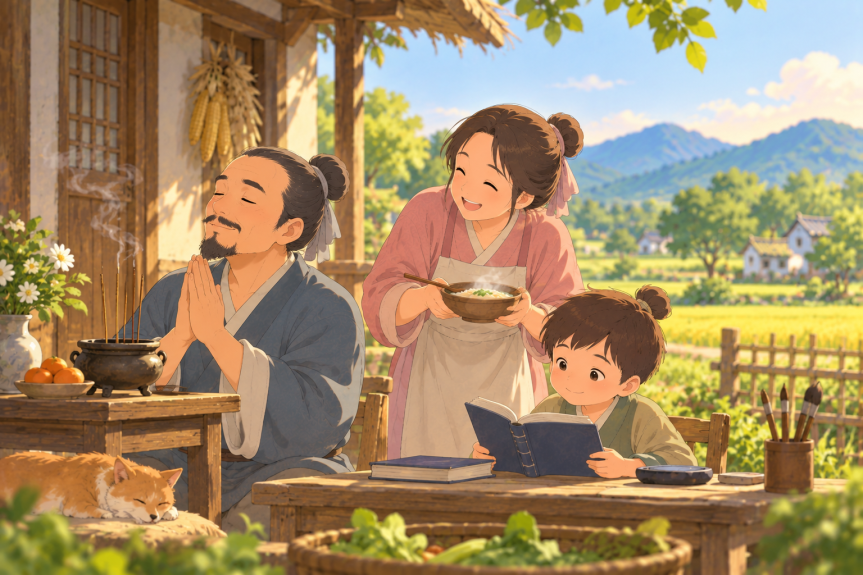
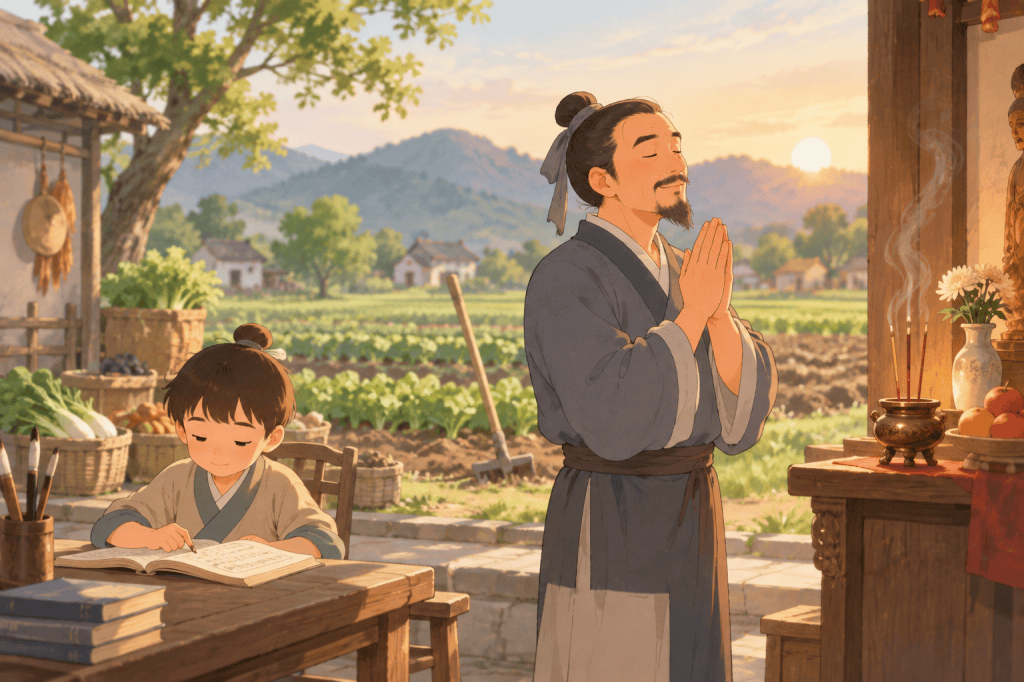
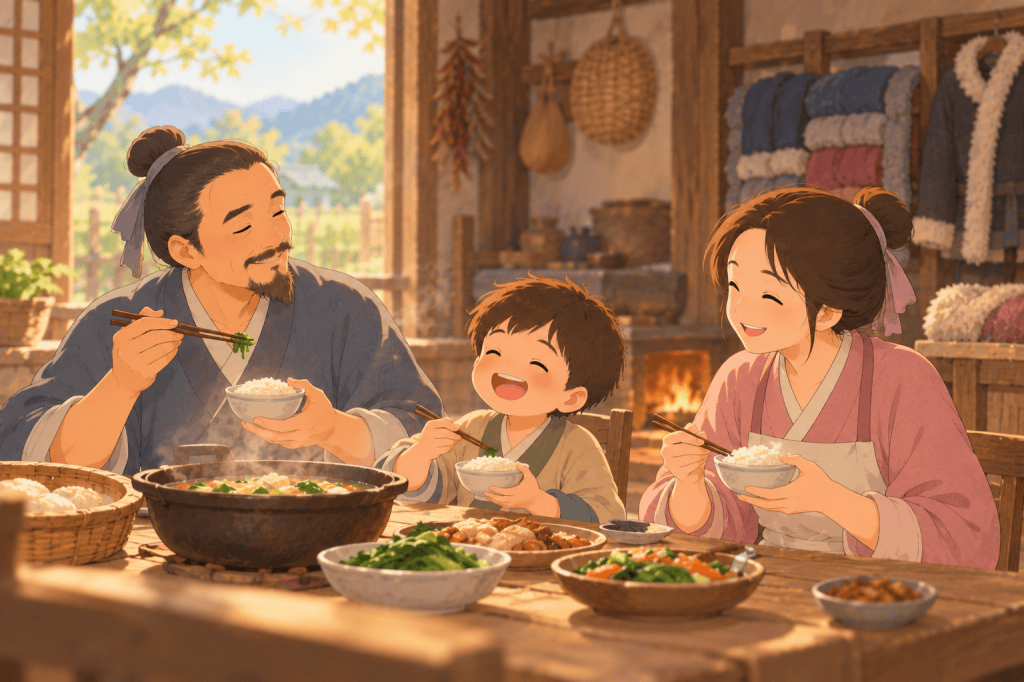
During the Ming Dynasty, there was a man named Hu Jiushao. He farmed while teaching his son to read and study, and the family had enough to meet their basic needs. Yet every day, he would burn incense and offer prayers, thanking Heaven for blessing him with another day of peace and contentment.
His wife laughed at him and said, “We eat vegetable porridge for all three meals. How can you call this a blessed life?”
He replied:
“First, we live in a time of peace and do not have to endure the suffering of war.
Second, our family has food to eat and clothes to wear, so we neither go hungry nor suffer from the cold.
Third, everyone in our family is healthy, and none of us has suffered the misfortune of imprisonment. Aren’t these blessings?”
In fact, people often fail to experience a sense of happiness because they have too many desires and do not know how to be content. As Namo H.H. Dorje Chang Buddha III taught: “A person not appreciative of the good life he is living is one who has forgotten his past miseries. A person in good health is not aware of its blessings until he loses it.”
This means that some people are blessed without realizing how fortunate they are. Even though things are going well for them in many respects, they still feel that this is unsatisfactory and that is not as they wish. They are full of complaints and feel unhappy with their circumstances. This is mainly because, while living in happiness, they have forgotten the hardships of adversity.
When enjoying happiness, they forget the difficulties they once experienced. It is just like people who are strong and healthy often failing to appreciate how painful it is to become ill. They may neglect their health and fail to cherish their strong and healthy bodies. Once they fall ill, however, they may find themselves confined to bed, unable to move about and without even the desire to eat. Only then do they realize the joy and blessing of good health.
The story above reminds us that many of life’s blessings can be found in the ordinary things we have grown accustomed to. Peace, having enough food and clothing, and good health may seem ordinary, but once they are lost, we come to realize just how precious they truly are. Therefore, we should learn to be content, cherish our blessings, and appreciate everything we have in the present.
Only by being content and knowing how to cherish what we have can we experience an enduring sense of happiness and joy.
Program Broadcast on the China International Education TV– Probe the Fundamental Origin of Propagating True Buddha Dharma
Focus on Pioneers
Cherishing a compassionate mind, bringing peace and harmony to living beings, being ardently respected by humans and heavenly beings alike, and engaging in the undertaking of broadly saving living beings, He is the genuine incarnation of primordial Sambhogakaya Buddha, Dorje Chang Buddha.
He is the first Buddha in the history of Buddhism of several thousand years who does not accept offerings. He imparts the Dharma in common and easy-to-understand language, enabling listeners to achieve awakening of different depths depending on their own background and ability. His accomplishments in the Five Vidyas are the best in the history of Buddhism.
In this session of our program, we will together step onto the journey of discovery to reach the fundamental root of Buddhism, from which true Buddha Dharma is propagated.
Buddhism and Its Role in Human Civilization
Through the ever-flowing long river of human history, what can last long is culture. Within the domain of culture, religious aspiration has the longest, widest, and deepest influence.
Looking through the history of the world since ancient time, you will discover that Buddhism, as a world-wide religion, has not only been an important force for the stability and development of society, but more importantly, also played a pioneering role in cultural development and advancement of civilization.
Xiong Wenli (Professor of Buddhist study, Hua Zang Buddhist Institute):
There are very many philosophical schools and sects in the world, but these philosophical schools and sects basically all start from the individuals’ subjective opinion. That is why, among so many philosophical schools and sects currently in society, there exist very many debates and controversies. This is the reason for such a situation.
However, the world view and methodology of Buddhism are different. They do not start from subjectivity and instead are established on the foundation of reality and the absolute truth of the universe. Therefore, that constitutes the type of the most scientific, the most objective, the most perfect, and the best world view and methodology.
Among the world’s multi-aspect cultural entities, Buddhism, by its unique duality of aspiration of transcending the world and feeling of concern about the world, has been evolving more and more into a spirit of humanity to guide and lead the world’s cultural development and to save the fate of mankind.
Exactly because of this, Buddha Dharma for attaining supreme, equal-minded, and perfect enlightenment is utmost important. Then, the ability to propagate the true Dharma of the Tathagatas is even more so a kind of greatly good karmic condition, a kind of great virtue.
The Dharma Teachings of H.H. Dorje Chang Buddha III
Dharma Master Shi Ruohui (Abbess of Hua Zang Si):
The coming of H.H. Dorje Chang Buddha III to this world brings the perfect and complete true Dharma of the Tathagatas. The goal is to help living beings cultivate themselves through learning from Buddha, in order to attain accomplishment and liberation.
For several decades, His Holiness the Buddha worked tirelessly day and night to compassionately edify living beings.
Since His Holiness the Buddha sees the fundamental nature of living beings thoroughly, He uses simple and explicit language to explain loft and profound Buddhist principles clearly in the process of teaching. Therefore, those who listen to the Dharma can understand at different depths based on their current background and enter deeper step by step. Eventually, they will be able to comprehend, realize, and awaken to the precious essence of the Tripitaka.
In addition to expounding the supreme absolute truth of the universe and human life, many teachings of His Holiness the Buddha also apply expedient means, provide guidance to cultivation, emphasize the importance of cultivation as well as its relationship with practicing the Dharma, and give many examples about the truth that the law of cause and effect never errs or ceases.
Whether the listeners are sect leaders, great holy virtuous persons, and great Dharma masters within the Buddhist world or even people of all walks in society, all have received innumerably many benefits after listening to the Dharma. Moreover, they are full of admirations to His Holiness the Buddha.
H.H. Dorje Chang Buddha III is the genuine incarnation in this world of the primordial Sambhogakaya Buddha, Dorje Chang Buddha.
Within the universe, all Buddhas and Bodhisattvas become Buddhas and Bodhisattvas by learning the Buddha Dharma of Dorje Chang Buddha.
For the first time in the history of Buddhism, H.H. Dorje Chang Buddha III publicized those erroneous views and evil views, totaling 128. The purpose is to restore the intrinsic essence of Buddha Dharma by emphasizing cultivation as the foundation of attaining accomplishment.
As of now, numerous disciples of H.H. Dorje Chang Buddha III have attained accomplishment. Moreover, the status of H.H. Dorje Chang Buddha III as a Buddha was universally recognized and corroborated by leaders of major sects of Buddhism.
Understanding the Concept of a Buddha
Dharma Master Shi Zhengda (Chief Teacher for Correctly Listening to Dharma Discourses, the World Buddhism Association Headquarters):
What is the concept of Buddha?
That is simply the supreme, equal-minded, and perfect enlightenment, or Anuttara-samyak-sambodhi. That is, Buddha has completely and thoroughly realized the absolute truth of human life and the universe.
The concept is that Buddha has the same lifespan as the heaven and is united as one entity with the universe. Therefore, I will not be able to describe it completely even if I speak for several days or several years.
To completely, truly, and thoroughly understand the absolute truth of Buddha Dharma, what must we read?
That will be the Buddhist books of H.H. Dorje Chang Buddha III, such as Imparting the Absolute Truth through the Heart Sutra, the Supreme and Unsurpassable Mahamudra of Liberation, the Sutra on Understanding the Definitive Truth, Dharma of Cultivation, Precious Essence of Buddha Dharma and others.
There are also recorded audio Dharma discourses expounded by the Buddha Master that are recorded on several thousand audio CDs. These Dharma discourses on several thousand audio CDs are in fact several thousand sutras since they have come to the world with His Holiness the Buddha.
As we can see in today’s world, chaotic situations are rising abundantly within Buddhism. Correct Buddha Dharma and holy virtuous Buddhists are very rare within the Buddhist world.
In order to liberate living beings and correctly restore Buddha Dharma, the beginning-less primordial H.H. Dorje Chang Buddha III has come to our saha world, bringing pure and complete Buddha Dharma to living beings.
The teachings of the world-honored Shakyamuni, the supreme leader of Buddhism in the saha world, have now been restored.
The Study of Buddhism and Buddha Dharma
Dharma Master Shi Xiangkuizhi (Head, Pagoda Temple, Los Angeles, USA):
I came from Taiwan. While in Taiwan, I founded a Buddhist academy. I also taught in the Buddhist academy, but what I taught was essentially the study of Buddhism.
Only when I entered deeper, did I know that the study of Buddhism was a totally different domain from Buddha Dharma.
That was why as I was teaching at the Buddhist academy, when real issues arose, I did not have any way to deal with them. This was because of the lack of Buddha Dharma.
Therefore, once I learned that a true Buddha is residing in our world, I made a vow. Whatever it may take, I must become the Buddha’s disciple to learn true Buddha Dharma.
Otherwise, how could I help living beings and benefit living beings as a Buddhist monastic? Without Buddha Dharma, one can only have hollow theories.
I have been close to the Buddha Master for nearly 20 years. What I saw and heard while being near the Buddha Master are exactly the states of realization and true Buddha Dharma that I read from the Tripitaka in the past.
Therefore, H.H. Dorje Chang Buddha III’s coming to our saha world is for correcting the Dharma.
The Five Vidyas
According to Buddhism, all kinds of knowledge within the universe are categorically summarized into five types. A complete mastery of achieving the highest level of a field is called a vidya, or brightness. That is how the Five Vidyas are defined in Buddhism.
Shakyamuni Buddha stipulated that all Bodhisattvas must possess the Five Vidyas. Furthermore, A Buddha is the king of the Five Vidyas.
When you walk into H.H. Dorje Chang Buddha III Cultural and Art Museum, you will find all the answers from the environment you are personally experiencing.
Dharma Master Shi Zhizhuang:
Throughout the history of Buddhism of several thousand years, the accomplishments of H.H. Dorje Chang Buddha III, who is familiar to and respected by us, in the Five Vidyas are the best and highest.
Then, what is implied in this status of being the best and highest?
It shows that Buddha knows about and have the ability to do all things in the universe and also introduces and transmits such knowledge and morality to Buddhist disciples, to guide and lead them to get onto the path of acquiring morality, education, and knowledge and thereby advance the development of civilization and progress through time in the entire world.
H.H. Dorje Chang Buddha III once openly told people that, during a period of five years, H.H. Dorje Chang Buddha III would answer any and all questions raised by any people and there would be no question that He could not answer.
You can all think, what concept is this?
If not having the ability to include the universe like a small object and hold Mt. Sumeru in a palm, would He be able to say such words?
More importantly, H.H. Dorje Chang Buddha III brought the complete Buddha Dharma, Buddhist teaching, and the study of Buddhism that are pure, correct, and impartial and corrected the Buddhism that had been mispresented by patriarchs and tainted by heretic practitioners.
Training Buddhists to Propagate the Dharma
However, currently, many Buddhist sites propagating true Buddha Dharma are faced with the reality of lacking qualified Buddhists for propagating the Dharma and having different qualities among Buddhists.
For that, quite a few Buddhist institutes have been established in Los Angeles and San Francisco in the state of California of the United States, to develop and train Buddhist with excellent qualities, to ensure that the perfect and complete Buddhist teachings and Buddha Dharma of H.H. Dorje Chang Buddha III can be correctly transmitted to the public without deviation.
Dharma Master Shi Longhui (Chairperson, the International Buddhism Sangha Association):
Many people from various places or overseas come to our Buddhist institute to study, learning from the Dharma expounded by His Holiness the Buddha. They all feel that they have received very great benefits. That is why they traveled thousands of miles to come and study.
Since the Supreme and Unsurpassable Mahamudra of Liberation is the biggest and greatest Dharma that Buddha Master brought to our saha world in this lifetime, everyone has attained one’s own benefits after learning.
I hope that we can all serve the society in good ways and become kind citizens.
His Holiness the Buddha taught us that Buddhist disciples must carefully consider and care about living beings’ interests.
Masters of Dharma-listening sessions take an examination and will then, at where they are, lead those who wish to respectfully listen to the recorded audio Dharma discourses expounded by His Holiness the Buddha, to learn how to become a true Buddhist and how to become a best cultivator.
The Buddhist institutes are international organizations for training and developing people with talent in Buddhism. The goal is to educate those who truly want to learn from Buddha into excellent Buddhist scholars with correct understanding and views and possessing truly cultivated realization.
They will clearly believe in the law of cause and effect, being free of hollow and baseless dogmas and feudal superstition and belief in strange and paranormal phenomena.
Teachings for the Modern World
Ven. Mozhi (Gold Button Grade II Holy Virtuous One):
Not only are the teachings of His Holiness Dorje Chang Buddha III in complete accordance with Shakyamuni Buddha, but they are even more incisive.
Not only are the teachings the same as Shakyamuni Buddha, but they are also more succinct, understandable, and direct.
His Holiness the Buddha demonstrated the irreplaceable positive role played by Buddhist culture in this new era of perfectly harmonizing the splendid assembly of world culture.
His Holiness the Buddha wholeheartedly focuses on giving and never accepts any offering, providing a propelling force for elevating morality, progress of civilization, and cultural development of whole society.
Henghsing Gyatso Rinpoche:
H.H. Dorje Chang Buddha III came to the world with the supreme Buddha Dharma, the Supreme and Unsurpassable Mahamudra of Liberation.
This is the gospel of good fortune for the entirety of humanity. This is because, if each of us, whether you are a Buddhist or not, whether you have a religious belief or not, can earnestly learn from the Supreme and Unsurpassable Mahamudra of Liberation, then we will all become the best people of kindness.
Then, as we live in this world, it will be an auspicious, harmonic, thriving, prosperous, stable, and peaceful world.
Buddhism, Inclusiveness, and Harmony
The world’s economic and cultural mode has already entered a modern and international era.
To adapt to the internationalized setting, H.H. Dorje Chang Buddha III enriched the inner connotation of Buddhist culture, to let it play an important role in reconciling various thoughts, breaking all kinds of closed ideologies, and promoting the development of civilization and advancement of the current era.
His Holiness Dorje Chang Buddha III has told us we must work to uphold the laws and aspirations of our nations and live together in harmony with others.
I think the other unique and powerful influence of Buddhism is that it is inclusive. It is inclusive of all.
And, that way, we can have influence over other religions and belief systems. But since it doesn’t promote dogma or teach that other belief systems are intrinsically evil, we can live in harmony with many different groups.
Benefiting Living Beings
Through the many years, H.H. Dorje Chang Buddha III taught and transmitted sacred Buddha Dharma to disciples in person.
By practicing in accordance with the Dharma, not only can the disciples receive perfect benefits and happiness in real life, but many of them were able to attain rebirth in Buddha-land, freedom from birth and death, and even higher states of realization.
H.H. Dorje Chang Buddha III wholeheartedly cares about living beings, teaches them by words and deeds, and is always on the path of benefiting living beings.
When We Put “Me” at the Center, We Inevitably Find Things Hard to Accept, Hard to Hear, and Hard to Understand
A close friend once complained to me about her child.
“My child is driving me crazy! He’s only four or five years old, yet he can already turn the whole household upside down!”
I asked, “What happened?”
She said, “He refuses to eat properly. After mealtime is over, he goes looking for cold leftovers. He wants to play until midnight, and if we refuse to play with him, he hits us—and he hits hard. Lately, he has been coughing constantly and has eczema all over his body. He has practically become a regular at the hospital…”
His eating habits were irregular, his sleep schedule was irregular, and he loved eating cold foods. With habits like these affecting his digestive health, how could he not get sick?
I then asked, “Do you often hit him? Is that why he has learned to hit others?”
“Ah,” she sighed. “My father believes in strict discipline and corporal punishment. Whenever the child misbehaves, Grandpa gives him a good spanking. I’ve tried talking to my father and asking him not to hit the child so much, but he won’t listen. As a result, the more the child is hit, the more unruly he becomes, and the more unruly he becomes, the more he gets hit. By the time I come home from work, I’m completely exhausted by all of this. Now even my father and I get upset with each other over the smallest things. We find each other’s behavior hard to accept, each other’s words hard to hear, and each other’s thinking impossible to understand…”
I couldn’t help but sympathize with my friend. Her child had not even reached the stage when she would have to help him with schoolwork, yet the household was already in complete chaos.
As the saying goes, “It takes ten years to grow a tree, but a hundred years to nurture a person.” Raising and educating a child is truly no easy task. When family members disagree about how a child should be raised, conflict is almost inevitable.
For many years, educators have advocated encouragement and positive reinforcement rather than corporal punishment. We cannot truly win people over through force; we need to reason with them and reach them through understanding and compassion. Two generations have different life experiences, levels of education, personalities, and understandings of life. Naturally, their approaches to raising a child can be very different. One wants strict and forceful discipline, while the other favors a gentle and patient approach. In the end, neither approach is carried out effectively, and the two sides only grow increasingly frustrated with each other.
But do situations in which people find one another “hard to accept, hard to listen to, and hard to understand” exist only between fathers and daughters? Of course not. Conflicts arise between husbands and wives, relatives and friends, coworkers, classmates, people from the same hometown, and even complete strangers.
Two of my coworkers once had a disagreement over a work assignment.
Coworkers A and B were responsible for producing the company magazine. A handled planning, editing, proofreading, and communication with the printing company, while B was responsible only for layout and typesetting. Because they were rushing to meet the deadline, A reviewed three rounds of proofs, checked the sample copy, and then authorized printing.
The following day, A looked through the sample again and discovered that the month printed on the cover was incorrect. During proofreading, A had already asked B to correct it. However, B had carelessly failed to properly save the final revised file, so the error remained. At the same time, A had also failed to notice the mistake when reviewing the sample copy.
When they contacted the printing company again, they learned that the company magazine was already being printed. Reprinting the cover would require additional expense. And so, a loss that should never have occurred was incurred.
A blamed B: “Why didn’t you properly save the file after making the correction? Why didn’t you take responsibility for your work?”
B, in turn, blamed A: “Why didn’t you carefully check the sample?”
Each found fault with the other. Neither wanted to hear what the other had to say, and neither could understand how the other could have been so careless.
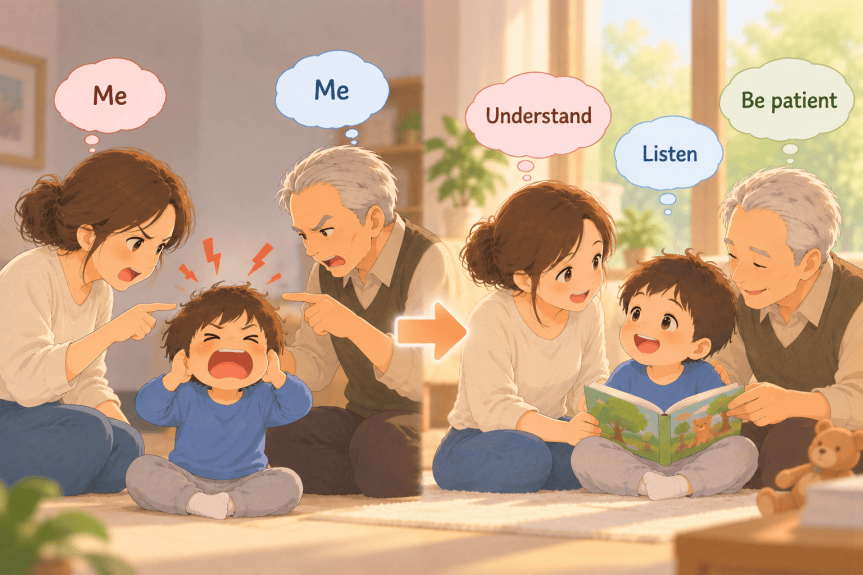
In fact, both of these real-life situations—the disagreement between father and daughter over how to raise the child and the conflict between coworkers caused by a lack of carefulness—stemmed from putting “me” at the center.
The grandfather thought, “If my grandson doesn’t behave, he needs to be disciplined physically. After all, this is how I raised several children.”
The mother thought, “When my son misbehaves, adults should reason with him. We shouldn’t substitute punishment for proper guidance. We should teach him gently and patiently.”
And what about the two coworkers?
One thought, “I already checked everything thoroughly.”
The other thought, “You were the one who failed to check carefully.”
Because they failed to cooperate effectively, mistakes naturally occurred.
Yet the father and daughter actually shared the same goal: to raise the child well.
And the two coworkers also shared the same goal: to produce the magazine well.
The attitude of “I don’t care what you think; what matters is what I think” places the self above everything else.
If people want to live together harmoniously, they need to learn to put themselves in one another’s shoes. If the grandfather listened to his daughter’s suggestion to use gentleness rather than force, and if the daughter communicated more patiently with her elderly father about ways of educating the child, wouldn’t their relationship become more harmonious?
Likewise, if the two coworkers showed greater understanding toward each other’s responsibilities, reminded one another when necessary, and complemented each other’s work, wouldn’t they be able to accomplish the task successfully? What would there be to argue about?
“A protracted dispute is wrong on both sides. Why? Entangled in such a dispute, both sides see only the faults of the opposing party and the merits of his own. Continuing dispute will but increase the wrongdoing. When one realizes that the other party is as annoyed as he is, one is apt to withdraw from the dispute.”
By letting go of attachment to the self and our own views, and by learning to be tolerant and understanding of one another, we become able to listen to other people’s opinions and recognize their strengths. In this way, we can gradually move from stubbornly clinging to our own views toward accepting and appreciating others.
Always remember: “I” am not the measure of the world.
If we always put “me” first in everything, we are simply creating trouble for ourselves. Instead, we should think: I am a Buddhist practitioner who still has much to be ashamed of. I still have many shortcomings and faults. I should learn more from the strengths of others and spend less time looking for their faults.
As the saying goes:
“The sea is vast because it embraces hundreds of rivers; a person is great because of the capacity to be tolerant.”
When we broaden our hearts and minds, expand our perspective, and elevate our moral character, our work and our lives can proceed more smoothly. We can gradually move away from selfish attachment to the self and toward benefiting both ourselves and others.
Isn’t letting go of the constant focus on “me” itself part of cultivation?
In Buddhist Cultivation, Never Overlook the “Drizzle” and the Butterfly Effect
(1) A Drizzle Can Soak You Before You Realize It
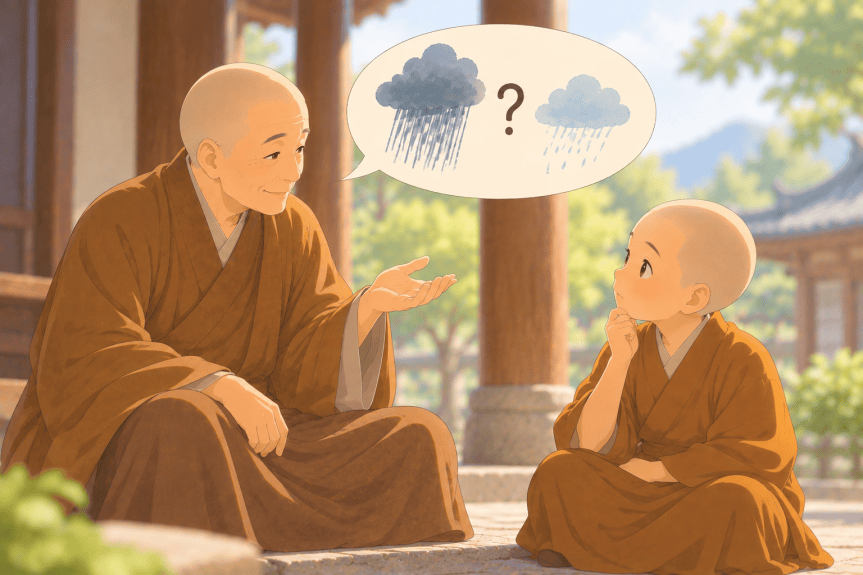
There was once a young monk cultivating himself at a Buddhist temple. He tended to pay little attention to small details, believing that minor matters were insignificant.
One day, his master asked him, “Which is more likely to get you soaked—a heavy downpour or a light drizzle?”
The disciple replied without hesitation, “Master, of course a heavy downpour is more likely to soak you.”
“But in everyday life,” the master said, “people are often more likely to have their clothes soaked by a drizzle than by a downpour.”
The disciple was puzzled. “A downpour brings much more rain, while a drizzle brings very little. How could a drizzle be more likely to soak our clothes?”
The master explained:
“When a heavy rain suddenly begins, people immediately become alert. Those carrying umbrellas quickly open them, while those without umbrellas hurry beneath the eaves to take shelter.
“But when there is only a light drizzle, people may hardly notice it. Even if they do, they often think nothing of it, believing that such a small amount of rain could never soak their clothes. So they continue walking through the rain as usual. Before they realize it, their clothes are completely wet.”
The master continued:
“Cultivating ourselves and learning Buddhism is much the same. As practitioners, everything in our conduct matters—our words and actions, every gesture and movement, every facial expression, every sentence we speak, and even every thought that arises.
“These things are like a fine drizzle. They may appear insignificant, but if we fail to pay attention and remain vigilant, we may intentionally or unintentionally hurt others or cause them distress and concern. In doing so, we may accumulate negative karma without even realizing it, ultimately preventing ourselves from attaining accomplishment and liberation.”
The disciple finally understood.
The “drizzle” represents our habitual tendencies and the seemingly minor details of our cultivation. Because they appear so small, we often fail to notice them. Yet if we continually neglect them, they can undermine our cultivation, leaving our efforts fruitless and even causing us to accumulate negative karma without realizing it.
(2) The Butterfly Effect
An apparently insignificant action can sometimes trigger a chain of far-reaching consequences. This is commonly known as the “butterfly effect.”
For nearly a century, from 1908 to 2003, British cyclists had won only one Olympic gold medal and had never won the Tour de France. Their results had been so disappointing that even bicycle manufacturers were unwilling to sell bicycles to the British team.
Then, in 2003, the team brought in a new coach.
The new coach asked the athletes to seek a 1% improvement in every aspect of their training.
Some might wonder: What difference could just 1% possibly make?
Yet these seemingly tiny improvements eventually helped transform British cycling.
At the 2008 Beijing Olympic Games, British cyclists delivered an extraordinary performance in track and road cycling, winning 60 percent of the available gold medals. During the ten years from 2007 through 2017, British cyclists won 178 world championships, 66 Olympic or Paralympic gold medals, and five Tour de France victories. These achievements came to be widely regarded as one of the most remarkable periods of success in cycling history.
The same principle can be applied to our daily cultivation.
If every day we could correct our habitual tendencies and undesirable habits by just 1%, while increasing our sincerity and devotion toward Buddhas and Bodhisattvas and strengthening our compassion for living beings by 1%, then each day we would be making progress along the path toward liberation. Our learning and cultivation would inevitably bring genuine benefit.
Unfortunately, just as we tend to overlook a light drizzle, we often overlook this seemingly insignificant 1% of diligent effort and improvement.
(3) Great Virtue Is Accomplished Through the Accumulation of Small Virtues
A great wind begins with the faintest stirring of the grass; mighty waves arise from tiny ripples.
As another ancient saying warns:
“A thousand-mile dike can collapse because of an ant hole.”
There is also an ancient Chinese teaching:
“Do not commit an evil deed simply because it seems small, and do not refrain from doing a good deed simply because it seems insignificant.”
In Buddhism, there is a vow:
“I vow to eliminate all evil, leaving no evil uneliminated; I vow to cultivate all goodness, leaving no good uncultivated; I vow to liberate all living beings, leaving no living being unliberated.”
If we do not put an end to small wrongdoings and do not accumulate small acts of goodness, how can we ultimately attain the realization of the holy ones?
Many eminent Buddhist practitioners of the past have set examples for us through the meticulous attention they paid to seemingly minor aspects of their cultivation.
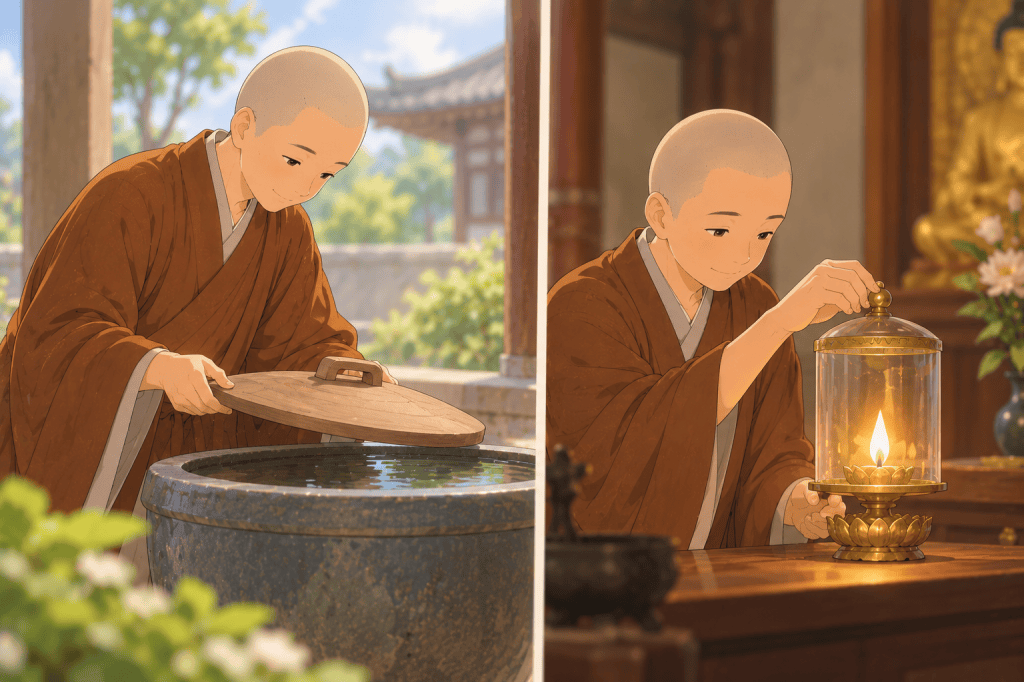
Master Yinguang was exceptionally attentive to details in his daily practice. When he lived at Fayu Temple on Mount Putuo, the basin he used for washing had a cover to prevent mosquitoes and other tiny insects from falling into the water and drowning. The oil lamp before the Buddha also had a protective cover so that moths would not fly into the flame and be burned to death.
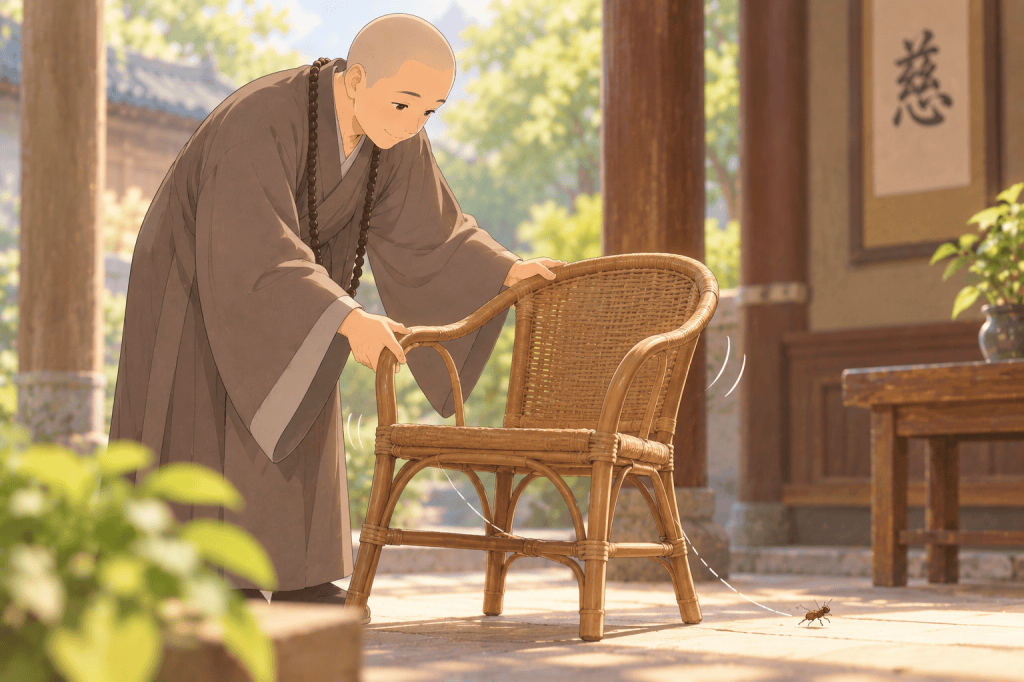
Before Master Hongyi sat down on a rattan chair, he would gently shake the chair from side to side several times. He did this to avoid harming tiny insects that might be hiding in the crevices of the chair. By moving the chair first, he was, in effect, giving these small creatures a warning and allowing them time to move away to safety.
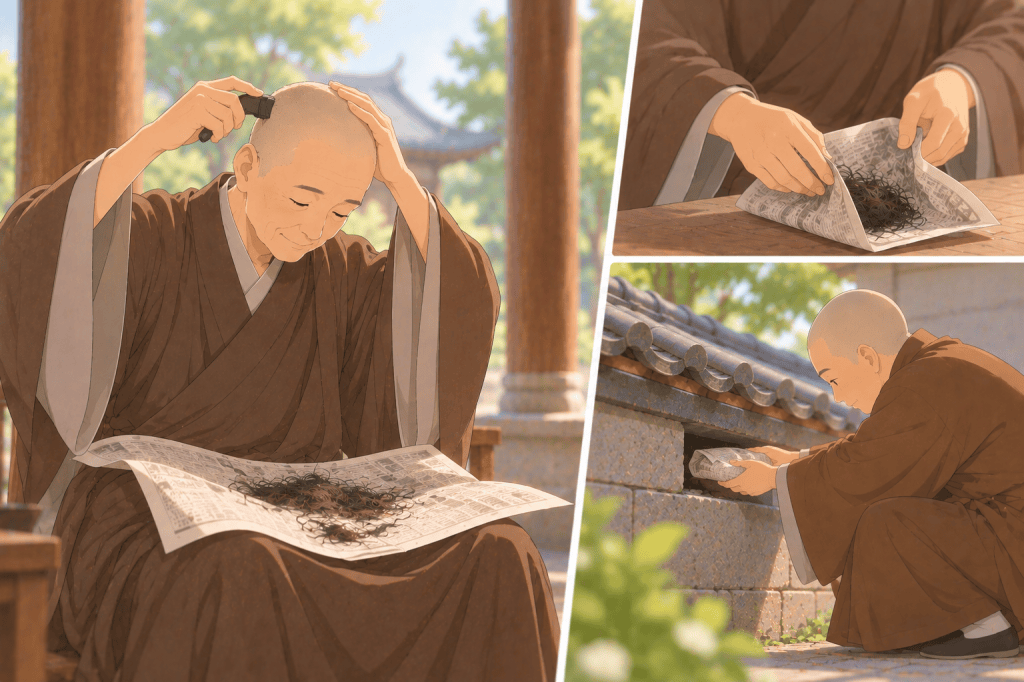
When Master Nenghai was at the Vajra Bodhimanda in Shanghai, his student, Master Dao’an, recalled that whenever Master Nenghai had his head shaved, he would not allow the cut hair to fall onto the ground. Instead, all the hair had to fall onto newspapers spread across his lap.
Afterward, the hair would be carefully wrapped in the newspaper and placed beneath roof tiles or into crevices in a wall. He did this simply to prevent strands of hair lying on the ground from injuring tiny insects.
Cultivation must begin with the smallest details.
As the saying goes:
“If one is careless about minor conduct, it will eventually impair one’s great virtue.”
This accords with one of the teachings imparted by Namo H.H. Dorje Chang Buddha III in Philosophical Sayings for Worldly Matters:
“Moral excellence is the total addition of small good deeds. Great roads are built when grains of sand are put together. To a person aspiring to become virtuous, nothing that helps is too trivial to claim his attention.”
True cultivation is reflected not only in great vows or major actions, but also in the smallest details of everyday life. A thought, a word, a facial expression, or a seemingly insignificant action may appear no more consequential than a drop of drizzle. Yet when such small causes accumulate, their effects can become profound.
Likewise, every small act of kindness, every habitual tendency we correct, and every increase in compassion may seem insignificant at the moment. But accumulated day after day, these small improvements can gradually transform our conduct and our cultivation.
Great virtue does not arise all at once. It is accomplished through the accumulation of small virtues.
In this world, no one can live without the basic necessities of food, clothing, shelter, and transportation. Everyone must work to provide for these needs. As the saying goes:
“The bustling world is driven by profit; the surging crowds are drawn by gain.”
It can be said that no one can live entirely without money, and few people dislike having it. As a result, money and wealth have often become symbols of a person’s social status and are frequently used in modern society as measures of one’s ability and success.
However, as another saying goes, “A person of integrity may value wealth, but acquires it through proper means.” Under the pressure of making a living or the desire to compare themselves with others, many people become eager for quick success. Some stray onto improper paths and even resort to unscrupulous means for profit, completely forgetting the principle that ill-gotten wealth should not be taken; what comes easily through improper means may just as easily be lost.
But what exactly constitutes ill-gotten wealth?
Many people narrowly assume that only money or property obtained through theft, deception, robbery, embezzlement, or similar wrongdoing can be considered ill-gotten. In reality, the scope of ill-gotten wealth extends far beyond these obvious examples.
Take an ordinary employee as a simple example. First and foremost, we should be diligent, dedicated to our work, and conscientious in carrying out our responsibilities. The salary and compensation we receive in return are then rightfully earned.
On the other hand, if a person is lazy, avoids responsibility, exploits loopholes in the system or workplace, does as little work as possible while still collecting a full salary, and constantly tries to get by through cunning shortcuts, then it is difficult to regard all that income as properly earned. Such a person has failed the organization as well as the supervisors and coworkers who placed their trust in them. Sooner or later, those debts will have to be repaid.
There is an old saying: “Whom has Heaven ever spared?”
Putting that aside, people who habitually behave this way are unlikely to make substantial progress wherever they go. Without planting the cause of diligence and self-improvement, how can one expect to reap the fruit of advancement? We often find that when organizations reduce their workforce, those who habitually shirk responsibilities, take shortcuts, and rely on petty cleverness are particularly vulnerable. In the end, their cleverness may work against them.
Namo H.H. Dorje Chang Buddha III teaches us in Philosophical Sayings for Worldly Matters:
“Richness comes from diligence. A rich person is one who is diligent and who chooses a fit career with proper goals.”
In other words, if we wish to attain prosperity, we must first be diligent. Diligence alone does not necessarily guarantee wealth, but without diligence, prosperity is difficult to achieve. Therefore, we must work diligently and apply ourselves through proper and constructive effort.
Second, diligence must be accompanied by ability and talent. Simply working hard without developing the necessary knowledge and capabilities may not be enough to build a successful undertaking. With knowledge, ability, and wisdom, we learn how to distinguish what should be pursued from what should be avoided. We become better able to assess circumstances and make sound choices—choosing endeavors with wholesome and promising prospects rather than improper, harmful, narrow, or unsustainable paths.
Third, and most importantly, the nature of one’s undertaking must be proper. The occupation or business we choose should follow a righteous path, and our intentions and conduct must also be upright. We should never harm the interests or well-being of others merely for our own benefit.
When it comes to what constitutes a proper occupation, however, many people have misconceptions. Some assume that anything permitted by law must therefore be proper. That is not necessarily so from the Buddhist perspective.
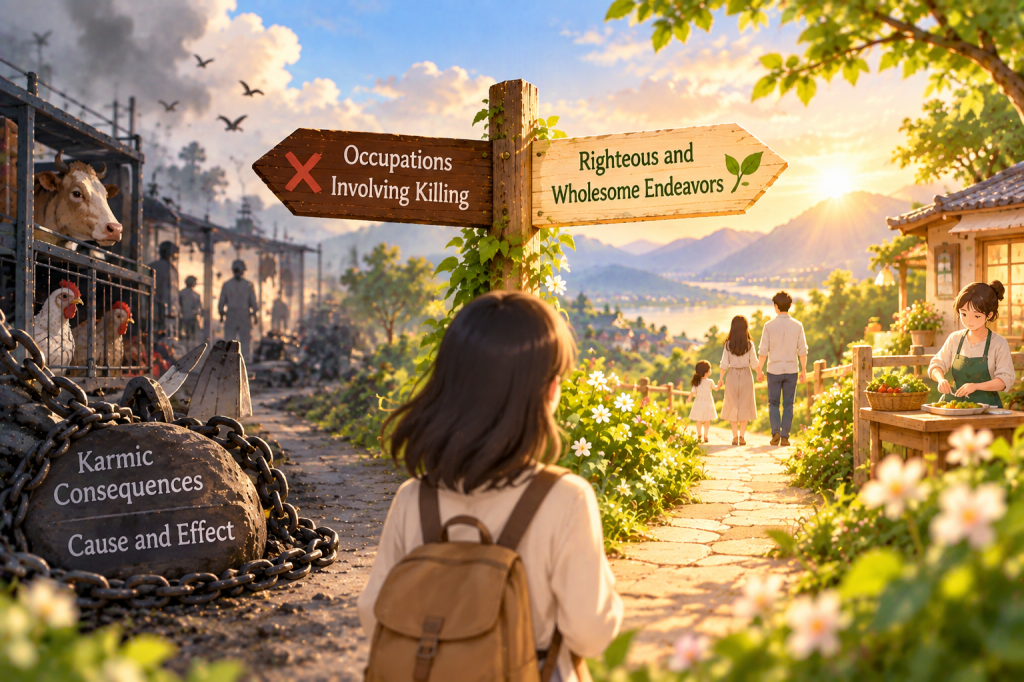
Take, for example, businesses involving the sale of live animals for food and the slaughtering of animals. Although such businesses may be permitted under national law, from the Buddhist perspective they cannot truly be regarded as proper livelihoods because they involve extensive killing. Such actions are believed to affect the karmic consequences one experiences in this life and in future lives.
This is not regarded in Buddhism merely as superstition, but as a matter of cause and effect. The Buddha taught that all living beings are equal. Pigs, dogs, cattle, sheep, fish, shrimp, birds, and other animals are all living beings. They too can experience pain and fear; they struggle, cry out, and try to escape suffering.
If our accumulation of wealth is built upon the suffering and cries of countless living beings, how can we assume that we ourselves will remain entirely untouched by the consequences? In ordinary language, one might ask, “Where would justice under Heaven be?” From the perspective of Buddhist teachings, the question is one of cause and effect.
If we observe carefully, we may see people who accumulated wealth through businesses involving the killing of living beings but later lost much of that wealth through illness, accidents, or other misfortunes.
I once knew the owner of a pharmacy whose business had initially been doing quite well. Several years later, however, the pharmacy was shut down following an investigation, leaving the owner owing substantial sums of money to various sales representatives. Whatever could be removed from the store was taken away.
Not long afterward, the owner passed away before reaching the age of sixty. His wife spent several years moving from place to place before eventually finding work as a caregiver, which barely provided her with enough to live on. Even then, she was afraid to let others know where she was. Their son was also imprisoned for several years because of debts involving high-interest loans and other problems.
I wondered how a family that had once operated a seemingly successful pharmacy could have fallen into such circumstances. Later, I heard that the elderly couple had worked as pig slaughterers in their earlier years. After saving several hundred thousand yuan, they left that business and opened the pharmacy. Their son, however, lived extravagantly, quickly squandered the family’s savings, and accumulated high-interest debt. In the end, a once-established family fell apart.
I also knew of someone who had worked in the fishing industry for more than twenty years. His daughter developed an unusual illness that severely affected her mental functioning. The family spent a great deal of money seeking treatment, but her condition did not improve. Later, the man himself became seriously ill, and the family eventually exhausted all of its savings.
If we pay attention, we may encounter many stories of this kind.
Many people wonder why so many unfortunate things happen in life. From the Buddhist perspective presented here, apart from the effects of harmful causes created in previous lives ripening in this life, some suffering may also be related to unwholesome karma created through our present actions.
The Mangala Sutta (Discourse on Blessings) teaches:
“To engage in occupations that cause no harm—this is the greatest blessing.”
Therefore, for the well-being and peace of ourselves and our families, we should stay away from occupations involving killing. From this Buddhist perspective, wealth accumulated through the taking of life is among the most troubling forms of improperly acquired wealth. The more such wealth is accumulated, the heavier the corresponding karmic consequences may become, for causes bring corresponding effects, and no one can ultimately escape the workings of cause and effect.
Therefore, if we wish to prosper, we should apply our diligence, abilities, and talents to righteous and wholesome endeavors. Wealth acquired in this manner can truly be used for our benefit without becoming a source of calamity.
As the saying goes, “Great virtue carries great responsibility and abundance.”
Virtue refers to morality, character, self-cultivation, and integrity. Material possessions include money, wealth, influence, and the conditions of our lives. Position refers to status, authority, office, and power.
We should therefore guard our minds and uphold virtue. We must never allow greed to drive us into reckless conduct. If one possesses little virtue yet seeks an exalted position, has limited wisdom yet attempts enormous undertakings, has little strength yet tries to bear an overwhelming burden, or possesses insufficient ability yet seeks great responsibilities—how could such imbalance not eventually bring trouble?
True prosperity, therefore, is not simply about how much wealth we accumulate. What matters equally is how that wealth is obtained, what causes we create in obtaining it, and whether we can enjoy it with a clear and peaceful conscience.
Recognize Your Shortcomings and Strive Forward; Though the Mountain Is Distant, Press On
A few days ago, I came across a saying: “Recognize your shortcomings and strive forward; though the mountain is distant, press on.” I found it deeply thought-provoking.
Taken literally, it means that when we recognize our shortcomings, we should strive to improve ourselves; when we see that the mountain ahead is distant and the path rugged, we should gather our strength and continue moving forward.
This saying also reminds us to look far ahead and establish lofty aspirations and goals. No matter how difficult the road before us may be, we should continue striving toward them.
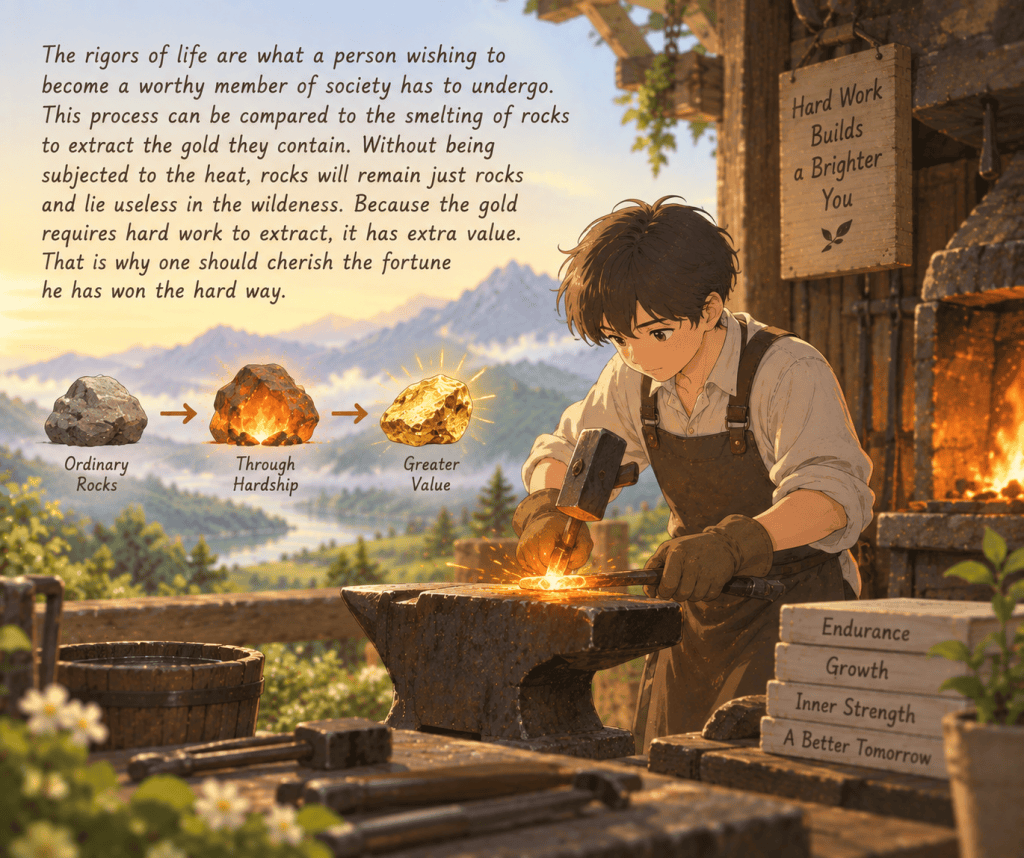
The rigors of life are what a person wishing to become a worthy member of society has to undergo. This process can be compared to the smelting of rocks to extract the gold they contain. Without being subjected to the heat, rocks will remain just rocks and lie useless in the wilderness. Because the gold requires hard work to extract, it has extra value. That is why one should cherish the fortune he has won the hard way.
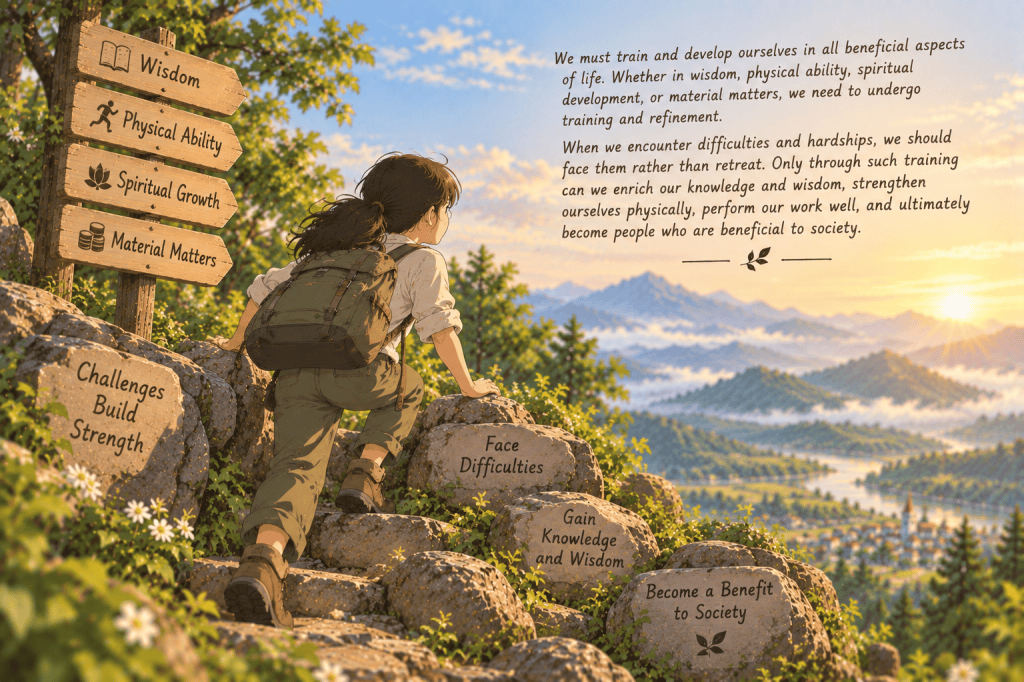
The meaning is that we must train and develop ourselves in all beneficial aspects of life. Whether in wisdom, physical ability, spiritual development, or material matters, we need to undergo training and refinement.
During this process, when we encounter difficulties and hardships, we should face them rather than retreat. Only through such training can we enrich our knowledge and wisdom, strengthen ourselves physically, perform our work well, and ultimately become people who are beneficial to society.
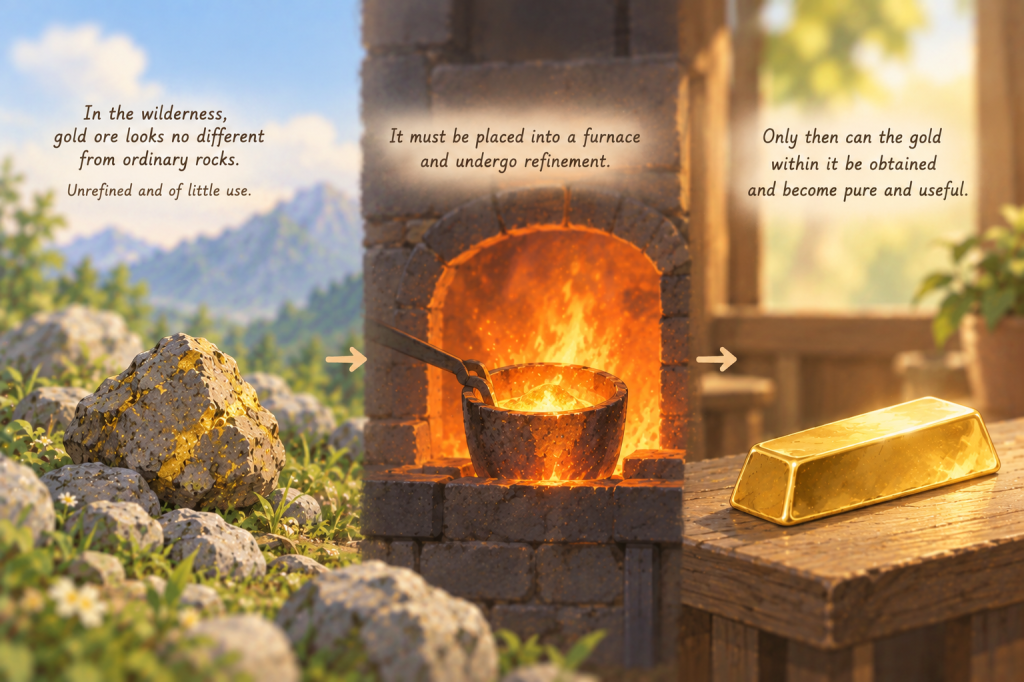
It is just like gold ore, which must be refined in a furnace before it can become pure gold. If a piece of gold ore is never placed into the furnace, the gold within it cannot be obtained. If it is simply left in the wilderness, among mountain valleys, cliffs, rocks, and wild vegetation, it appears no different from the ordinary stones around it—unclean, unrefined, and of little use. Put simply, without refinement, it remains nothing more than an ordinary piece of rock.
Likewise, as human beings, we must use various beneficial ways to train and refine ourselves, developing our knowledge and abilities, building successful undertakings, and cherishing the happiness that results from our efforts.
If blessings and happiness could be obtained effortlessly, there would be no need for us to train ourselves or strive for anything. It is precisely because happiness and blessings are often attained through trials and refinement that we should especially cherish what has not come easily. By knowing how to cherish our blessings, we can continue to enjoy the benefits they bring.
From this teaching, we can clearly see that there is no such thing as instant success. Genuine growth and achievement are inseparable from continuous effort and refinement. When confronted with difficulties and hardships, only by facing them courageously and refusing to fear setbacks can we improve ourselves through repeated trials and ultimately achieve genuine transformation.
The Same Is Even More True in Learning Buddhism and Cultivation
What is true of worldly accomplishments is even more true of learning Buddhism and cultivating ourselves.
In the process of transforming from an ordinary being into a holy being, we will inevitably encounter various obstacles, hardships, and trials. If we become afraid of these difficulties and refuse to move forward, we will forever remain ordinary beings. We will not be able to transform from ordinary beings into holy beings, nor will there be hope of transcending the suffering of samsara.
When Patriarch Milarepa sought to learn the Buddha Dharma from Master Marpa, he endured extraordinary hardships that ordinary people could scarcely bear, yet he did so without complaint. Without his determination to seek the Dharma and his perseverance in the face of such severe trials, there could not have been the Milarepa who later became such an accomplished practitioner.
Likewise, before attaining Buddhahood, Namo Shakyamuni Buddha underwent six years of ascetic practice in pursuit of the ultimate truth. Had the World-Honored One not resolved to seek the path in order to liberate living beings from the suffering of birth, aging, sickness, and death, who knows when Buddhism would have arisen in the Saha world?
Therefore, if we who learn Buddhism wish to attain accomplishment and liberation, we must persevere through the trials and hardships we encounter.
No matter how difficult life becomes, we should remain content even in poverty and never covet wealth obtained through unrighteous means. When confronted with ridicule or abusive words, we should remain composed rather than responding with insults or harsh speech. No matter how exhausting our work may be, we should not become lax and should always regard learning Buddhism as our primary undertaking. When we encounter attacks, slander, or isolation, we should remain calm rather than respond with anger, hatred, or retaliation.
In short, we can no longer simply act according to our impulses as we may have done before learning Buddhism. We must discipline ourselves in all circumstances, guard our minds, uphold what is right, and stay away from wrongdoing.
No matter how difficult the adversity we encounter, we must persevere. If we continue persevering, perhaps at the next turning point, good fortune and blessings may arrive when we least expect them.
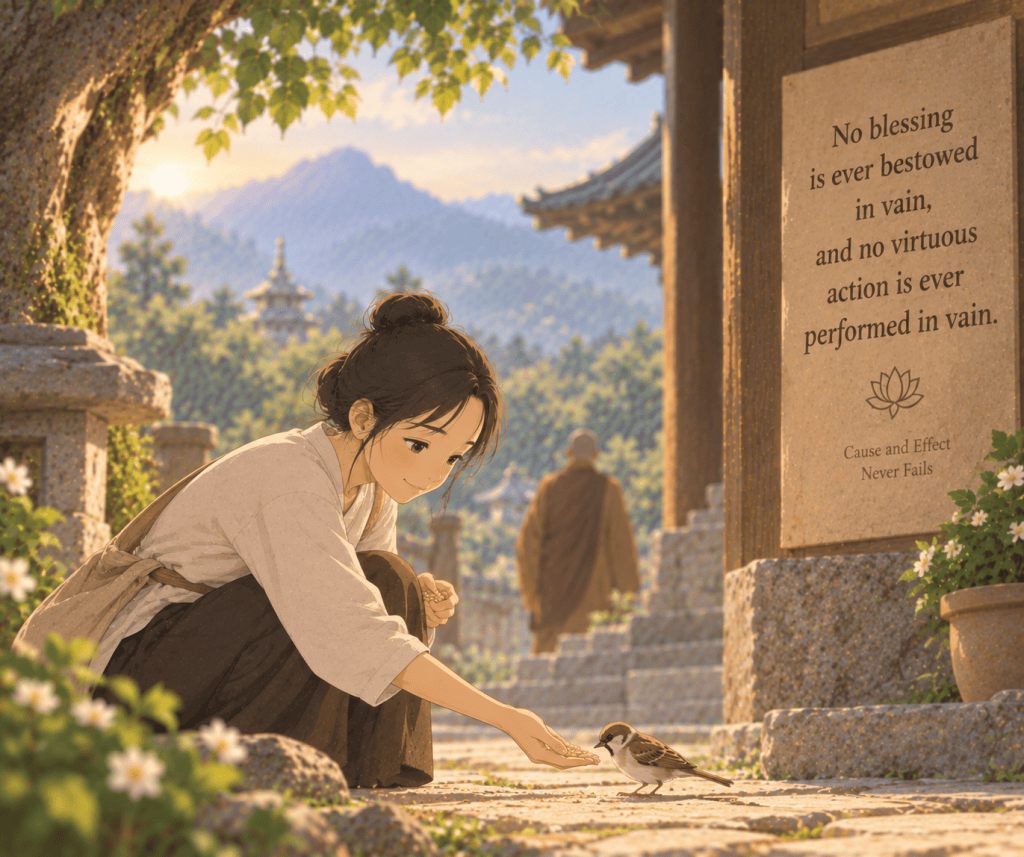
There is a saying: “No blessing is ever bestowed in vain, and no virtuous action is ever performed in vain.” This is precisely related to the law of cause and effect.
Of course, cultivation progresses through one stage after another. Each stage brings its own trials, and each stage may also bring its own unexpected joys. When joyful circumstances arise, we should not become carried away; when obstacles appear, we should not complain.
If we can always maintain a peaceful yet steadfast mind and refuse to retreat in the face of difficulties, then profound transformation—turning from an ordinary being toward holiness—can ultimately be realized.
May these words serve as mutual encouragement for all those who are striving to better themselves and move forward.
Recently, I happened to come across the poem Huan Xi Sha: What I Fear Most Is Being Asked About My Original Aspirations. Reading it in middle age filled me with countless emotions, and its meaning lingered deeply in my mind. It gave me the feeling that, “When I first heard these words, I did not understand their meaning; when I heard them again, I had already become the person described in them.”
How could these few short lines not be a reflection of the life I am experiencing today?
What I fear most is being asked about my original aspirations, Only to realize that my dreams have faded into emptiness.
In youth, I aspired to journey three thousand miles, Yet after hesitating for a hundred steps, I had accomplished nothing.
In the blink of an eye, my parents’ hair has turned white, While my children, still taking unsteady steps, have begun their schooling.
The need to earn a few pieces of silver hastens the passing of the years. My heart remains young, Yet wrinkles have quietly appeared upon my brow.
In this fleeting life, I drink and drift back into dreams. Youth has passed, though I still feel like the person I once was. I can only sigh at how swiftly time has flown.
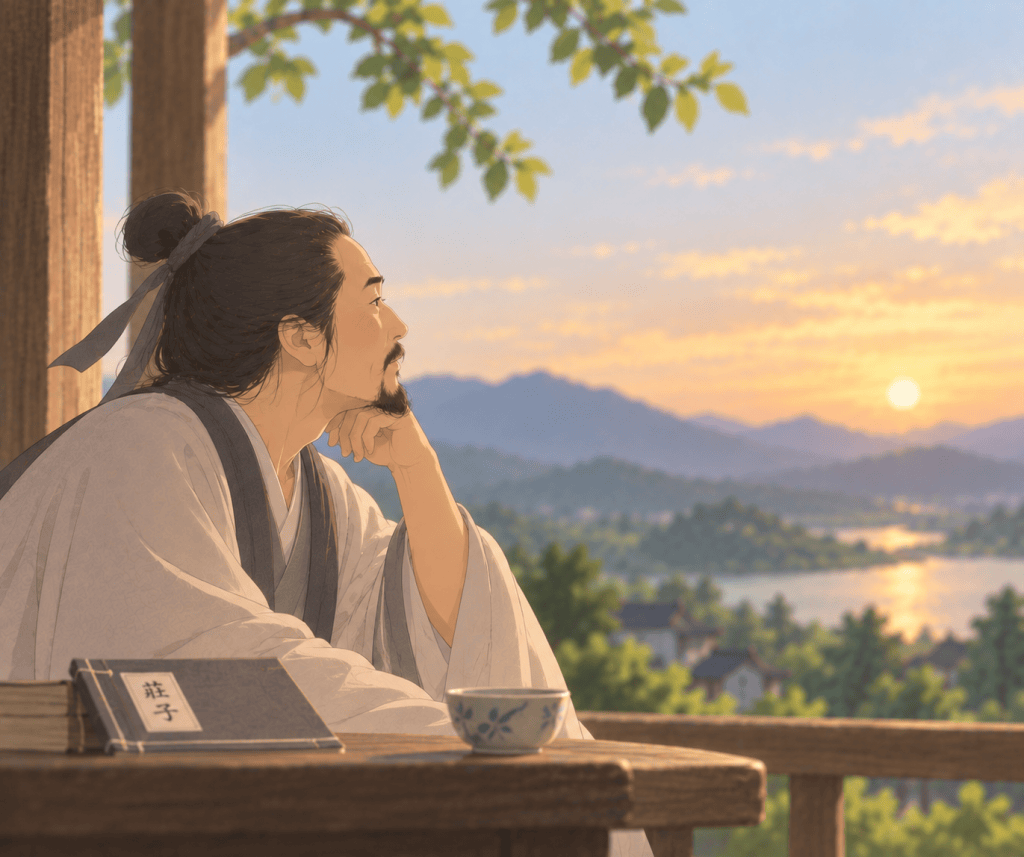
Zhuangzi said:
“A person’s life between heaven and earth is like a white colt glimpsed through a crack—it passes in an instant.”
Looking back upon the road we have traveled, we realize that throughout our lives, we have grown, encountered countless people and experiences, and then bid them farewell one after another. Between flowers blooming and falling, countless beautiful moments have already become memories. Amid gains and losses, sorrow and joy, so much of the past has vanished like drifting clouds and smoke.
As the saying goes:
The green mountains never grow old, yet I never find rest; All my life, I toil simply to make a living.
After decades of wind and rain, In the blink of an eye, we may already be buried beneath the earth.
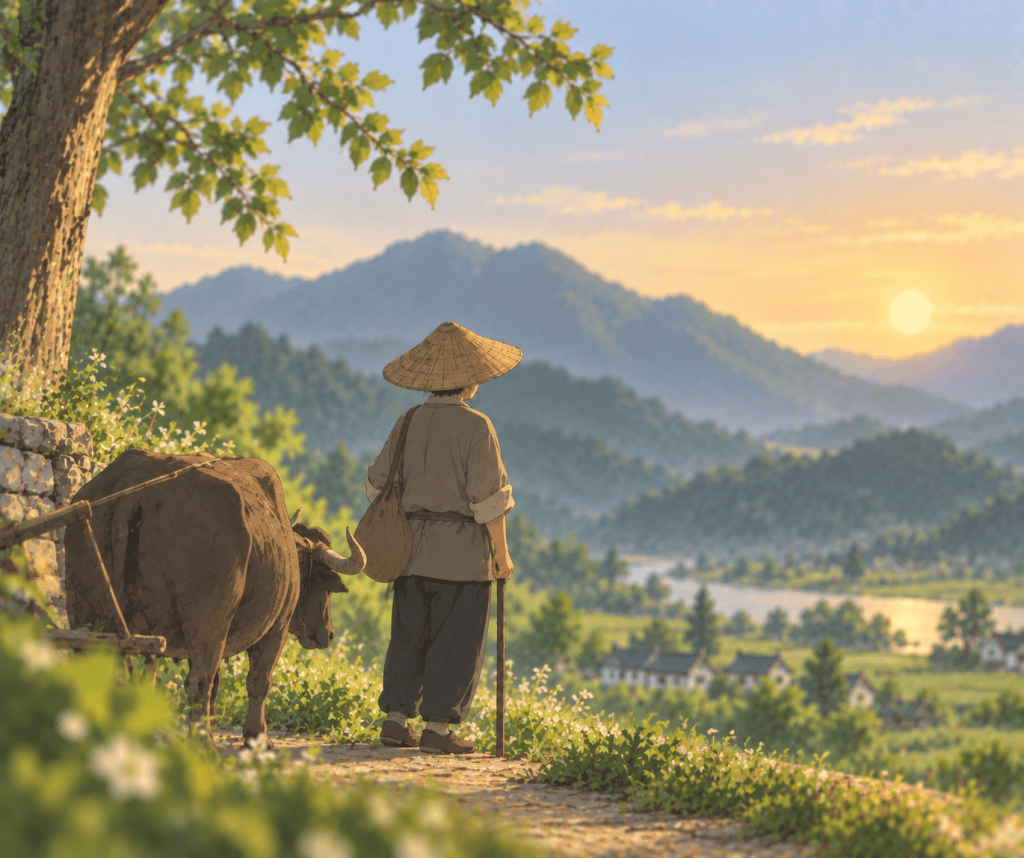
I laugh because the green mountains never change, The mountains laugh because I have already grown old. Like an ox that toils into old age, never knowing a day of rest; By the time rest finally comes, one has already been laid to rest in the mountains.
How many people have lived exactly this way, passing hurriedly through an entire lifetime burdened with regrets and helplessness?
Time always seems to slip away without our noticing, and often we realize its passing only afterward. There are things whose preciousness we understand only after we have completely lost them. Then we cannot stop thinking about them and regret that we did not cherish them when we had the chance.
But the years pass swiftly. How could time ever allow us to remain lost in a dream while our lives quietly grow shorter? Impermanence is the true nature of worldly existence. The past is like tea—only after tasting it do we come to understand how important it is to cherish the present.
Everything in this world that we have decided to do should be acted upon with determination. We should not postpone it until after we have rested for a while, until tomorrow, or until some future opportunity.
Nor should we allow a small setback to make us procrastinate day after day, sighing in discouragement, overwhelmed by worry, and losing our courage. If we allow ourselves to be completely defeated by setbacks, the undertaking can no longer succeed.
Therefore, when we encounter difficulties, we should promptly transform pessimism and negative emotions into strength—and replace hesitation with action.
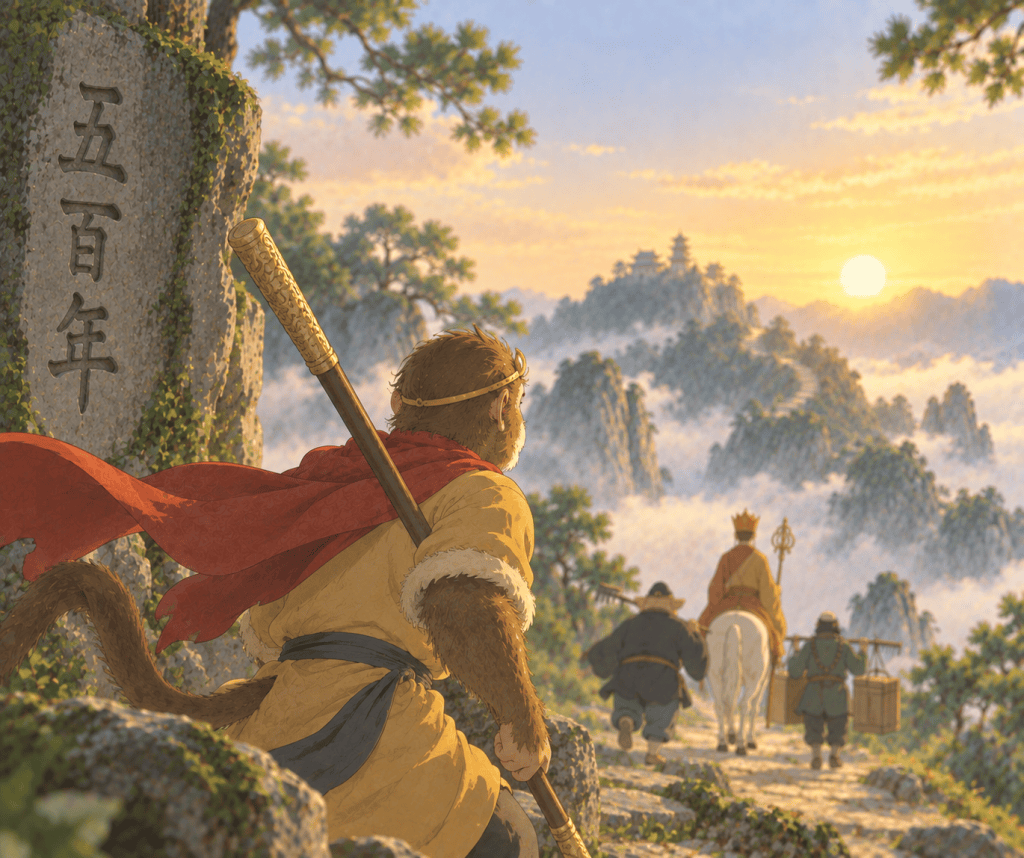
I remember that in Journey to the West, after Sun Wukong, the Monkey King, was imprisoned beneath the Five Elements Mountain, the song Five Hundred Years of Changing Seas and Mulberry Fields expressed the following idea:
Five hundred years—the seas and fields have changed places, Even the stubborn stone has become covered with moss. Yet one heart has never died, Still yearning for freedom.
Even if wildfires burn, Even if ice and snow cover the earth, The aspiration remains unchanged, And faith remains unshaken.
Was it not precisely because Sun Wukong endured five hundred years of hardship without allowing his determination and longing for freedom to be extinguished that he ultimately had the opportunity to embark upon the journey to obtain the Buddhist scriptures?
Once you are set to achieve a goal, pursue it with doggedness and refuse to be distracted by anything deceptively attractive. A mountain climber should not stop to pick leaves and branches on the way, or he will never reach the top. This applies to everything.
The Buddha clearly teaches us here that once a person has made a specific and proper vow and established a goal, that person should strive to bring it to fulfillment and work diligently to turn that aspiration into reality. One must not become distracted by illusory circumstances encountered along the way and consequently stop moving forward.
Those who aspire to accomplish a great undertaking and ultimately reach the summit must not waste their time plucking leaves and grasping branches halfway up the mountain. Nor should they allow themselves to be detained by an illusory city, becoming content with having reached it and no longer wishing to continue.
If we stop at such an illusory city, we will never accomplish our ultimate goal, nor will we ever reach the summit.
Life continually presents us with challenges, and we learn to deal with each one as it comes. The setting sun sinks into the mountains and sea; Within them lies a profound meaning.
Looking back, we may suddenly realize that, without even noticing it, we have already endured and overcome many hardships. Through them, we have become people who can gradually heal ourselves even while struggling through moments when everything seems to be falling apart.
No matter how many setbacks we encounter or how much suffering we must endure, as long as our minds do not become attached and we face circumstances with calmness and composure, even the greatest difficulties can eventually be faced and overcome.
What Can We Reflect Upon After Reading the Story of Zen Master Hakuin?
In today’s rapidly developing age of big data, the pace of life continues to accelerate, while competition and pressure increase along with it. Driven by ever-growing greed and desires, many people resort to deception, fabrication, slander, and defamation.
So when disputes, lies, and deception actually confront us, how should we respond to them properly?
The Story of Zen Master Hakuin
There is a well-known Zen story:
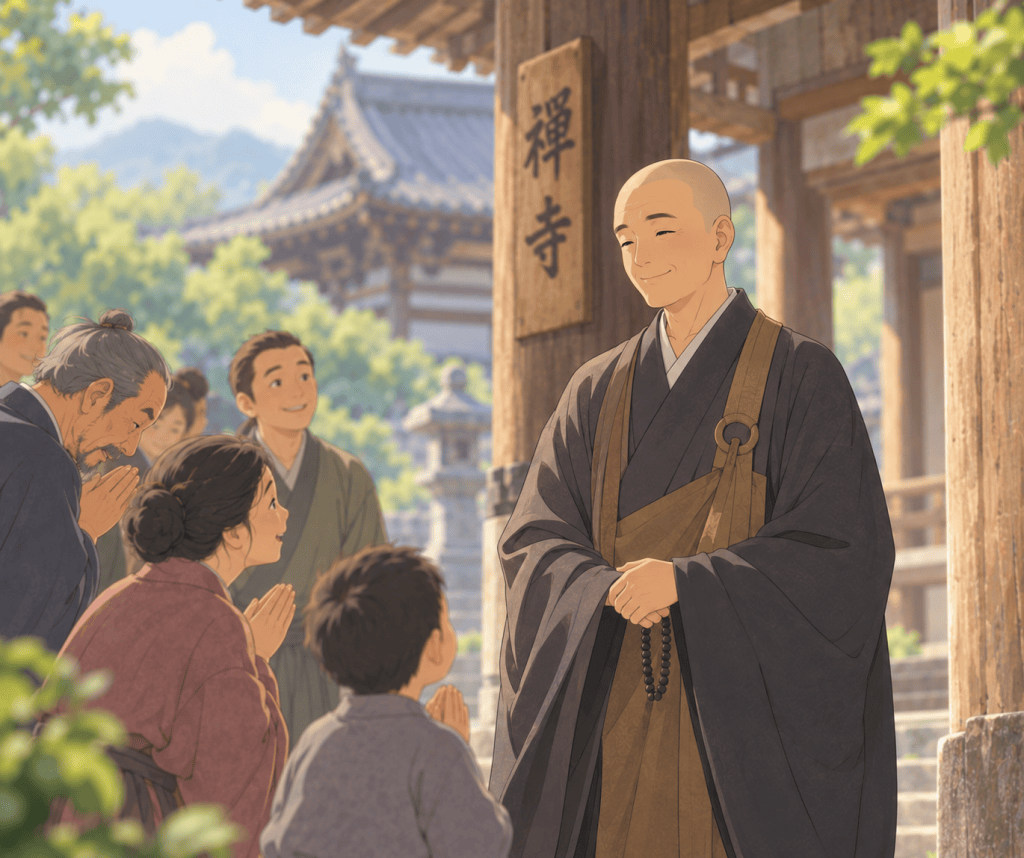
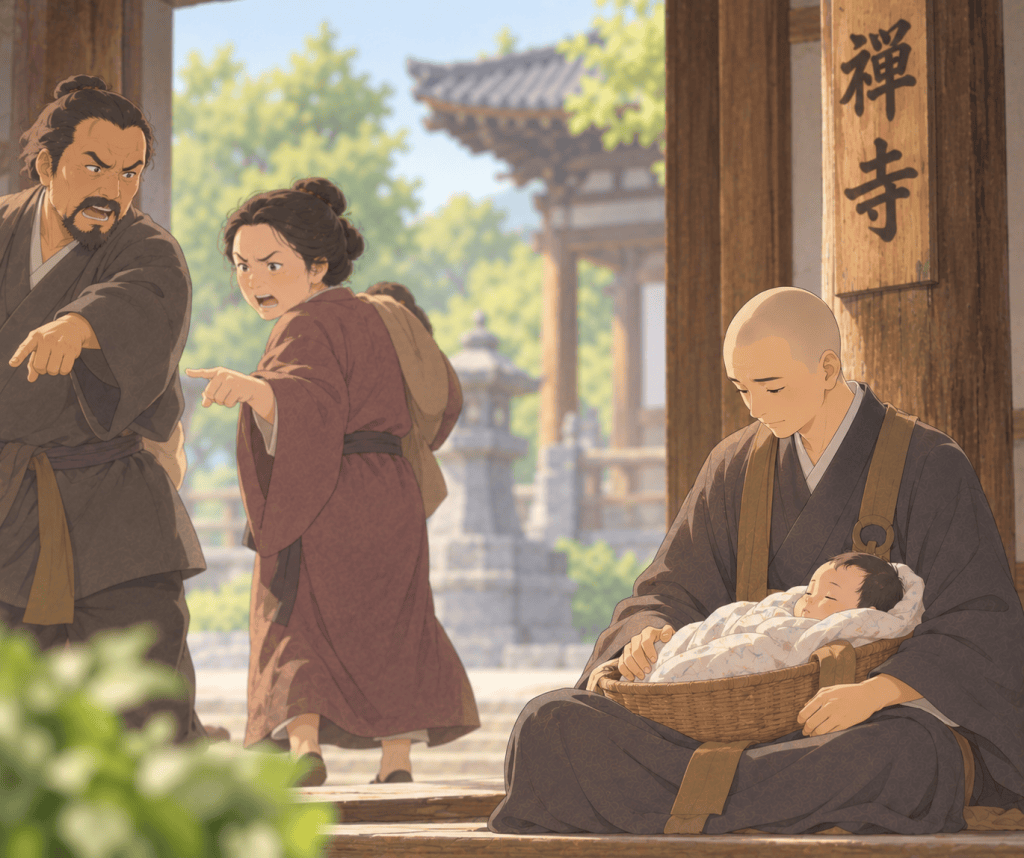
Zen Master Hakuin was an eminent monk renowned for his strict observance of the precepts and was deeply respected by the people around him.
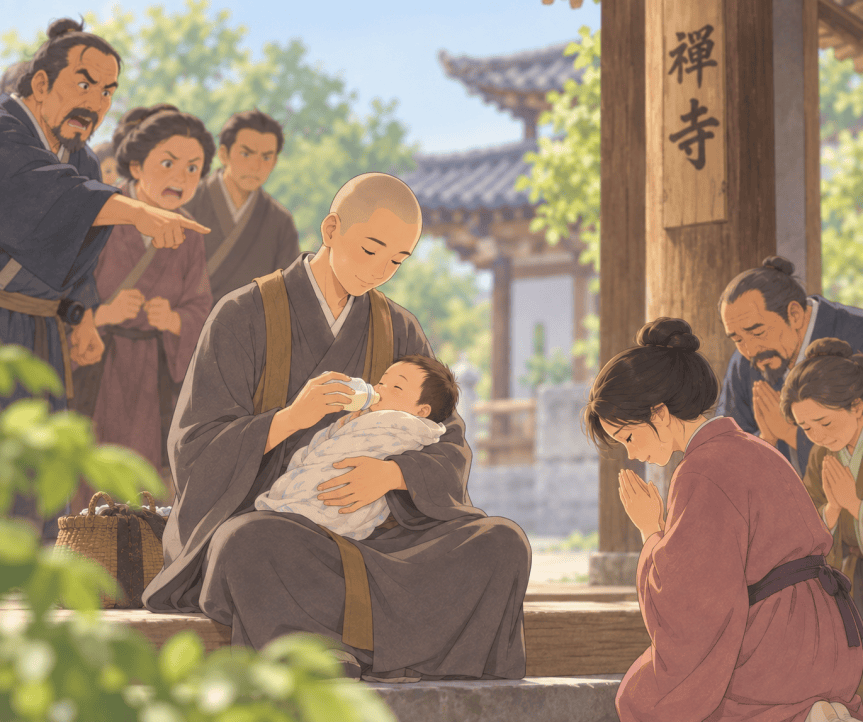
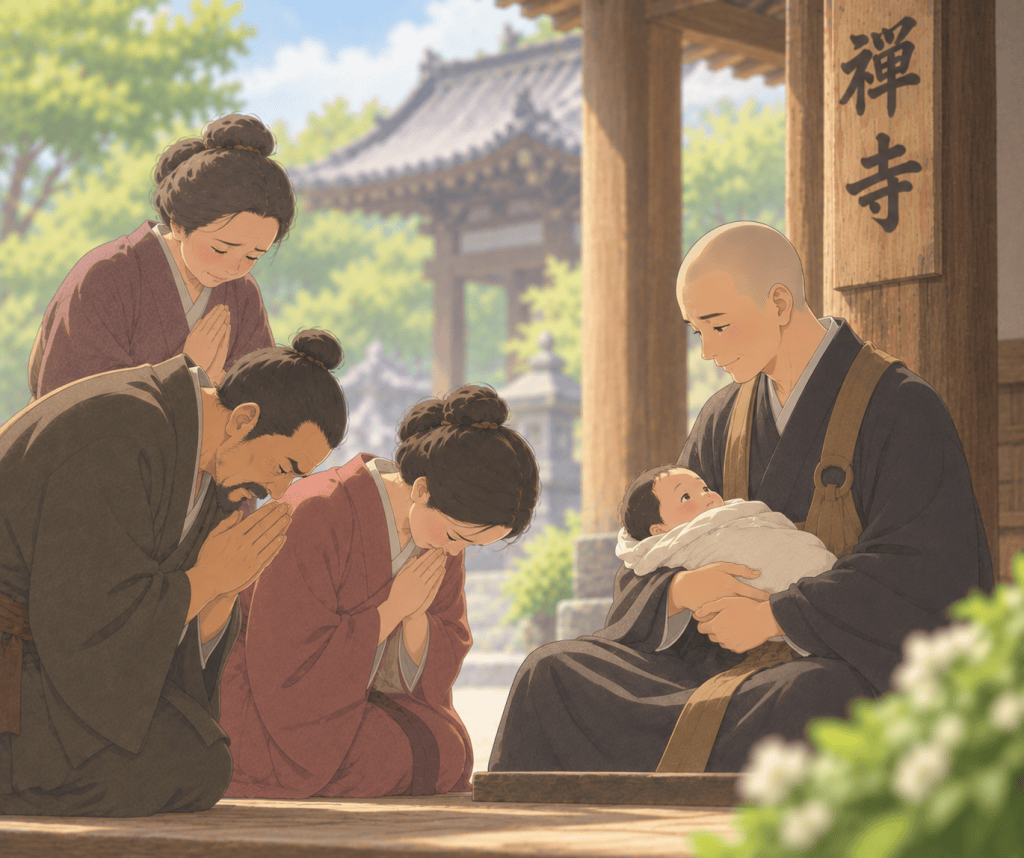
Near the temple where Zen Master Hakuin lived was a family with an unmarried daughter who became pregnant. When her parents discovered her pregnancy, they were furious and repeatedly demanded to know who the father of the child was. Under intense pressure from her parents, the daughter finally uttered the name, “Hakuin.”
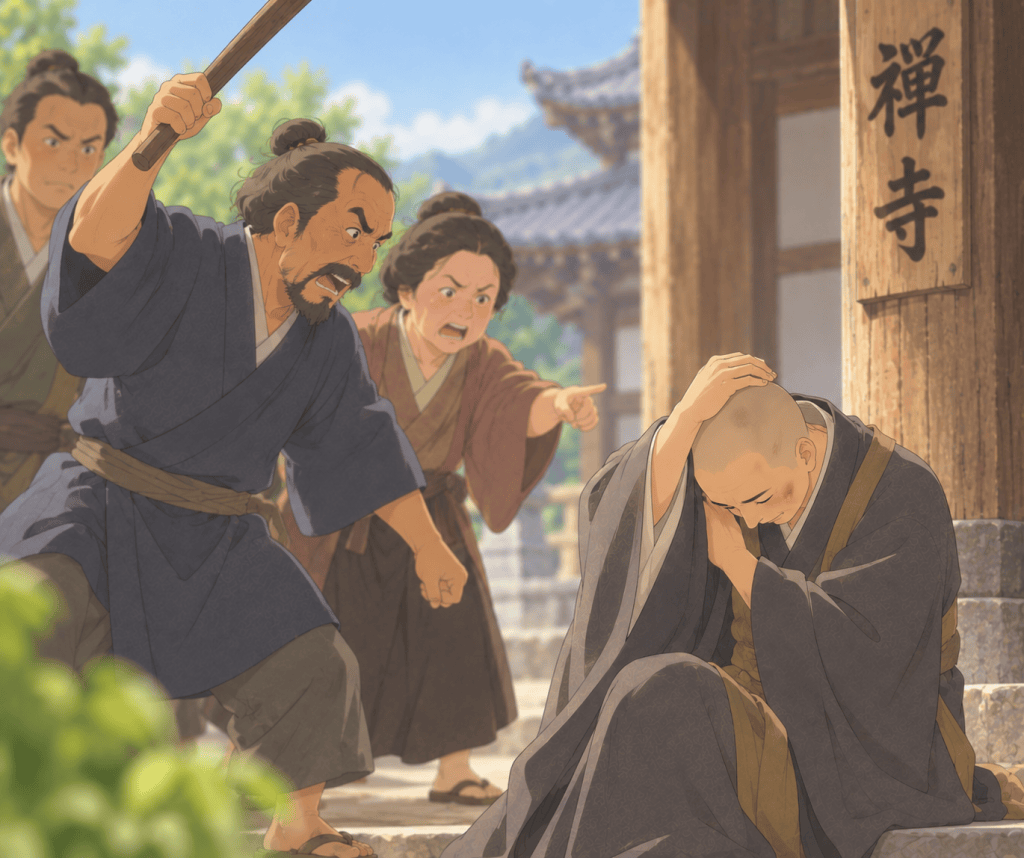
Shocked and enraged, her parents gathered a group of people and stormed into the temple. In front of everyone, they humiliated Zen Master Hakuin and even beat him.
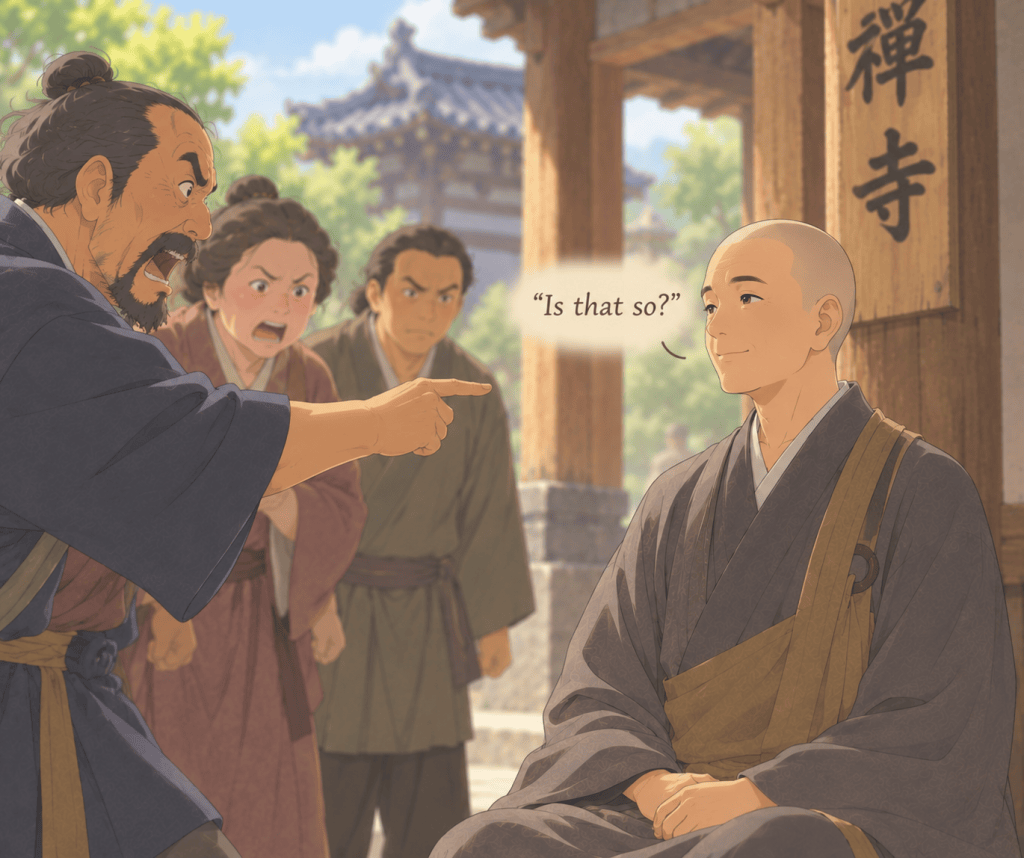
Yet Zen Master Hakuin offered no explanation or defense. He simply responded softly:
“Is that so?”
After the baby was born, the girl’s parents carried the child to the temple, left the baby with Zen Master Hakuin, and departed while angrily cursing him.
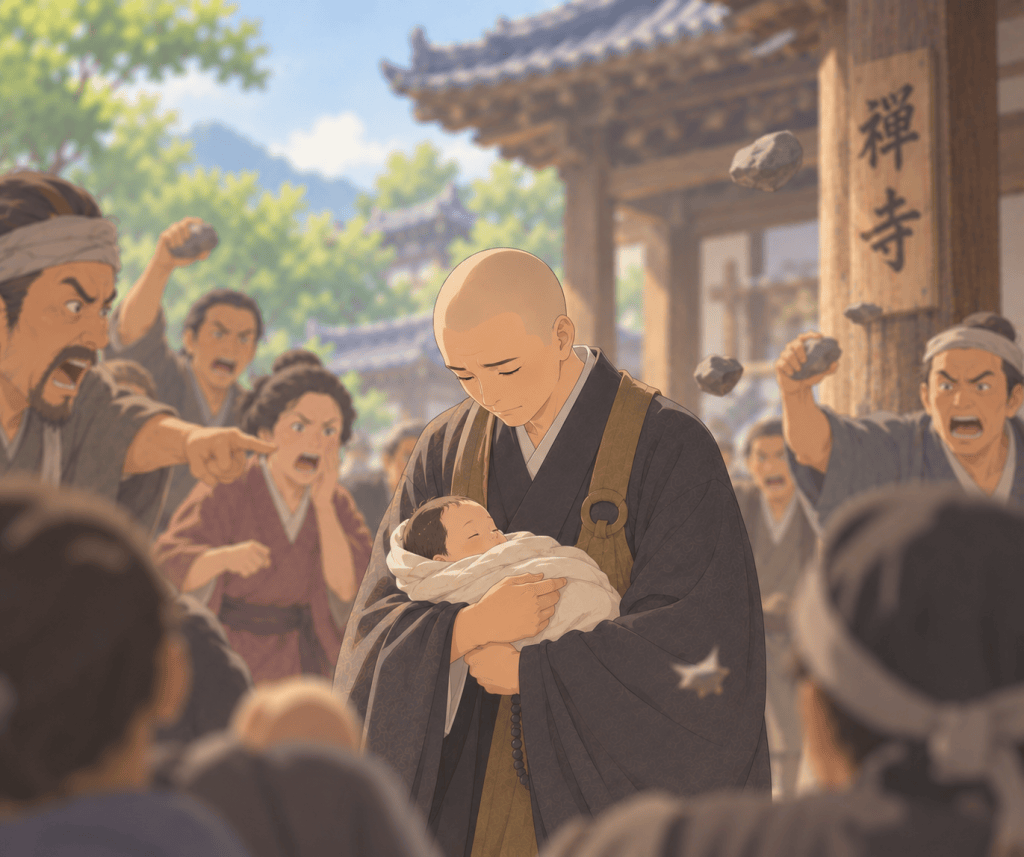
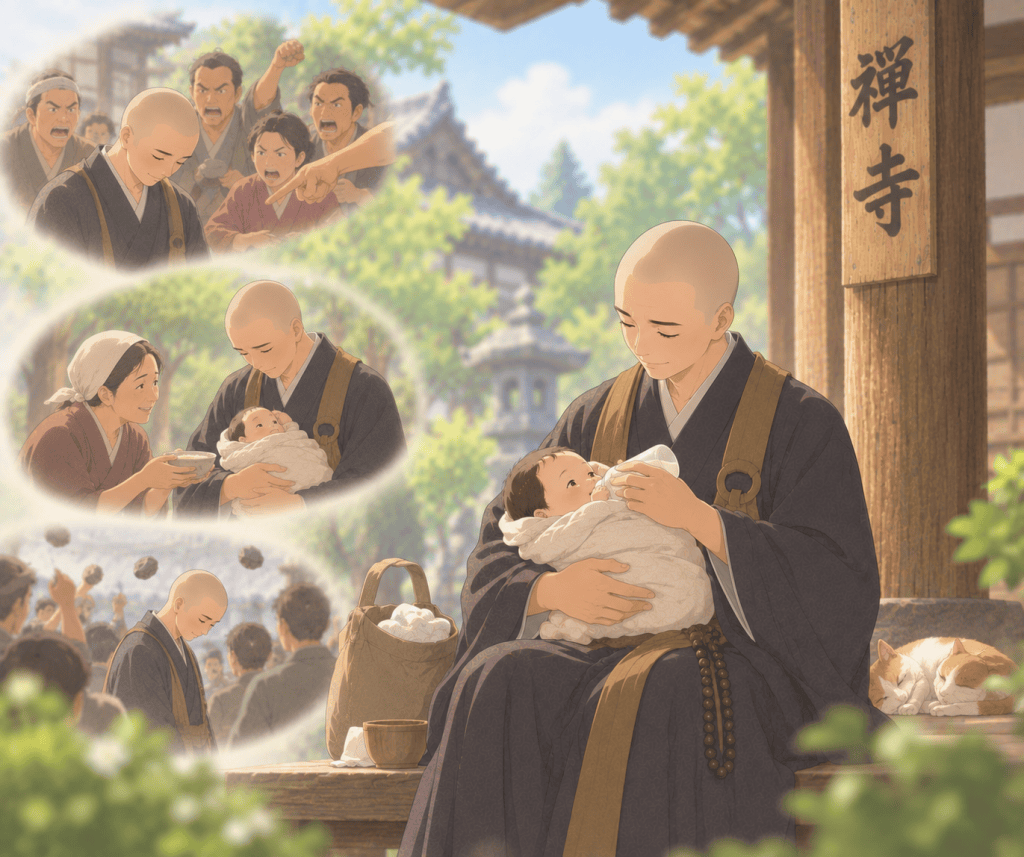
As news of the scandal spread, public outrage erupted. People accused Zen Master Hakuin of being a hypocrite. Some spat at him, insulted him, and even threw stones at him. As the saying goes, “Good news travels slowly, but bad news travels fast.” Before long, Zen Master Hakuin’s reputation was ruined.
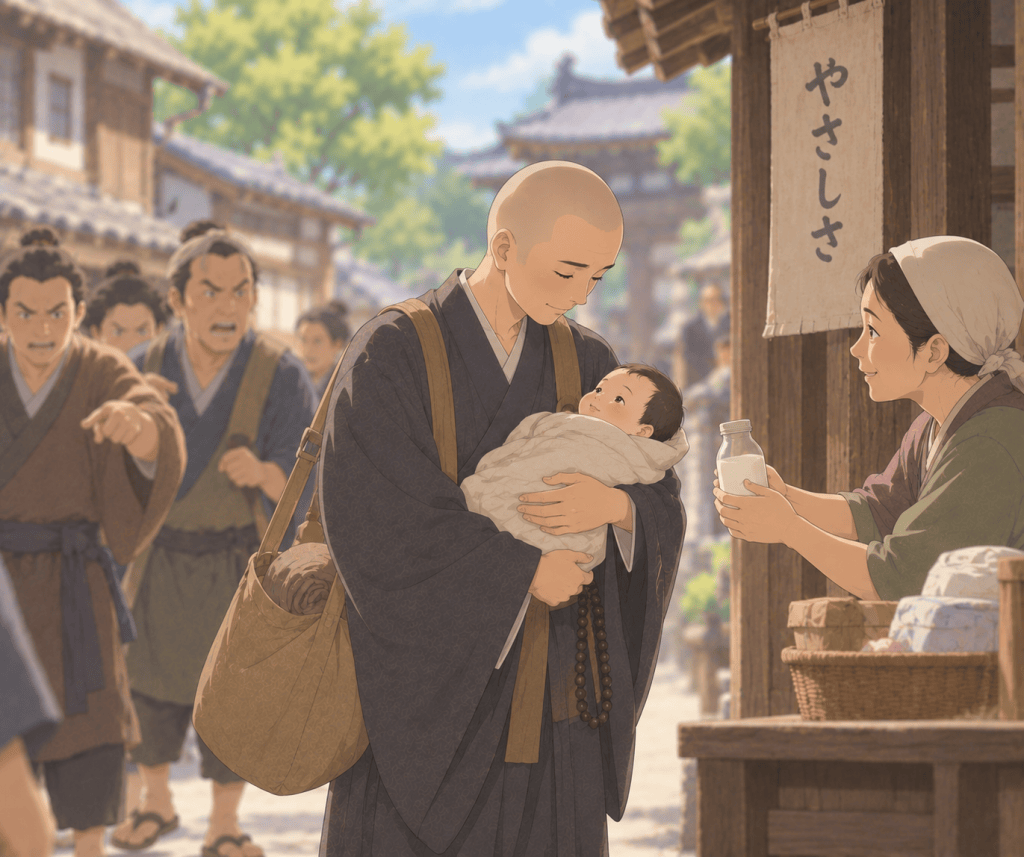
Yet no matter how severely he was insulted, he silently endured everything without defending himself or arguing. Every day, he carried the infant with him and went from place to place seeking milk and other necessities for the child.
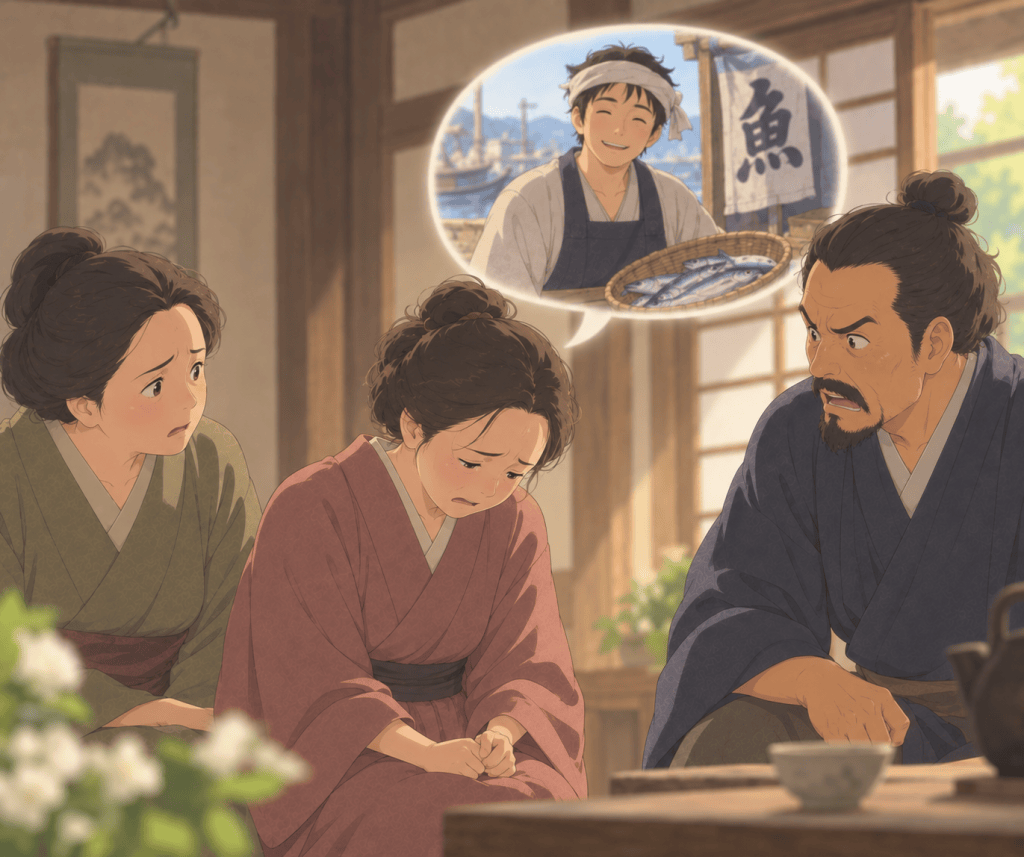
Eventually, the young woman could no longer bear the guilt and condemnation weighing upon her conscience. She finally confessed the truth to her parents: the actual father of the child was a young man who sold fish.
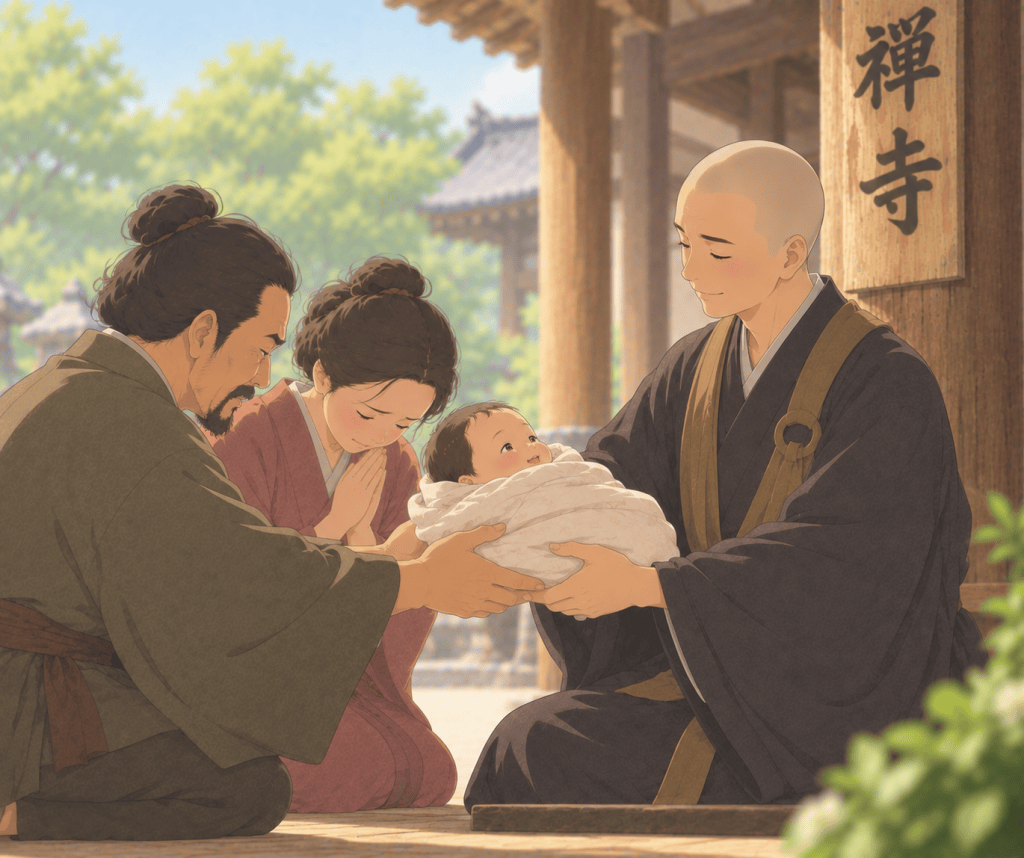
After learning the truth, the parents and their daughter went to the temple filled with profound shame and respect. They apologized to Zen Master Hakuin, expressed their remorse, and asked to take the child back.
Zen Master Hakuin remained just as composed as he had been at the beginning, as though nothing had ever happened. As he handed the child back to them, he simply said softly:
“Is that so?”
Zen Master Hakuin was indeed an eminent monk of genuine virtue. When he was falsely accused, personally humiliated, condemned as though he had committed an unforgivable offense, and stripped of his reputation, he neither defended himself nor argued or tried to justify himself. Instead, he continued to place the well-being of living beings before himself.
Amid insults, humiliation, and condemnation, he continued to care attentively for the child. Throughout the entire ordeal, he maintained compassion and patiently endured the tremendous humiliation and hardship placed upon him.
What Can We Learn From This Story?
Now that the story has been told, what can we deeply reflect upon?
In a dispute about right and wrong, there is nothing worse than to stick to one’s position and continue arguing, thus compounding one’s wrong and finally getting into trouble. For this reason, one should not let oneself be overwhelmed by disputes.
The general meaning of this teaching is that when we encounter slander or ridicule, we should not hold it in our hearts. As time passes, such disputes will naturally and gradually fade away because their very nature is impermanent. Therefore, when confronted with disputes over right and wrong, not holding them in our hearts benefits both ourselves and others.
In real life, when we actually encounter disputes, lies, slander, defamation, or other malicious tactics, if we respond with hatred, anger, insults, or emotional outbursts, ultimately we are the ones who suffer. Our anger, hatred, and verbal outbursts may not harm the other person in the slightest; the other person may even secretly take pleasure in seeing us become upset. If instead we choose retaliation, what we receive in return may simply be even stronger retaliation.
Therefore, in learning Buddhism and cultivating ourselves, we must conscientiously practice in accordance with the teachings of Namo H.H. Dorje Chang Buddha III. We should understand that all matters and phenomena are inseparable from cause and effect. We should learn to put ourselves in others’ shoes, be tolerant toward others, maintain compassion, patiently endure adversity and humiliation, and refrain from holding disputes over right and wrong in our hearts.
If we can do so, not only will we avoid being overwhelmed by pressure, conflict, and disputes, but we will also be able to temper and strengthen ourselves through difficulties and challenges.
Zen Master Hakuin provides a powerful example. Amid disputes, humiliation, and false accusations, he patiently endured and continued his cultivation. Rather than being swayed by external circumstances, his conduct revealed even more clearly the virtue and dignity of a truly eminent monk.
The path of life must be walked by each of us, one step at a time. Which path we choose to follow is ultimately our own choice.
When we can truly understand cause and effect and awaken to the truth of impermanence, we can gain deeper insight into life. In doing so, we can better make use of this precious lifetime and ultimately walk toward a life filled with happiness, brightness, and hope.
“In a dispute about right and wrong, there is nothing worse than to stick to one’s position and continue arguing, thus compounding one’s wrong and finally getting into trouble. For this reason, one should not let oneself be overwhelmed by disputes.”
The meaning is that matters of right and wrong are not something we should become attached to. Attachment to them can only bring harm, misfortune, and even calamity. Therefore, when we encounter disputes over right and wrong, we must not become attached to them.
When such disputes arise, let others debate among themselves. Let them say whatever they wish to say. Otherwise, once we become entangled in disputes over right and wrong, arguments will inevitably follow. People will try to determine who is telling the truth and who is not, who is right and who is wrong, and this can lead to verbal conflict.
Moreover, neither side is usually willing to concede. Each side believes that it is right. In the end, after a great deal of time and energy has been wasted, the question of who is right and who is wrong may still remain unresolved. Instead, the situation may continue to escalate, relationships may deteriorate, and conflicts between people may become increasingly complicated. Eventually, this can lead to serious trouble and, in extreme cases, even violence, loss of life, and other calamities.
Therefore, once we understand that we should not become attached to matters of right and wrong, we should not keep such matters in our hearts when we encounter them. As time passes, the disputes will naturally and gradually fade away, because their very nature is impermanent. Thus, when confronted with matters of right and wrong, not holding them in our hearts benefits both ourselves and others.
The Story of Two Tigers and a Cunning Fox
There is a story about two fierce tigers named Shanya and Shanbo who lived deep in the mountains long ago. The two tigers were good friends and lived together in harmony.
There was also a cunning fox that was lazy, greedy, and deceitful. It survived by scavenging the remains of the prey left behind by the two tigers and followed them around every day.
Although the fox depended on the two tigers for survival, it was also extremely afraid of them. It worried that one day, if the tigers failed to catch any prey, they might turn against it, and its very life could be in danger. The fox therefore devised a scheme to sow discord between the two tigers.
Because of the fox’s instigation, the next time the two tigers met, Shanya attacked Shanbo first.
Shanbo did not immediately fight back. Instead, he chose to retreat.
As Shanya continued attacking, he angrily rebuked Shanbo:
“Why did you tell the other animals that you are better than me in every way?”
Upon hearing this, Shanbo realized that something was wrong. He urged Shanya to calm down and explained:
“The truth is that the fox told me that you had been telling the other animals that I was inferior to you in every way.”
When Shanya heard this, he too realized that something was amiss. He immediately stopped fighting.
The two tigers resolved their misunderstanding and reconciled. From that time onward, they once again lived together peacefully, and tranquility returned to the forest.
The Lesson of the Story
This story teaches us not to readily believe rumors, become attached to disputes over right and wrong, or act impulsively without first understanding the situation. Had Shanbo immediately fought back instead of remaining calm, the fox’s deception could have led to serious consequences.
In our own lives, becoming entangled in arguments over who is right and who is wrong can consume our time and energy, damage relationships, and cause conflicts to escalate. Sometimes, the more we try to prove ourselves right, the more deeply we become entangled in the dispute.
Once we understand that matters of right and wrong are impermanent, we can learn not to let them occupy our hearts. When we refuse to be drawn into unnecessary disputes, they may gradually fade away. In this way, letting go of attachment to right and wrong benefits both ourselves and others.
“A city does not need all the food a province produces, but that much food is far from enough to feed the whole country; it needs all the food the country can produce. The strength of an individual is nothing compared with collective strength.”
The meaning of this principle is that the size, corresponding energy, and function of all things in the world are relative and can be understood through comparison. Without comparison, we cannot discern what is large or small, nor can we understand the principles governing their appropriate application.
For example, if the farmland of an entire province were used to support only one city, it would seem vast and abundant. However, if an entire country had to depend on the farmland of just that one province, it would be insufficient to meet the needs of its people. Thus, the people of a nation require the land and resources of a nation to sustain them.
This illustrates an important principle: No matter how powerful an individual may be, and no matter how great that person’s abilities or talents are, the power of one person is ultimately limited. Only when the strength of many people is brought together can truly great power arise.
How can we better understand this principle? Let us consider several examples from everyday life.
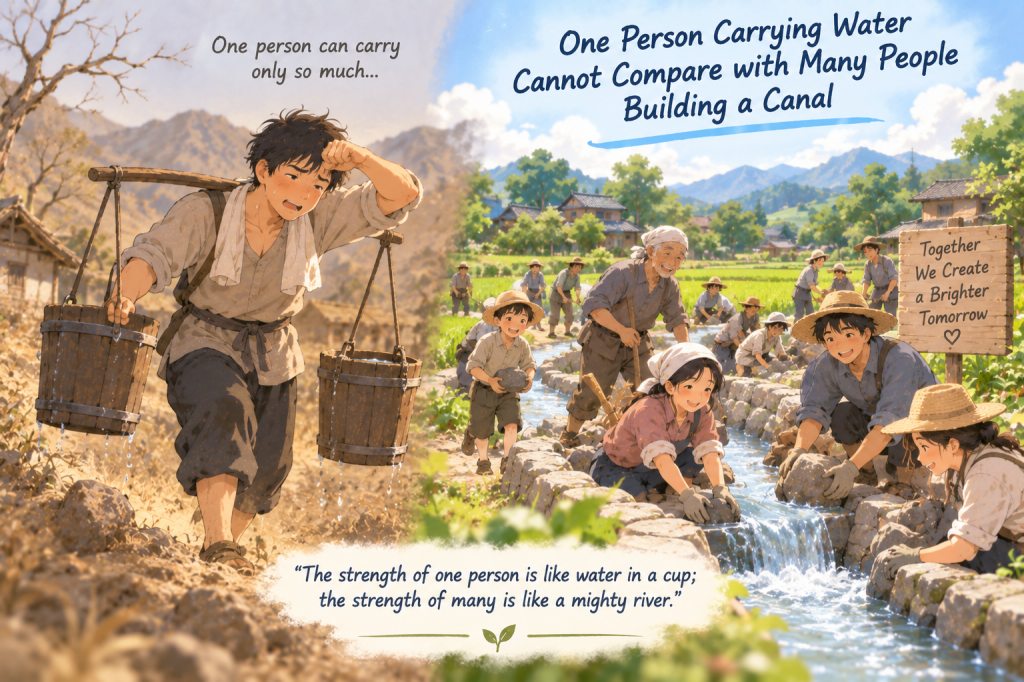
One Person Carrying Water Cannot Compare with Many People Building a Canal
Long ago, there was a mountain village that suffered from drought year after year. A remarkably strong man in the village could carry fifty loads of water each day, enough to support his own household and several neighboring families. The villagers praised him for his extraordinary strength.
But when a severe drought struck and hundreds of villagers desperately needed water, even his great strength was of little help. He broke his carrying pole and wore his shoulders raw, yet he still could not provide enough water for everyone.
Eventually, all the villagers—men and women, young and old—joined together to dig a canal, divert water, and build stone embankments. Three months later, clear water flowed into the village, and barren hillsides were transformed into fertile farmland.
The strong man sighed with realization:
“The strength of one person is like water in a cup; the strength of many is like a mighty river.”
Working Alone Cannot Compare with Advancing as a Team
At a technology company, there was a brilliant developer who independently created a piece of software with industry-leading performance. However, customers soon requested more than a hundred customized requirements. Despite working day and night, he was able to complete only a fraction of them.
The company later assembled a team. Some members specialized in interface design, others optimized algorithms, while still others communicated directly with customers. Within only three months, the team released multiple improved versions, and the company’s market share tripled.
The talented developer became thoroughly convinced of the power of teamwork:
“No matter how fast one person can run, he cannot outrun the wheels of a team moving together.”
One Pair of Hands Is Not Enough; United Effort Is Far Stronger
“I am only one matchstick. I can illuminate only a small corner.”
This was the realization of a doctor who collapsed from exhaustion during an epidemic. He had worked continuously for 72 hours, treating dozens of patients, and people called him an “iron man.”
But when the number of infections surged into the thousands, his strength finally gave out, and he collapsed beside a hospital bed.
Soon afterward, medical workers, volunteers, logistics personnel, and community workers arrived from across the country in great numbers. Together, they built temporary medical facilities, delivered essential supplies, conducted screenings, and eventually brought the outbreak under control.
Reflecting on this, the doctor said:
“Only when countless matchsticks burn together can they illuminate an entire city.”
No matter how strong one person may be, that individual cannot surpass the strength created when many hearts unite. A single drop of water may seem insignificant, but countless drops come together to form an ocean. A handful of earth may seem inconsequential, but countless handfuls can rise into a mountain.
The principle expressed by the Buddha in the words, “A city does not need all the food a province produces, but that much food is far from enough to feed the whole country,” teaches us precisely this: the strength of an individual will eventually reach its limit, but when the strength of many is united, tremendous power can arise.
Yet if we wish to investigate more deeply and seek greater truths, we should seek them within the True Buddha Dharma expounded by Namo H.H. Dorje Chang Buddha III.
Alone, one may travel quickly; together, many can travel far. The strength of one is limited; the strength of many is great.
May we cherish the light that each individual can offer while also understanding the importance of bringing together the flames of many. With our actions and with our hearts, may we put into practice the path of benefiting others.