
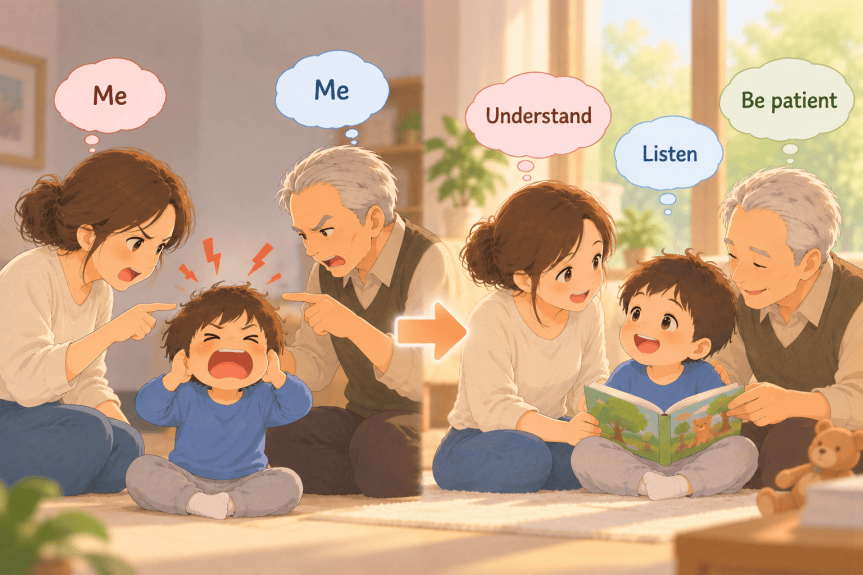
When We Put “Me” at the Center, We Inevitably Find Things Hard to Accept, Hard to Hear, and Hard to Understand
A close friend once complained to me about her child.
“My child is driving me crazy! He’s only four or five years old, yet he can already turn the whole household upside down!”
I asked, “What happened?”
She said, “He refuses to eat properly. After mealtime is over, he goes looking for cold leftovers. He wants to play until midnight, and if we refuse to play with him, he hits us—and he hits hard. Lately, he has been coughing constantly and has eczema all over his body. He has practically become a regular at the hospital…”
His eating habits were irregular, his sleep schedule was irregular, and he loved eating cold foods. With habits like these affecting his digestive health, how could he not get sick?

I then asked, “Do you often hit him? Is that why he has learned to hit others?”
“Ah,” she sighed. “My father believes in strict discipline and corporal punishment. Whenever the child misbehaves, Grandpa gives him a good spanking. I’ve tried talking to my father and asking him not to hit the child so much, but he won’t listen. As a result, the more the child is hit, the more unruly he becomes, and the more unruly he becomes, the more he gets hit. By the time I come home from work, I’m completely exhausted by all of this. Now even my father and I get upset with each other over the smallest things. We find each other’s behavior hard to accept, each other’s words hard to hear, and each other’s thinking impossible to understand…”

I couldn’t help but sympathize with my friend. Her child had not even reached the stage when she would have to help him with schoolwork, yet the household was already in complete chaos.
As the saying goes, “It takes ten years to grow a tree, but a hundred years to nurture a person.” Raising and educating a child is truly no easy task. When family members disagree about how a child should be raised, conflict is almost inevitable.
For many years, educators have advocated encouragement and positive reinforcement rather than corporal punishment. We cannot truly win people over through force; we need to reason with them and reach them through understanding and compassion. Two generations have different life experiences, levels of education, personalities, and understandings of life. Naturally, their approaches to raising a child can be very different. One wants strict and forceful discipline, while the other favors a gentle and patient approach. In the end, neither approach is carried out effectively, and the two sides only grow increasingly frustrated with each other.
But do situations in which people find one another “hard to accept, hard to listen to, and hard to understand” exist only between fathers and daughters? Of course not. Conflicts arise between husbands and wives, relatives and friends, coworkers, classmates, people from the same hometown, and even complete strangers.
Two of my coworkers once had a disagreement over a work assignment.
Coworkers A and B were responsible for producing the company magazine. A handled planning, editing, proofreading, and communication with the printing company, while B was responsible only for layout and typesetting. Because they were rushing to meet the deadline, A reviewed three rounds of proofs, checked the sample copy, and then authorized printing.

The following day, A looked through the sample again and discovered that the month printed on the cover was incorrect. During proofreading, A had already asked B to correct it. However, B had carelessly failed to properly save the final revised file, so the error remained. At the same time, A had also failed to notice the mistake when reviewing the sample copy.

When they contacted the printing company again, they learned that the company magazine was already being printed. Reprinting the cover would require additional expense. And so, a loss that should never have occurred was incurred.

A blamed B: “Why didn’t you properly save the file after making the correction? Why didn’t you take responsibility for your work?”

B, in turn, blamed A: “Why didn’t you carefully check the sample?”

Each found fault with the other. Neither wanted to hear what the other had to say, and neither could understand how the other could have been so careless.
In fact, both of these real-life situations—the disagreement between father and daughter over how to raise the child and the conflict between coworkers caused by a lack of carefulness—stemmed from putting “me” at the center.
The grandfather thought, “If my grandson doesn’t behave, he needs to be disciplined physically. After all, this is how I raised several children.”
The mother thought, “When my son misbehaves, adults should reason with him. We shouldn’t substitute punishment for proper guidance. We should teach him gently and patiently.”
And what about the two coworkers?
One thought, “I already checked everything thoroughly.”
The other thought, “You were the one who failed to check carefully.”
Because they failed to cooperate effectively, mistakes naturally occurred.
Yet the father and daughter actually shared the same goal: to raise the child well.
And the two coworkers also shared the same goal: to produce the magazine well.
The attitude of “I don’t care what you think; what matters is what I think” places the self above everything else.
If people want to live together harmoniously, they need to learn to put themselves in one another’s shoes. If the grandfather listened to his daughter’s suggestion to use gentleness rather than force, and if the daughter communicated more patiently with her elderly father about ways of educating the child, wouldn’t their relationship become more harmonious?
Likewise, if the two coworkers showed greater understanding toward each other’s responsibilities, reminded one another when necessary, and complemented each other’s work, wouldn’t they be able to accomplish the task successfully? What would there be to argue about?
As Namo H.H. Dorje Chang Buddha III said:
“A protracted dispute is wrong on both sides. Why? Entangled in such a dispute, both sides see only the faults of the opposing party and the merits of his own. Continuing dispute will but increase the wrongdoing. When one realizes that the other party is as annoyed as he is, one is apt to withdraw from the dispute.”
By letting go of attachment to the self and our own views, and by learning to be tolerant and understanding of one another, we become able to listen to other people’s opinions and recognize their strengths. In this way, we can gradually move from stubbornly clinging to our own views toward accepting and appreciating others.
Always remember: “I” am not the measure of the world.
If we always put “me” first in everything, we are simply creating trouble for ourselves. Instead, we should think: I am a Buddhist practitioner who still has much to be ashamed of. I still have many shortcomings and faults. I should learn more from the strengths of others and spend less time looking for their faults.
As the saying goes:
“The sea is vast because it embraces hundreds of rivers; a person is great because of the capacity to be tolerant.”
When we broaden our hearts and minds, expand our perspective, and elevate our moral character, our work and our lives can proceed more smoothly. We can gradually move away from selfish attachment to the self and toward benefiting both ourselves and others.
Isn’t letting go of the constant focus on “me” itself part of cultivation?
Written by: He Suoyou
Link: https://myhappylifestyle.net/2026/09/28/dorjechangbuddhaiii-when-we-put-me-at-the-center/
#DorjeChangBuddhaIII #Spirituality #Buddha #Buddhism

