

How Great Is the Power of One Person?

How Great Is the Power of One Person?

Namo H.H. Dorje Chang Buddha III once expounded the Dharma:

“A city does not need all the food a province produces, but that much food is far from enough to feed the whole country; it needs all the food the country can produce. The strength of an individual is nothing compared with collective strength.”

The meaning of this principle is that the size, corresponding energy, and function of all things in the world are relative and can be understood through comparison. Without comparison, we cannot discern what is large or small, nor can we understand the principles governing their appropriate application.

For example, if the farmland of an entire province were used to support only one city, it would seem vast and abundant. However, if an entire country had to depend on the farmland of just that one province, it would be insufficient to meet the needs of its people. Thus, the people of a nation require the land and resources of a nation to sustain them.

This illustrates an important principle: No matter how powerful an individual may be, and no matter how great that person’s abilities or talents are, the power of one person is ultimately limited. Only when the strength of many people is brought together can truly great power arise.

How can we better understand this principle? Let us consider several examples from everyday life.

One Person Carrying Water Cannot Compare with Many People Building a Canal
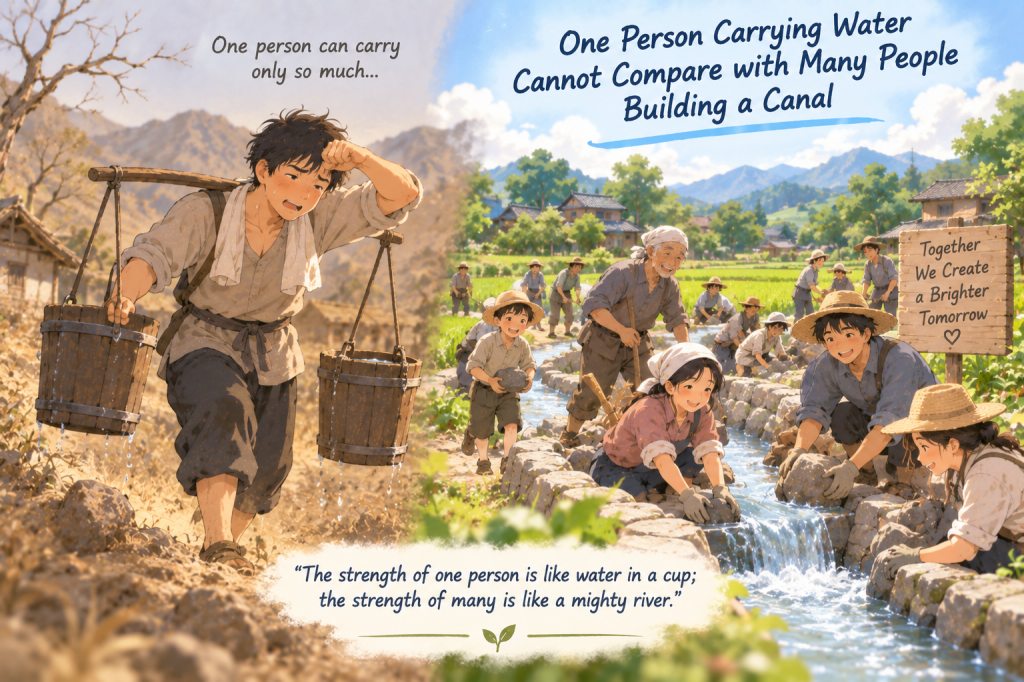
Long ago, there was a mountain village that suffered from drought year after year. A remarkably strong man in the village could carry fifty loads of water each day, enough to support his own household and several neighboring families. The villagers praised him for his extraordinary strength.

But when a severe drought struck and hundreds of villagers desperately needed water, even his great strength was of little help. He broke his carrying pole and wore his shoulders raw, yet he still could not provide enough water for everyone.

Eventually, all the villagers—men and women, young and old—joined together to dig a canal, divert water, and build stone embankments. Three months later, clear water flowed into the village, and barren hillsides were transformed into fertile farmland.

The strong man sighed with realization:

“The strength of one person is like water in a cup; the strength of many is like a mighty river.”

Working Alone Cannot Compare with Advancing as a Team

At a technology company, there was a brilliant developer who independently created a piece of software with industry-leading performance. However, customers soon requested more than a hundred customized requirements. Despite working day and night, he was able to complete only a fraction of them.

The company later assembled a team. Some members specialized in interface design, others optimized algorithms, while still others communicated directly with customers. Within only three months, the team released multiple improved versions, and the company’s market share tripled.

The talented developer became thoroughly convinced of the power of teamwork:

“No matter how fast one person can run, he cannot outrun the wheels of a team moving together.”

One Pair of Hands Is Not Enough; United Effort Is Far Stronger

“I am only one matchstick. I can illuminate only a small corner.”

This was the realization of a doctor who collapsed from exhaustion during an epidemic. He had worked continuously for 72 hours, treating dozens of patients, and people called him an “iron man.”

But when the number of infections surged into the thousands, his strength finally gave out, and he collapsed beside a hospital bed.

Soon afterward, medical workers, volunteers, logistics personnel, and community workers arrived from across the country in great numbers. Together, they built temporary medical facilities, delivered essential supplies, conducted screenings, and eventually brought the outbreak under control.

Reflecting on this, the doctor said:

“Only when countless matchsticks burn together can they illuminate an entire city.”

No matter how strong one person may be, that individual cannot surpass the strength created when many hearts unite. A single drop of water may seem insignificant, but countless drops come together to form an ocean. A handful of earth may seem inconsequential, but countless handfuls can rise into a mountain.

The principle expressed by the Buddha in the words, “A city does not need all the food a province produces, but that much food is far from enough to feed the whole country,” teaches us precisely this: the strength of an individual will eventually reach its limit, but when the strength of many is united, tremendous power can arise.

Yet if we wish to investigate more deeply and seek greater truths, we should seek them within the True Buddha Dharma expounded by Namo H.H. Dorje Chang Buddha III.

Alone, one may travel quickly; together, many can travel far.
The strength of one is limited; the strength of many is great.

May we cherish the light that each individual can offer while also understanding the importance of bringing together the flames of many. With our actions and with our hearts, may we put into practice the path of benefiting others.

By Yijie Xueren

Link: https://myhappylifestyle.net/2026/09/12/dorjechangbuddhaiii-how-great-is-the-power-of-one-person/

#DorjeChangBuddhaIII #Spirituality #Buddha #Buddhism

10 Essential Tips for Beating Jet Lag

Whether you are traveling for work, leisure, or visiting family, long-haul flights can be an amazing experience. You board a plane, watch a few movies, and before you know it, you have arrived on the other side of the world.

As exciting as long-distance travel can be, however, the disruption to your body clock can be challenging. Jet lag can leave you exhausted during the day, wide awake at night, and struggling to adjust to your new surroundings.

Fortunately, a little preparation can make a big difference. Here are 10 practical tips to help your body adjust more quickly and get your internal clock back on track.

1. Choose the Right Arrival Time

Choose the Right Arrival Time

Preparing for jet lag can begin as early as the moment you book your flight.

If you find it difficult to sleep on airplanes, consider choosing a flight that arrives at your destination in the evening. After checking into your hotel, you can go to bed at a relatively normal local bedtime.

If you usually sleep well during flights, arriving around midday may be a better choice. You will still have half a day to stay active and remind your body, “It’s time to be awake!”—even if your body thinks it is the middle of the night back home.

2. Break Up a Long Journey

Break Up a Long Journey

Generally, the more time zones you cross at once, the more noticeable jet lag can become.

If your schedule allows, consider breaking up a very long journey with a stopover. Spending a day or two somewhere between your departure point and final destination may give your body a chance to adjust gradually rather than dealing with a dramatic time change all at once.

It can also turn a long trip into an opportunity to explore another destination along the way.

3. Gradually Adjust Your Sleep and Meal Times

Gradually Adjust Your Sleep and Meal Times

A few days before departure, begin gradually shifting your sleeping schedule toward the time zone of your destination.

For example, if you normally go to bed at 11 p.m., try going to bed somewhat earlier or later each day, depending on the direction you are traveling.

You do not necessarily need to completely match your destination’s schedule before leaving. Even a modest adjustment may make the transition easier.

Changing your meal times gradually can also help your body adapt and may reduce the likelihood of becoming hungry in the middle of the night after you arrive.

4. Change Your Clock as Soon as You Board the Plane

Change Your Clock as Soon as You Board the Plane

Don’t wait until the plane lands to start thinking in your destination’s local time.

Once you are on board, change your watch and phone to the time at your destination. This can help you mentally begin adjusting to your new schedule.

If it is nighttime at your destination, try to sleep. An eye mask, earplugs, neck pillow, or other travel accessories may help create a more comfortable sleeping environment.

If it is daytime at your destination, try to remain awake. If you desperately need some rest, take a short nap rather than sleeping for several hours.

5. Try to Stay Awake Until Evening

After a long flight, especially one during which you slept poorly, your first instinct may be to go straight to bed.

However, sleeping for several hours during the daytime can make it more difficult to sleep that night and may prolong your adjustment.

Whenever possible, try to stay awake until a reasonable local bedtime.

If you are extremely tired and really need a nap, keep it relatively short so that you can still fall asleep that evening.

6. Get Plenty of Daylight

Sunlight is one of the most important signals your body uses to regulate its internal clock.

After arriving at your destination, spend some time outdoors during daylight hours. Take a walk, explore the neighborhood, or simply sit outside for a while.

Many travelers find eastward travel particularly challenging because the body often has to adjust to an earlier schedule. Exposure to daylight at appropriate times can help your internal clock begin adapting to the new time zone.

Even if you feel tired during the day, getting outside and staying moderately active can make it easier to adjust.

7. Limit Alcohol and Caffeine

When you are exhausted, it may be tempting to drink coffee to stay awake or alcohol to help you fall asleep. However, both can interfere with the quality of your sleep.

Having some coffee after arrival may be fine if it helps you remain awake during the day, but avoid caffeine too close to bedtime.

Alcohol may make you feel sleepy initially, but it can disrupt your sleep later in the night and may leave you feeling groggy the following morning.

Jet lag is uncomfortable enough on its own—you don’t need a hangover on top of it.

8. Create an Environment for a Good Night’s Sleep

When bedtime finally arrives, you may discover something frustrating: you have been sleepy all day, but suddenly you cannot fall asleep.

Try creating a calm and comfortable sleeping environment.

Put away electronic devices and give yourself 30 to 60 minutes to relax before bed. Consider using earplugs and an eye mask, closing the curtains to keep the room dark, and using a fan or another source of gentle white noise.

A quiet, dark, and comfortable room can make it easier for your body to recognize that it is finally time to sleep.

9. Get Up Early and Explore

Even if you slept for only a few hours, try to resist the temptation to stay in bed until late in the day.

Setting an alarm can help, but giving yourself a reason to get up may work even better.

Book a morning food tour, make a reservation at a popular breakfast or brunch restaurant, take an early walk, or plan a sunrise activity.

Getting outside, seeing daylight, moving your body, and interacting with other people can help reinforce your destination’s daytime schedule and encourage your body clock to adjust.

10. For Very Short Trips, Consider Keeping Your Home Schedule

For Very Short Trips, Consider Keeping Your Home Schedule

Adjusting completely to a new time zone can take several days. If you are traveling abroad for only a short period, completely shifting your body clock may not always be worthwhile—especially if you will have to readjust again immediately after returning home.

Depending on the time difference and your schedule, it may sometimes be more practical to maintain at least part of your normal routine.

For example, you might wake up unusually early at your destination or go to bed much earlier than local residents do. This approach can be particularly useful when your trip lasts only a few days.

Final Thoughts

Jet lag can make the first few days of a trip difficult, but thoughtful preparation can make the adjustment much easier.

Gradually adjusting your schedule before departure, following your destination’s local time once you board the plane, getting plenty of daylight after arrival, avoiding long daytime naps, and maintaining a consistent local bedtime can all help your body adapt.

Most importantly, give your body a little time. Before long, your internal clock should begin catching up with your new surroundings—leaving you free to enjoy your journey.

Link: https://myhappylifestyle.net/2026/09/11/10-essential-tips-for-beating-jet-lag/

#HealthyLifestyle #HealthyLife #Happylifestyle #wellness #JetLag

Finding Patience at Costco ~ A Shopping Adventure😊✨

It felt like Costco taught me: patience is good, but great service makes patience a lot easier 🙏😊.

Went to Costco today, and you know how it usually feels like a training ground for patience — carts blocking the way, everyone rushing like they’re in some Olympic event for bulk shopping 😂. Normally, I treat it like a test in self-cultivation: “Breathe…don’t get annoyed…everyone’s just trying to get their 48-pack of water bottles.”

But today was different! They had this pre-scan service before the cashier, and wow — the line moved so much faster. No waiting around forever, no cart traffic jam. The helper was so cheerful too, smiling the whole time.

waiting at the exit of Costco for the receipt check.
waiting at the exit of Costco for the receipt check

beautiful and fresh flowers at Costco

stuffs I bought at Costco

Honestly, it reminded me that good service doesn’t just speed things up — it makes the whole atmosphere lighter. Costco actually turned my grocery trip into a mini-lesson: patience is good, but friendly service makes patience a lot easier! 🙏😊

Link: https://myhappylifestyle.net/2025/09/11/finding-patience-at-costco-a-shopping-adventure%f0%9f%98%8a%e2%9c%a8/

#Costco #CostcoShopping #CustomerService #MindfulLiving #SelfCultivation #MindfulnessPractice #Patience #KindnessInAction #ShoppingExperience #EverydayMindfulness