

In Buddhist Cultivation, Never Overlook the “Drizzle” and the Butterfly Effect

In Buddhist Cultivation, Never Overlook the “Drizzle” and the Butterfly Effect

(1) A Drizzle Can Soak You Before You Realize It

There was once a young monk cultivating himself at a Buddhist temple. He tended to pay little attention to small details, believing that minor matters were insignificant.

One day, his master asked him, “Which is more likely to get you soaked—a heavy downpour or a light drizzle?”

The disciple replied without hesitation, “Master, of course a heavy downpour is more likely to soak you.”

“But in everyday life,” the master said, “people are often more likely to have their clothes soaked by a drizzle than by a downpour.”

The disciple was puzzled. “A downpour brings much more rain, while a drizzle brings very little. How could a drizzle be more likely to soak our clothes?”

The master explained:

“When a heavy rain suddenly begins, people immediately become alert. Those carrying umbrellas quickly open them, while those without umbrellas hurry beneath the eaves to take shelter.

“But when there is only a light drizzle, people may hardly notice it. Even if they do, they often think nothing of it, believing that such a small amount of rain could never soak their clothes. So they continue walking through the rain as usual. Before they realize it, their clothes are completely wet.”

The master continued:

“Cultivating ourselves and learning Buddhism is much the same. As practitioners, everything in our conduct matters—our words and actions, every gesture and movement, every facial expression, every sentence we speak, and even every thought that arises.

“These things are like a fine drizzle. They may appear insignificant, but if we fail to pay attention and remain vigilant, we may intentionally or unintentionally hurt others or cause them distress and concern. In doing so, we may accumulate negative karma without even realizing it, ultimately preventing ourselves from attaining accomplishment and liberation.”

The disciple finally understood.

The “drizzle” represents our habitual tendencies and the seemingly minor details of our cultivation. Because they appear so small, we often fail to notice them. Yet if we continually neglect them, they can undermine our cultivation, leaving our efforts fruitless and even causing us to accumulate negative karma without realizing it.

(2) The Butterfly Effect

An apparently insignificant action can sometimes trigger a chain of far-reaching consequences. This is commonly known as the “butterfly effect.”

For nearly a century, from 1908 to 2003, British cyclists had won only one Olympic gold medal and had never won the Tour de France. Their results had been so disappointing that even bicycle manufacturers were unwilling to sell bicycles to the British team.

Then, in 2003, the team brought in a new coach.

The new coach asked the athletes to seek a 1% improvement in every aspect of their training.

Some might wonder: What difference could just 1% possibly make?

Yet these seemingly tiny improvements eventually helped transform British cycling.

At the 2008 Beijing Olympic Games, British cyclists delivered an extraordinary performance in track and road cycling, winning 60 percent of the available gold medals. During the ten years from 2007 through 2017, British cyclists won 178 world championships, 66 Olympic or Paralympic gold medals, and five Tour de France victories. These achievements came to be widely regarded as one of the most remarkable periods of success in cycling history.

The same principle can be applied to our daily cultivation.

If every day we could correct our habitual tendencies and undesirable habits by just 1%, while increasing our sincerity and devotion toward Buddhas and Bodhisattvas and strengthening our compassion for living beings by 1%, then each day we would be making progress along the path toward liberation. Our learning and cultivation would inevitably bring genuine benefit.

Unfortunately, just as we tend to overlook a light drizzle, we often overlook this seemingly insignificant 1% of diligent effort and improvement.

(3) Great Virtue Is Accomplished Through the Accumulation of Small Virtues

A great wind begins with the faintest stirring of the grass; mighty waves arise from tiny ripples.

As another ancient saying warns:

“A thousand-mile dike can collapse because of an ant hole.”

There is also an ancient Chinese teaching:

“Do not commit an evil deed simply because it seems small, and do not refrain from doing a good deed simply because it seems insignificant.”

In Buddhism, there is a vow:

“I vow to eliminate all evil, leaving no evil uneliminated; I vow to cultivate all goodness, leaving no good uncultivated; I vow to liberate all living beings, leaving no living being unliberated.”

If we do not put an end to small wrongdoings and do not accumulate small acts of goodness, how can we ultimately attain the realization of the holy ones?

Many eminent Buddhist practitioners of the past have set examples for us through the meticulous attention they paid to seemingly minor aspects of their cultivation.

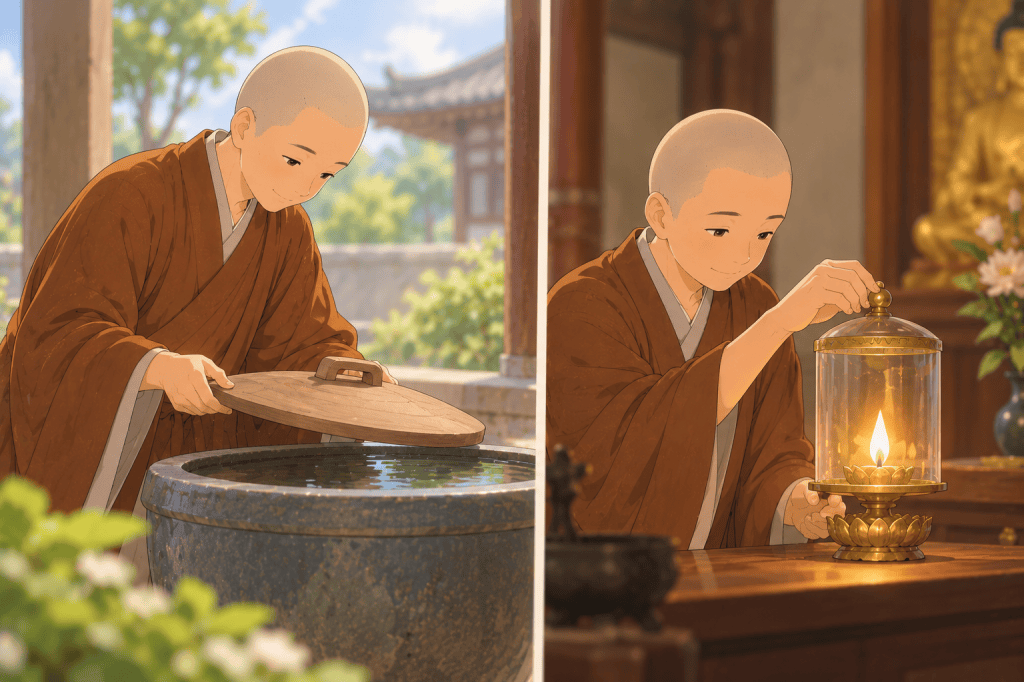
Master Yinguang was exceptionally attentive to details in his daily practice. When he lived at Fayu Temple on Mount Putuo, the basin he used for washing had a cover to prevent mosquitoes and other tiny insects from falling into the water and drowning. The oil lamp before the Buddha also had a protective cover so that moths would not fly into the flame and be burned to death.
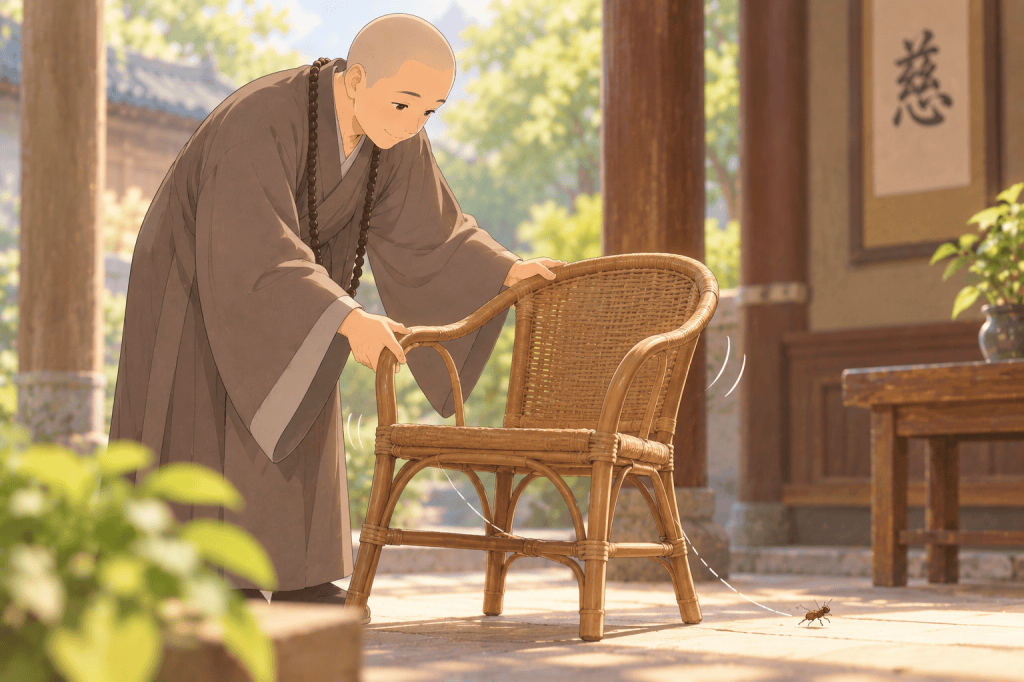
Before Master Hongyi sat down on a rattan chair, he would gently shake the chair from side to side several times. He did this to avoid harming tiny insects that might be hiding in the crevices of the chair. By moving the chair first, he was, in effect, giving these small creatures a warning and allowing them time to move away to safety.
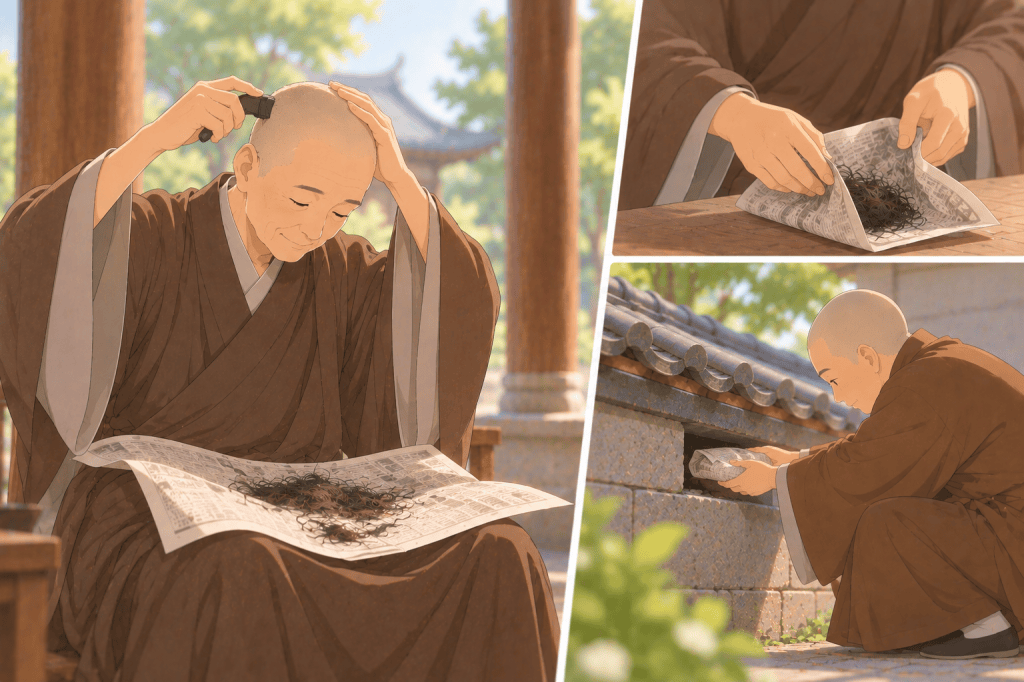
When Master Nenghai was at the Vajra Bodhimanda in Shanghai, his student, Master Dao’an, recalled that whenever Master Nenghai had his head shaved, he would not allow the cut hair to fall onto the ground. Instead, all the hair had to fall onto newspapers spread across his lap.

Afterward, the hair would be carefully wrapped in the newspaper and placed beneath roof tiles or into crevices in a wall. He did this simply to prevent strands of hair lying on the ground from injuring tiny insects.
Cultivation must begin with the smallest details.

As the saying goes:

“If one is careless about minor conduct, it will eventually impair one’s great virtue.”

This accords with one of the teachings imparted by Namo H.H. Dorje Chang Buddha III in Philosophical Sayings for Worldly Matters:

“Moral excellence is the total addition of small good deeds. Great roads are built when grains of sand are put together. To a person aspiring to become virtuous, nothing that helps is too trivial to claim his attention.”

True cultivation is reflected not only in great vows or major actions, but also in the smallest details of everyday life. A thought, a word, a facial expression, or a seemingly insignificant action may appear no more consequential than a drop of drizzle. Yet when such small causes accumulate, their effects can become profound.

Likewise, every small act of kindness, every habitual tendency we correct, and every increase in compassion may seem insignificant at the moment. But accumulated day after day, these small improvements can gradually transform our conduct and our cultivation.

Great virtue does not arise all at once. It is accomplished through the accumulation of small virtues.

Written by: Zai Lushang

Link: https://myhappylifestyle.net/2026/09/26/dorjechangbuddhaiii-in-buddhist-cultivation-never-overlook-the-drizzle/

#DorjeChangBuddhaIII #Spirituality #Buddha #Buddhism

Do Not Laugh at the Dreams of Youth

Do Not Laugh at the Dreams of Youth

Recently, I happened to come across the poem Huan Xi Sha: What I Fear Most Is Being Asked About My Original Aspirations. Reading it in middle age filled me with countless emotions, and its meaning lingered deeply in my mind. It gave me the feeling that, “When I first heard these words, I did not understand their meaning; when I heard them again, I had already become the person described in them.”

How could these few short lines not be a reflection of the life I am experiencing today?

What I fear most is being asked about my original aspirations,
Only to realize that my dreams have faded into emptiness.

In youth, I aspired to journey three thousand miles,
Yet after hesitating for a hundred steps, I had accomplished nothing.

In the blink of an eye, my parents’ hair has turned white,
While my children, still taking unsteady steps, have begun their schooling.

The need to earn a few pieces of silver hastens the passing of the years.
My heart remains young,
Yet wrinkles have quietly appeared upon my brow.

In this fleeting life, I drink and drift back into dreams.
Youth has passed, though I still feel like the person I once was.
I can only sigh at how swiftly time has flown.

Do Not Laugh at the Dreams of Youth

Zhuangzi said:

“A person’s life between heaven and earth is like a white colt glimpsed through a crack—it passes in an instant.”

Do Not Laugh at the Dreams of Youth

Looking back upon the road we have traveled, we realize that throughout our lives, we have grown, encountered countless people and experiences, and then bid them farewell one after another. Between flowers blooming and falling, countless beautiful moments have already become memories. Amid gains and losses, sorrow and joy, so much of the past has vanished like drifting clouds and smoke.

Do Not Laugh at the Dreams of Youth

As the saying goes:

The green mountains never grow old, yet I never find rest;
All my life, I toil simply to make a living.

After decades of wind and rain,
In the blink of an eye, we may already be buried beneath the earth.

I laugh because the green mountains never change,
The mountains laugh because I have already grown old.
Like an ox that toils into old age, never knowing a day of rest;
By the time rest finally comes, one has already been laid to rest in the mountains.

How many people have lived exactly this way, passing hurriedly through an entire lifetime burdened with regrets and helplessness?

Time always seems to slip away without our noticing, and often we realize its passing only afterward. There are things whose preciousness we understand only after we have completely lost them. Then we cannot stop thinking about them and regret that we did not cherish them when we had the chance.

But the years pass swiftly. How could time ever allow us to remain lost in a dream while our lives quietly grow shorter? Impermanence is the true nature of worldly existence. The past is like tea—only after tasting it do we come to understand how important it is to cherish the present.

Everything in this world that we have decided to do should be acted upon with determination. We should not postpone it until after we have rested for a while, until tomorrow, or until some future opportunity.

Nor should we allow a small setback to make us procrastinate day after day, sighing in discouragement, overwhelmed by worry, and losing our courage. If we allow ourselves to be completely defeated by setbacks, the undertaking can no longer succeed.

Therefore, when we encounter difficulties, we should promptly transform pessimism and negative emotions into strength—and replace hesitation with action.

I remember that in Journey to the West, after Sun Wukong, the Monkey King, was imprisoned beneath the Five Elements Mountain, the song Five Hundred Years of Changing Seas and Mulberry Fields expressed the following idea:

Five hundred years—the seas and fields have changed places,
Even the stubborn stone has become covered with moss.
Yet one heart has never died,
Still yearning for freedom.

Even if wildfires burn,
Even if ice and snow cover the earth,
The aspiration remains unchanged,
And faith remains unshaken.

Was it not precisely because Sun Wukong endured five hundred years of hardship without allowing his determination and longing for freedom to be extinguished that he ultimately had the opportunity to embark upon the journey to obtain the Buddhist scriptures?

Namo H.H. Dorje Chang Buddha III taught:

Once you are set to achieve a goal, pursue it with doggedness and refuse to be distracted by anything deceptively attractive. A mountain climber should not stop to pick leaves and branches on the way, or he will never reach the top. This applies to everything.

The Buddha clearly teaches us here that once a person has made a specific and proper vow and established a goal, that person should strive to bring it to fulfillment and work diligently to turn that aspiration into reality. One must not become distracted by illusory circumstances encountered along the way and consequently stop moving forward.

Those who aspire to accomplish a great undertaking and ultimately reach the summit must not waste their time plucking leaves and grasping branches halfway up the mountain. Nor should they allow themselves to be detained by an illusory city, becoming content with having reached it and no longer wishing to continue.

Do Not Laugh at the Dreams of Youth

If we stop at such an illusory city, we will never accomplish our ultimate goal, nor will we ever reach the summit.

Life continually presents us with challenges, and we learn to deal with each one as it comes. The setting sun sinks into the mountains and sea; Within them lies a profound meaning.

Looking back, we may suddenly realize that, without even noticing it, we have already endured and overcome many hardships. Through them, we have become people who can gradually heal ourselves even while struggling through moments when everything seems to be falling apart.

No matter how many setbacks we encounter or how much suffering we must endure, as long as our minds do not become attached and we face circumstances with calmness and composure, even the greatest difficulties can eventually be faced and overcome.

Author: Fuyao Zhishang

Link: https://myhappylifestyle.net/2026/09/19/dorjechangbuddhaiii-do-not-laugh-at-the-dreams-of-youth/

#DorjeChangBuddhaIII #Spirituality #Buddha #Buddhism

10 Essential Tips for Beating Jet Lag

Whether you are traveling for work, leisure, or visiting family, long-haul flights can be an amazing experience. You board a plane, watch a few movies, and before you know it, you have arrived on the other side of the world.

As exciting as long-distance travel can be, however, the disruption to your body clock can be challenging. Jet lag can leave you exhausted during the day, wide awake at night, and struggling to adjust to your new surroundings.

Fortunately, a little preparation can make a big difference. Here are 10 practical tips to help your body adjust more quickly and get your internal clock back on track.

1. Choose the Right Arrival Time

Choose the Right Arrival Time

Preparing for jet lag can begin as early as the moment you book your flight.

If you find it difficult to sleep on airplanes, consider choosing a flight that arrives at your destination in the evening. After checking into your hotel, you can go to bed at a relatively normal local bedtime.

If you usually sleep well during flights, arriving around midday may be a better choice. You will still have half a day to stay active and remind your body, “It’s time to be awake!”—even if your body thinks it is the middle of the night back home.

2. Break Up a Long Journey

Break Up a Long Journey

Generally, the more time zones you cross at once, the more noticeable jet lag can become.

If your schedule allows, consider breaking up a very long journey with a stopover. Spending a day or two somewhere between your departure point and final destination may give your body a chance to adjust gradually rather than dealing with a dramatic time change all at once.

It can also turn a long trip into an opportunity to explore another destination along the way.

3. Gradually Adjust Your Sleep and Meal Times

Gradually Adjust Your Sleep and Meal Times

A few days before departure, begin gradually shifting your sleeping schedule toward the time zone of your destination.

For example, if you normally go to bed at 11 p.m., try going to bed somewhat earlier or later each day, depending on the direction you are traveling.

You do not necessarily need to completely match your destination’s schedule before leaving. Even a modest adjustment may make the transition easier.

Changing your meal times gradually can also help your body adapt and may reduce the likelihood of becoming hungry in the middle of the night after you arrive.

4. Change Your Clock as Soon as You Board the Plane

Change Your Clock as Soon as You Board the Plane

Don’t wait until the plane lands to start thinking in your destination’s local time.

Once you are on board, change your watch and phone to the time at your destination. This can help you mentally begin adjusting to your new schedule.

If it is nighttime at your destination, try to sleep. An eye mask, earplugs, neck pillow, or other travel accessories may help create a more comfortable sleeping environment.

If it is daytime at your destination, try to remain awake. If you desperately need some rest, take a short nap rather than sleeping for several hours.

5. Try to Stay Awake Until Evening

After a long flight, especially one during which you slept poorly, your first instinct may be to go straight to bed.

However, sleeping for several hours during the daytime can make it more difficult to sleep that night and may prolong your adjustment.

Whenever possible, try to stay awake until a reasonable local bedtime.

If you are extremely tired and really need a nap, keep it relatively short so that you can still fall asleep that evening.

6. Get Plenty of Daylight

Sunlight is one of the most important signals your body uses to regulate its internal clock.

After arriving at your destination, spend some time outdoors during daylight hours. Take a walk, explore the neighborhood, or simply sit outside for a while.

Many travelers find eastward travel particularly challenging because the body often has to adjust to an earlier schedule. Exposure to daylight at appropriate times can help your internal clock begin adapting to the new time zone.

Even if you feel tired during the day, getting outside and staying moderately active can make it easier to adjust.

7. Limit Alcohol and Caffeine

When you are exhausted, it may be tempting to drink coffee to stay awake or alcohol to help you fall asleep. However, both can interfere with the quality of your sleep.

Having some coffee after arrival may be fine if it helps you remain awake during the day, but avoid caffeine too close to bedtime.

Alcohol may make you feel sleepy initially, but it can disrupt your sleep later in the night and may leave you feeling groggy the following morning.

Jet lag is uncomfortable enough on its own—you don’t need a hangover on top of it.

8. Create an Environment for a Good Night’s Sleep

When bedtime finally arrives, you may discover something frustrating: you have been sleepy all day, but suddenly you cannot fall asleep.

Try creating a calm and comfortable sleeping environment.

Put away electronic devices and give yourself 30 to 60 minutes to relax before bed. Consider using earplugs and an eye mask, closing the curtains to keep the room dark, and using a fan or another source of gentle white noise.

A quiet, dark, and comfortable room can make it easier for your body to recognize that it is finally time to sleep.

9. Get Up Early and Explore

Even if you slept for only a few hours, try to resist the temptation to stay in bed until late in the day.

Setting an alarm can help, but giving yourself a reason to get up may work even better.

Book a morning food tour, make a reservation at a popular breakfast or brunch restaurant, take an early walk, or plan a sunrise activity.

Getting outside, seeing daylight, moving your body, and interacting with other people can help reinforce your destination’s daytime schedule and encourage your body clock to adjust.

10. For Very Short Trips, Consider Keeping Your Home Schedule

For Very Short Trips, Consider Keeping Your Home Schedule

Adjusting completely to a new time zone can take several days. If you are traveling abroad for only a short period, completely shifting your body clock may not always be worthwhile—especially if you will have to readjust again immediately after returning home.

Depending on the time difference and your schedule, it may sometimes be more practical to maintain at least part of your normal routine.

For example, you might wake up unusually early at your destination or go to bed much earlier than local residents do. This approach can be particularly useful when your trip lasts only a few days.

Final Thoughts

Jet lag can make the first few days of a trip difficult, but thoughtful preparation can make the adjustment much easier.

Gradually adjusting your schedule before departure, following your destination’s local time once you board the plane, getting plenty of daylight after arrival, avoiding long daytime naps, and maintaining a consistent local bedtime can all help your body adapt.

Most importantly, give your body a little time. Before long, your internal clock should begin catching up with your new surroundings—leaving you free to enjoy your journey.

Link: https://myhappylifestyle.net/2026/09/11/10-essential-tips-for-beating-jet-lag/

#HealthyLifestyle #HealthyLife #Happylifestyle #wellness #JetLag

There Is No Generation Gap—Am I the North Wind or the Sun?

There Is No Generation Gap—Am I the North Wind or the Sun?

There is a saying: “If you have never experienced what others have gone through, do not be quick to judge their faults. If you have never endured their suffering, do not be quick to tell them how they should behave. If you had suffered what I have suffered, you might not have done any better than I did.” Such a simple truth—yet I never realized how poorly I had practiced it in the past.

Ever since I was young, my father had raised me with a strict and authoritative approach. This was very different from my relationship with my mother, with whom I always seemed to have endless things to talk about.

As I grew older, friction between my parents gradually increased, leaving many negative impressions deeply embedded in my mind. My father and I rarely talked. Whenever my parents had a disagreement, I invariably took my mother’s side without trying to view the situation objectively. As a result, my misunderstandings of my father grew deeper and deeper.

During the years when I suffered most severely from illness, my father took care of me tirelessly and without complaint. Although I was deeply moved by everything he did for me, for some reason I could never let go of the memories of his arguments with my mother. Deep inside, I still harbored resentment toward him.

After my mother passed away, my father was overwhelmed with grief. Yet he often pulled himself together to encourage me, simply because he was afraid that remembering my mother would make me sad and bring me to tears.

Now that only my father and I remained to keep each other company, the awkwardness of having so little to talk about became even more apparent. Sometimes when I accompanied him on walks, I would become impatient when he repeatedly talked about things from the past. Although this was his way of expressing his emotions, I failed to recognize the helplessness and loneliness hidden behind his words.

Instead, I behaved almost like a fault-finding inspector. Even as I listened to him, I would contradict or correct him. Our conversations would often end with him saying, “If you don’t like talking to me, at least don’t lose your temper with me!”

I do not know how many times this pattern repeated itself. Then one day, I suddenly became alarmed by my own conduct. I realized what an inconsiderate daughter I had been. I had continued to hold on to the painful memories of my parents’ arguments, and because of that, I had never truly listened to what was in my father’s heart.

I began to think: We can change ourselves without demanding that others change, can’t we? Moreover, how could I possibly understand all the causes and conditions underlying the relationship between my parents?

I therefore resolved to become a gentler and more understanding daughter. I began training myself to truly listen, to let go of the burdens and attachments of the past, and to sincerely fulfill my filial duty toward my father.

It reminded me of Aesop’s famous fable, “The North Wind and the Sun.” I was determined to be the sun!

Gradually, my relationship with my father became more and more harmonious. Whenever I am not by his side, I call him at a regular time each day to see how he is doing. When I return home, I also make an effort to spend more time talking with him. Over time, my father has come to feel that I genuinely care about him.

My father and I had once been almost like strangers, but now we live together in harmony. I deeply understand that this transformation came about through genuinely learning and practicing Buddhism. It is also a result of frequently listening respectfully to the Dharma discourses expounded by Namo H.H. Dorje Chang Buddha III, through which I received purification and blessings.

The Buddha Dharma exists in this world and is inseparable from awakening within this world. There is no knot in life that cannot be untied. What matters is whether we are willing to let go of our attachments and make the change.

Link: https://myhappylifestyle.net/2026/09/08/there-is-no-generation-gap-am-i-the-north-wind-or-the-sun/

#DorjeChangBuddhaIII #Spirituality #Buddha #Buddhism

Positive energy quotes | Know Yourself and Bring it to a higher level

Positive energy quotes | Know Yourself and Bring it to a higher level

Positive energy quotes | Know Yourself and Bring it to a higher level

Video Link: https://www.youtube.com/watch?v=uLYKDgfqrbA

Link: https://myhappylifestyle.net/2021/09/23/positive-energy-quotes-know-yourself-and-bring-it-to-a-higher-level/

Welcome to subscribe~ https://www.youtube.com/channel/UCIsELxUClSUnGBXdzRxrrQA?sub_confirmation=1

#PositiveQuotes #PositiveEnergyQuotes #PositiveEnergy #SelfMotivation #shortcomings #excuse #forgive #Forgiveness #SelfReflect #Mistake #humility #respect #SelfImprovement

Know Yourself and Bring Yourself to a Higher Level.

Know Yourself and Bring Yourself to a Higher Level.

       Do we really know ourselves? A fact we all have not found: We often cannot see our own mistakes and shortcomings. Even if we have noticed one, we will find excuses and forgive ourselves. It is hard for us to visualize how we are in others’ eyes. It is as if you cannot see your back. No matter what methods you try, you will never be able to turn your head all around. Yet others can see your back clearly. Applying the same principle, it is very difficult for us to find our mistakes and shortcomings, yet they are in plain sight for others.  


 If we can self-reflect and become aware of our shortcomings, know what mistakes we have made, do not deny them, instead we face ourselves and seek to know more with humility in order to correct our mistakes and shortcomings, we naturally will bring our level up. As a result, we will also receive respect from others.  Others then are willing to help us. Therefore, only when we truly know ourselves can we develop our character. Only when we have developed our character can we then gain support from others. Everything in the world will then move on well.

Know Yourself and Bring Yourself to a Higher Level.

Link: https://myhappylifestyle.net/2021/09/14/know-yourself-and-bring-yourself-to-a-higher-level/

#PositiveEnergy #PositiveQuotes #PositiveEnergyQuotes #motivation #SelfMotivation #SelfImprovement #Mistakes #Shortcomings #Forgiveness #SelfReflect #humility #respect