In Buddhist Cultivation, Never Overlook the “Drizzle” and the Butterfly Effect

In Buddhist Cultivation, Never Overlook the “Drizzle” and the Butterfly Effect

(1) A Drizzle Can Soak You Before You Realize It

There was once a young monk cultivating himself at a Buddhist temple. He tended to pay little attention to small details, believing that minor matters were insignificant.

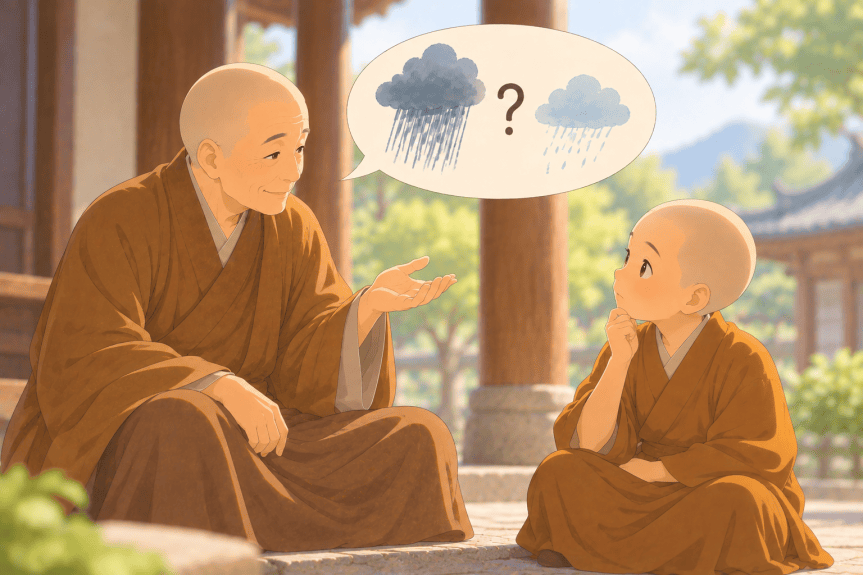
One day, his master asked him, “Which is more likely to get you soaked—a heavy downpour or a light drizzle?”

The disciple replied without hesitation, “Master, of course a heavy downpour is more likely to soak you.”

“But in everyday life,” the master said, “people are often more likely to have their clothes soaked by a drizzle than by a downpour.”

The disciple was puzzled. “A downpour brings much more rain, while a drizzle brings very little. How could a drizzle be more likely to soak our clothes?”
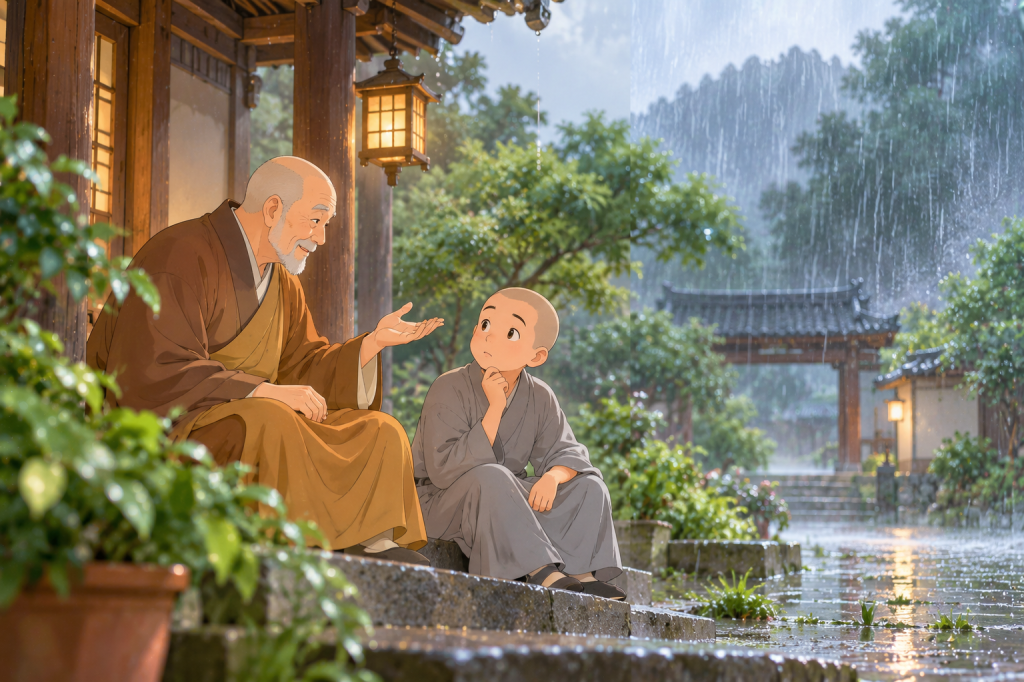
The master explained:

“When a heavy rain suddenly begins, people immediately become alert. Those carrying umbrellas quickly open them, while those without umbrellas hurry beneath the eaves to take shelter.

“But when there is only a light drizzle, people may hardly notice it. Even if they do, they often think nothing of it, believing that such a small amount of rain could never soak their clothes. So they continue walking through the rain as usual. Before they realize it, their clothes are completely wet.”
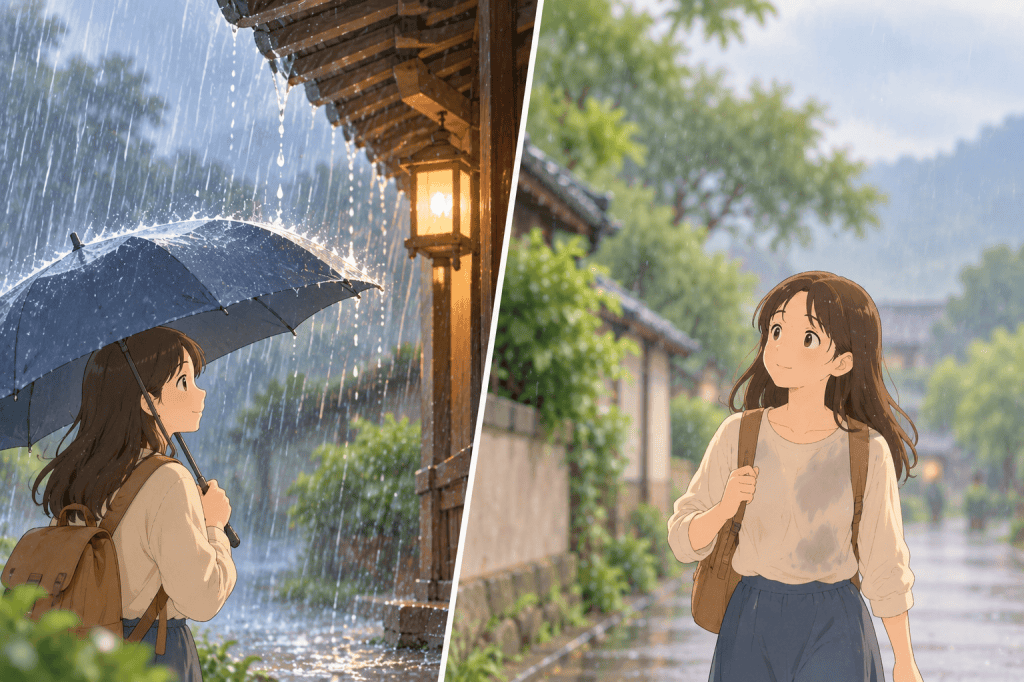
The master continued:

“Cultivating ourselves and learning Buddhism is much the same. As practitioners, everything in our conduct matters—our words and actions, every gesture and movement, every facial expression, every sentence we speak, and even every thought that arises.

“These things are like a fine drizzle. They may appear insignificant, but if we fail to pay attention and remain vigilant, we may intentionally or unintentionally hurt others or cause them distress and concern. In doing so, we may accumulate negative karma without even realizing it, ultimately preventing ourselves from attaining accomplishment and liberation.”

The disciple finally understood.

The “drizzle” represents our habitual tendencies and the seemingly minor details of our cultivation. Because they appear so small, we often fail to notice them. Yet if we continually neglect them, they can undermine our cultivation, leaving our efforts fruitless and even causing us to accumulate negative karma without realizing it.

(2) The Butterfly Effect

An apparently insignificant action can sometimes trigger a chain of far-reaching consequences. This is commonly known as the “butterfly effect.”

For nearly a century, from 1908 to 2003, British cyclists had won only one Olympic gold medal and had never won the Tour de France. Their results had been so disappointing that even bicycle manufacturers were unwilling to sell bicycles to the British team.

Then, in 2003, the team brought in a new coach.

The new coach asked the athletes to seek a 1% improvement in every aspect of their training.

Some might wonder: What difference could just 1% possibly make?

Yet these seemingly tiny improvements eventually helped transform British cycling.

At the 2008 Beijing Olympic Games, British cyclists delivered an extraordinary performance in track and road cycling, winning 60 percent of the available gold medals. During the ten years from 2007 through 2017, British cyclists won 178 world championships, 66 Olympic or Paralympic gold medals, and five Tour de France victories. These achievements came to be widely regarded as one of the most remarkable periods of success in cycling history.

The same principle can be applied to our daily cultivation.

If every day we could correct our habitual tendencies and undesirable habits by just 1%, while increasing our sincerity and devotion toward Buddhas and Bodhisattvas and strengthening our compassion for living beings by 1%, then each day we would be making progress along the path toward liberation. Our learning and cultivation would inevitably bring genuine benefit.

Unfortunately, just as we tend to overlook a light drizzle, we often overlook this seemingly insignificant 1% of diligent effort and improvement.

(3) Great Virtue Is Accomplished Through the Accumulation of Small Virtues

A great wind begins with the faintest stirring of the grass; mighty waves arise from tiny ripples.

As another ancient saying warns:

“A thousand-mile dike can collapse because of an ant hole.”

There is also an ancient Chinese teaching:

“Do not commit an evil deed simply because it seems small, and do not refrain from doing a good deed simply because it seems insignificant.”

In Buddhism, there is a vow:

“I vow to eliminate all evil, leaving no evil uneliminated; I vow to cultivate all goodness, leaving no good uncultivated; I vow to liberate all living beings, leaving no living being unliberated.”

If we do not put an end to small wrongdoings and do not accumulate small acts of goodness, how can we ultimately attain the realization of the holy ones?

Many eminent Buddhist practitioners of the past have set examples for us through the meticulous attention they paid to seemingly minor aspects of their cultivation.

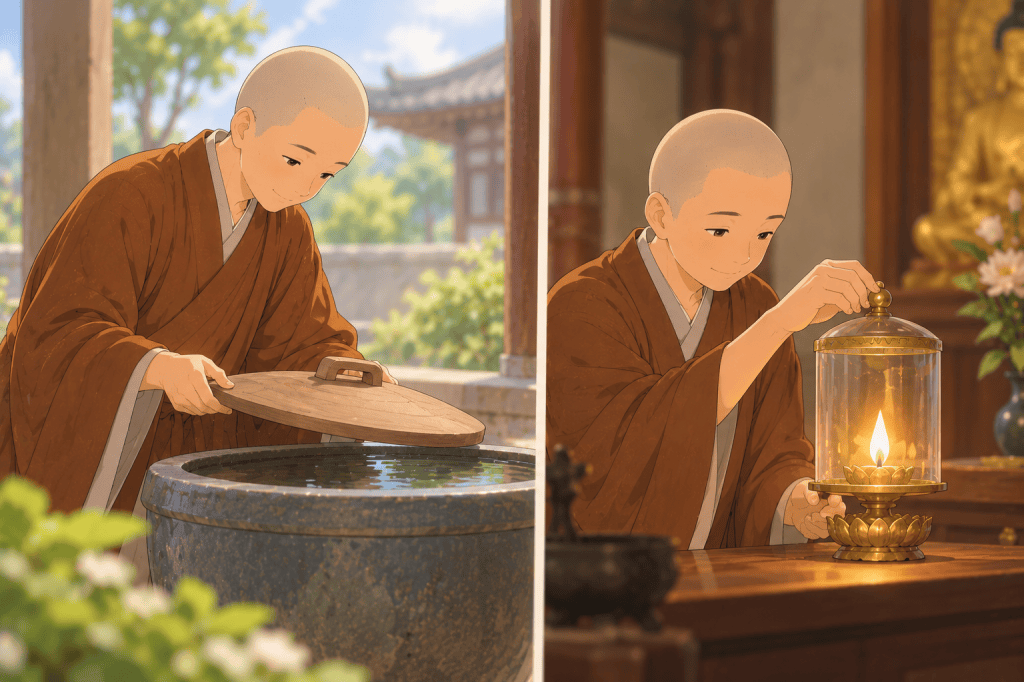
Master Yinguang was exceptionally attentive to details in his daily practice. When he lived at Fayu Temple on Mount Putuo, the basin he used for washing had a cover to prevent mosquitoes and other tiny insects from falling into the water and drowning. The oil lamp before the Buddha also had a protective cover so that moths would not fly into the flame and be burned to death.
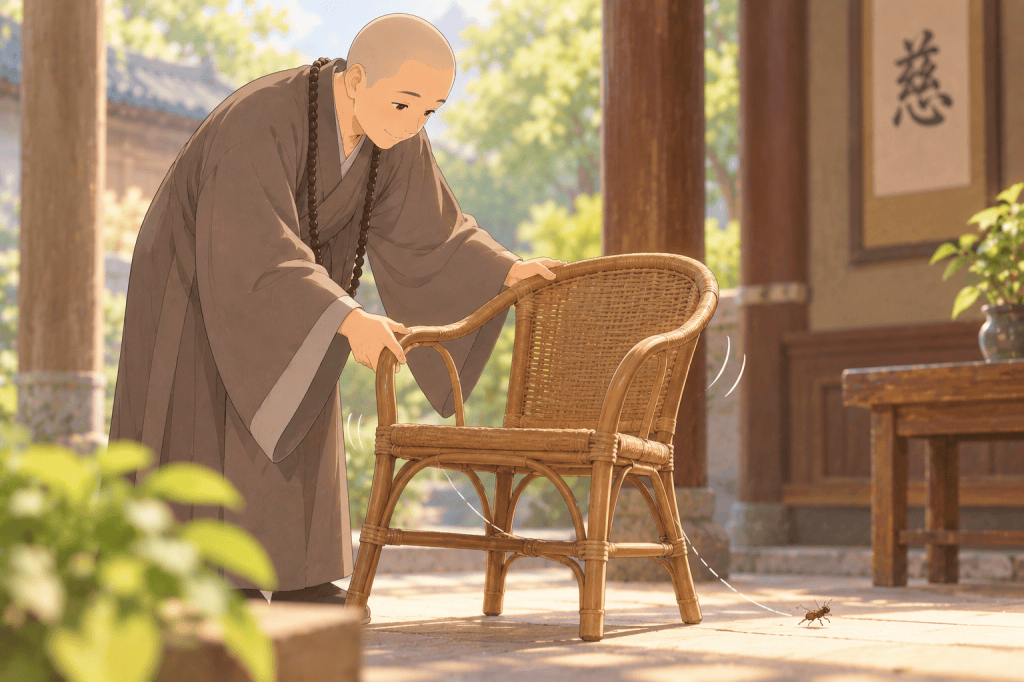
Before Master Hongyi sat down on a rattan chair, he would gently shake the chair from side to side several times. He did this to avoid harming tiny insects that might be hiding in the crevices of the chair. By moving the chair first, he was, in effect, giving these small creatures a warning and allowing them time to move away to safety.
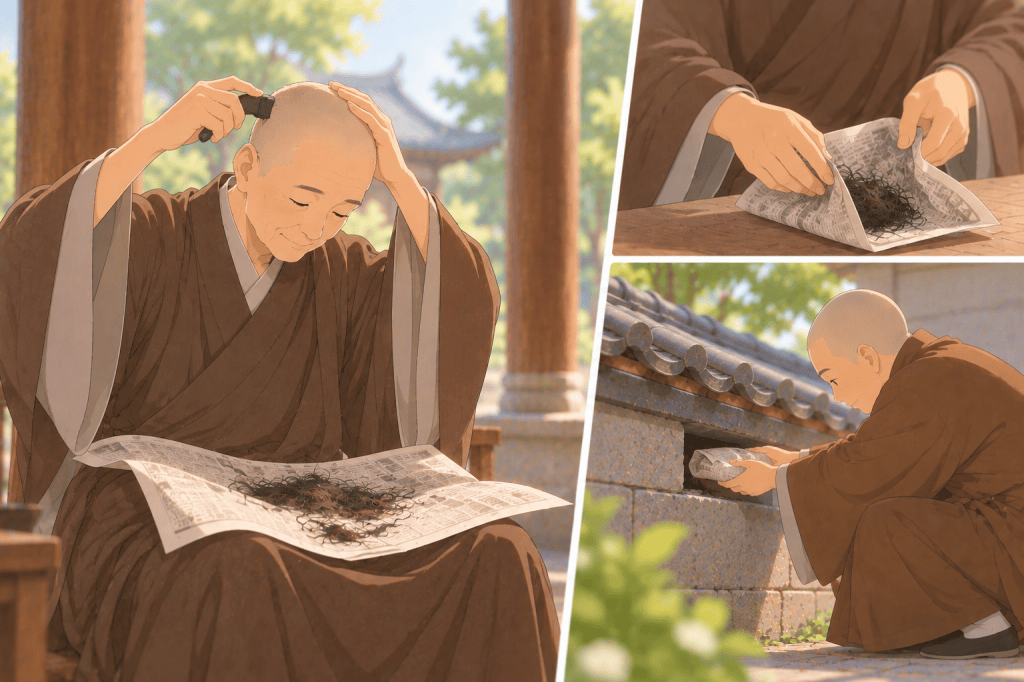
When Master Nenghai was at the Vajra Bodhimanda in Shanghai, his student, Master Dao’an, recalled that whenever Master Nenghai had his head shaved, he would not allow the cut hair to fall onto the ground. Instead, all the hair had to fall onto newspapers spread across his lap.

Afterward, the hair would be carefully wrapped in the newspaper and placed beneath roof tiles or into crevices in a wall. He did this simply to prevent strands of hair lying on the ground from injuring tiny insects.
Cultivation must begin with the smallest details.

As the saying goes:

“If one is careless about minor conduct, it will eventually impair one’s great virtue.”

This accords with one of the teachings imparted by Namo H.H. Dorje Chang Buddha III in Philosophical Sayings for Worldly Matters:

“Moral excellence is the total addition of small good deeds. Great roads are built when grains of sand are put together. To a person aspiring to become virtuous, nothing that helps is too trivial to claim his attention.”

True cultivation is reflected not only in great vows or major actions, but also in the smallest details of everyday life. A thought, a word, a facial expression, or a seemingly insignificant action may appear no more consequential than a drop of drizzle. Yet when such small causes accumulate, their effects can become profound.

Likewise, every small act of kindness, every habitual tendency we correct, and every increase in compassion may seem insignificant at the moment. But accumulated day after day, these small improvements can gradually transform our conduct and our cultivation.

Great virtue does not arise all at once. It is accomplished through the accumulation of small virtues.

Written by: Zai Lushang

Link: https://myhappylifestyle.net/2026/09/26/dorjechangbuddhaiii-in-buddhist-cultivation-never-overlook-the-drizzle/

#DorjeChangBuddhaIII #Spirituality #Buddha #Buddhism
There Is No Generation Gap—Am I the North Wind or the Sun?

There Is No Generation Gap—Am I the North Wind or the Sun?

There is a saying: “If you have never experienced what others have gone through, do not be quick to judge their faults. If you have never endured their suffering, do not be quick to tell them how they should behave. If you had suffered what I have suffered, you might not have done any better than I did.” Such a simple truth—yet I never realized how poorly I had practiced it in the past.

Ever since I was young, my father had raised me with a strict and authoritative approach. This was very different from my relationship with my mother, with whom I always seemed to have endless things to talk about.

As I grew older, friction between my parents gradually increased, leaving many negative impressions deeply embedded in my mind. My father and I rarely talked. Whenever my parents had a disagreement, I invariably took my mother’s side without trying to view the situation objectively. As a result, my misunderstandings of my father grew deeper and deeper.

During the years when I suffered most severely from illness, my father took care of me tirelessly and without complaint. Although I was deeply moved by everything he did for me, for some reason I could never let go of the memories of his arguments with my mother. Deep inside, I still harbored resentment toward him.

After my mother passed away, my father was overwhelmed with grief. Yet he often pulled himself together to encourage me, simply because he was afraid that remembering my mother would make me sad and bring me to tears.

Now that only my father and I remained to keep each other company, the awkwardness of having so little to talk about became even more apparent. Sometimes when I accompanied him on walks, I would become impatient when he repeatedly talked about things from the past. Although this was his way of expressing his emotions, I failed to recognize the helplessness and loneliness hidden behind his words.

Instead, I behaved almost like a fault-finding inspector. Even as I listened to him, I would contradict or correct him. Our conversations would often end with him saying, “If you don’t like talking to me, at least don’t lose your temper with me!”

I do not know how many times this pattern repeated itself. Then one day, I suddenly became alarmed by my own conduct. I realized what an inconsiderate daughter I had been. I had continued to hold on to the painful memories of my parents’ arguments, and because of that, I had never truly listened to what was in my father’s heart.

I began to think: We can change ourselves without demanding that others change, can’t we? Moreover, how could I possibly understand all the causes and conditions underlying the relationship between my parents?

I therefore resolved to become a gentler and more understanding daughter. I began training myself to truly listen, to let go of the burdens and attachments of the past, and to sincerely fulfill my filial duty toward my father.

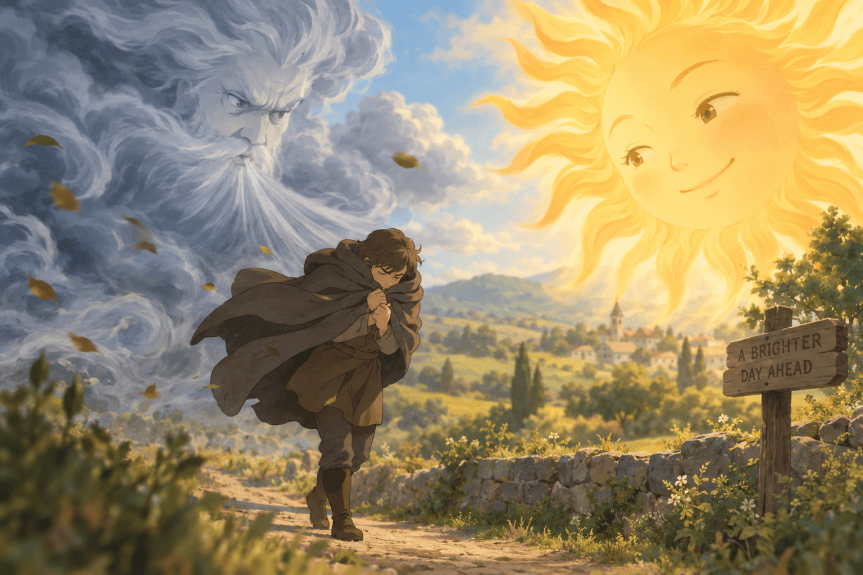
It reminded me of Aesop’s famous fable, “The North Wind and the Sun.” I was determined to be the sun!

Gradually, my relationship with my father became more and more harmonious. Whenever I am not by his side, I call him at a regular time each day to see how he is doing. When I return home, I also make an effort to spend more time talking with him. Over time, my father has come to feel that I genuinely care about him.

My father and I had once been almost like strangers, but now we live together in harmony. I deeply understand that this transformation came about through genuinely learning and practicing Buddhism. It is also a result of frequently listening respectfully to the Dharma discourses expounded by Namo H.H. Dorje Chang Buddha III, through which I received purification and blessings.

The Buddha Dharma exists in this world and is inseparable from awakening within this world. There is no knot in life that cannot be untied. What matters is whether we are willing to let go of our attachments and make the change.

Link: https://myhappylifestyle.net/2026/09/08/there-is-no-generation-gap-am-i-the-north-wind-or-the-sun/

#DorjeChangBuddhaIII #Spirituality #Buddha #Buddhism

When I Came to Understand the Pain Deep Within My Mother’s Heart

When I Came to Understand the Pain Deep Within My Mother’s Heart

Through participating in group study, respectfully and deeply listening to the Dharma discourses expounded by my Buddha Master, Namo H.H. Dorje Chang Buddha III, and sharing what I had learned with others, I gradually came to understand and feel the pain deep within my mother’s heart.

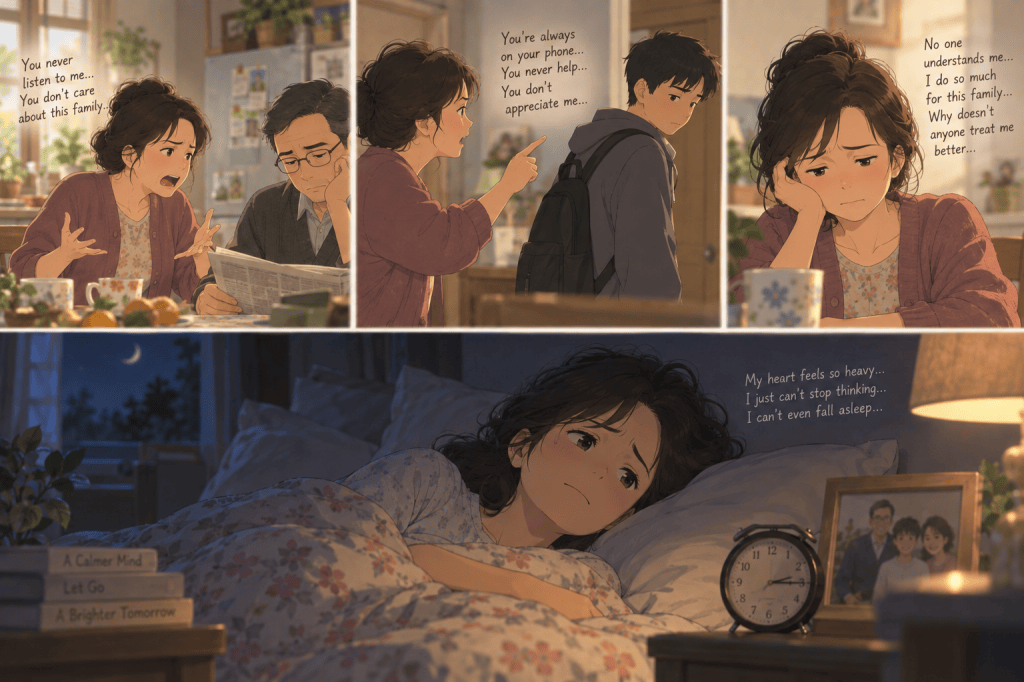
For as long as I can remember, my parents were constantly arguing. During holidays and festivals in particular, our home would become filled with tension. After an argument, my mother would always wear a stern expression and remain silent, while my father would sigh repeatedly, not knowing what to do.

After encountering the Tathagata’s True Dharma taught by H.H. Dorje Chang Buddha III, I wanted to resolve a question that had puzzled me for a long time: My mother had everything she needed in terms of food and clothing and was free from serious illness or misfortune, so why did she complain every day? She would either say that my father did not treat her well or feel that my younger brother and his wife did not treat her well. She would become so upset that she sometimes could not sleep all night.

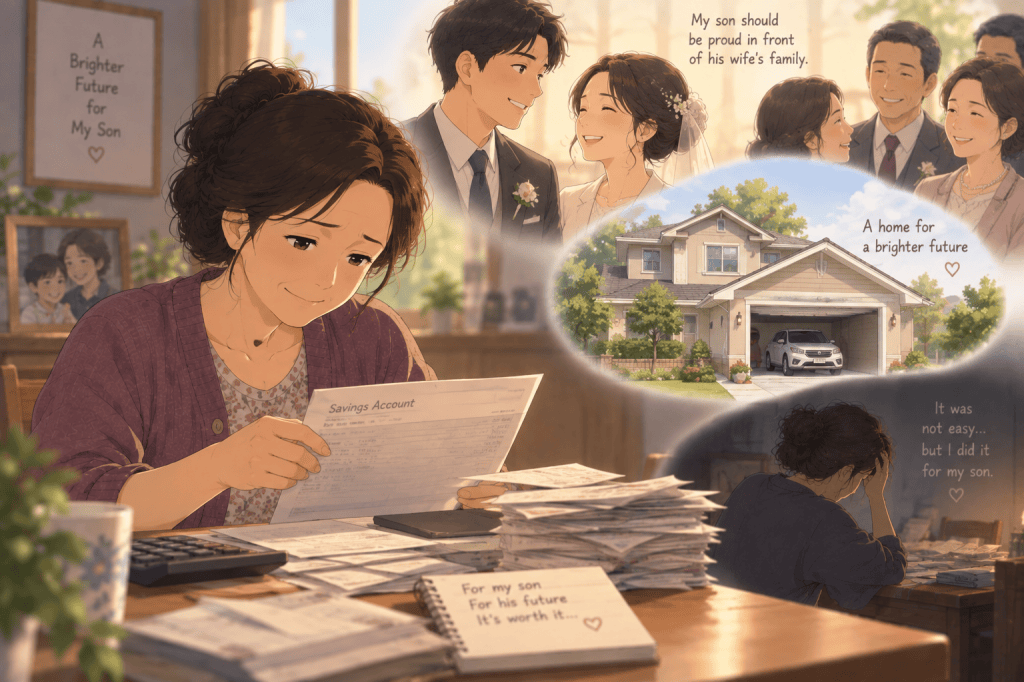
My mother cared greatly about maintaining appearances, even when doing so caused her hardship. She especially doted on my younger brother, whom she treasured dearly. To ensure that he could hold his head high in front of his wife’s family, my mother used almost all of her savings to buy them a home and a garage.

Whenever there was an important occasion or even a smaller matter involving my sister-in-law’s family, my mother always handled everything generously and properly. She would rather live frugally herself than allow my brother to lose face.

Yet despite all she had done, my brother seldom contacted her. Although they lived in the same city, he rarely checked in on her, much less came to see her. I could feel how deeply my mother missed her son. She would often ask me, “I wonder what your brother has been so busy with lately?”

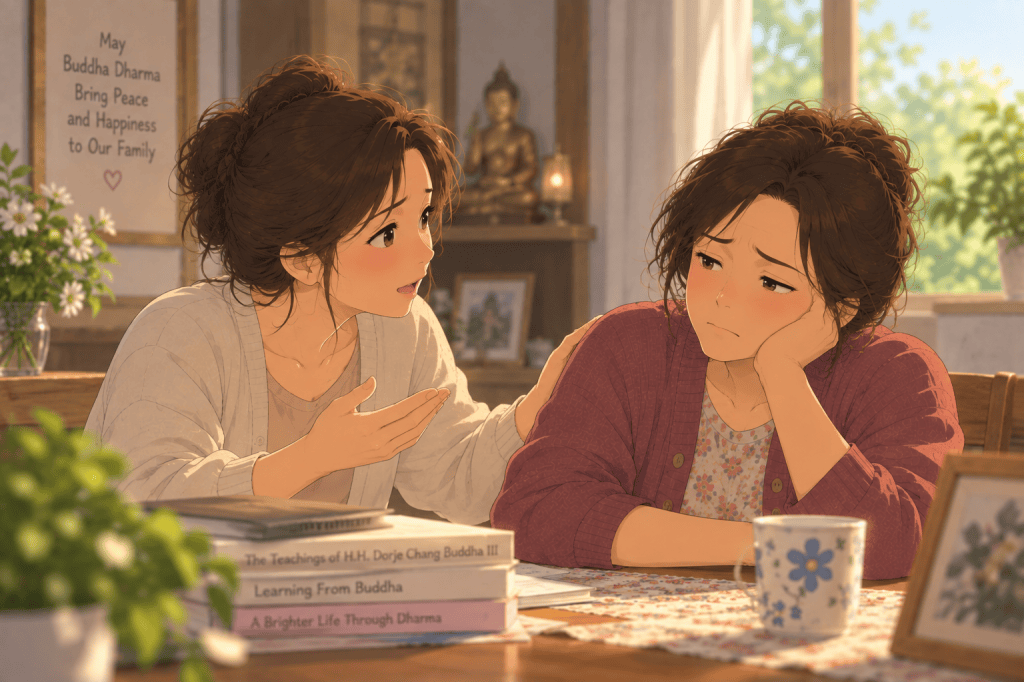
To tell the truth, seeing my mother like this made my heart ache, and I also felt deeply concerned about my inability to help her. How I wished she could learn the true Dharma of the Tathagata with me! After all, it was through learning the true Dharma of H.H. Dorje Chang Buddha III and developing right understanding and right views that I myself had been able to free myself from the suffering caused by my divorce.

Having personally experienced the benefits of learning Buddhism and cultivating myself, I tried to persuade my mother not to dwell on the things that troubled her. I explained to her that these circumstances were the result of causes, conditions, and karmic forces planted in the past. But she did not agree with what I told her.

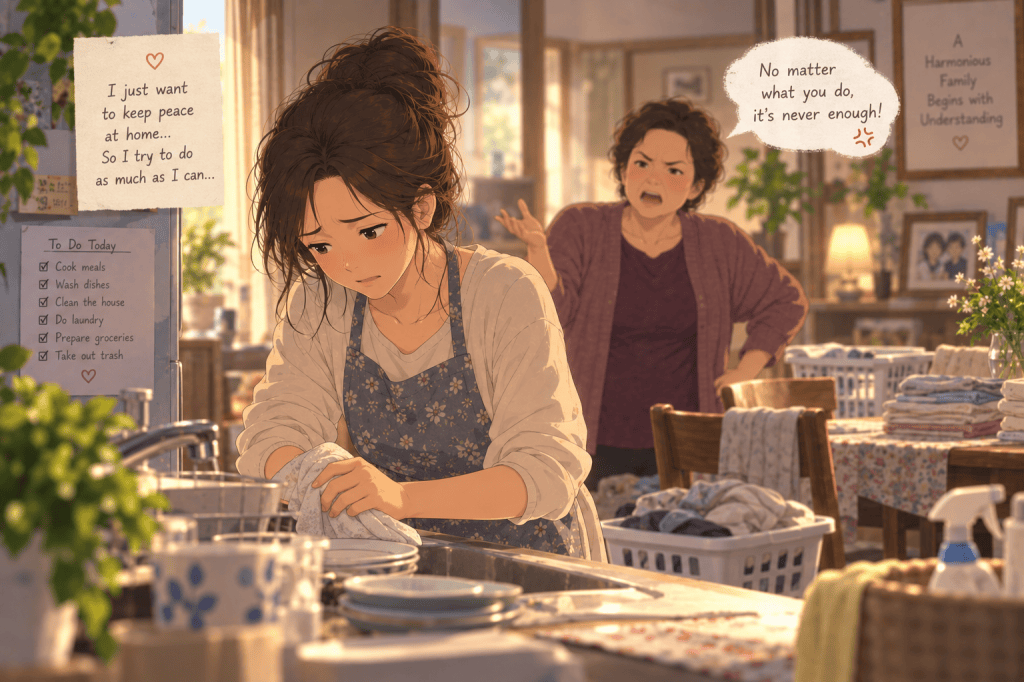
To avoid upsetting my mother, I tried to take care of nearly all the household chores myself so that she would have to do as little as possible for my single-parent household. Yet strangely, the more responsibilities I took upon myself, the more upset she seemed to become. No matter what I did, I could not seem to make her happy.

Back then, I lived very cautiously around her, afraid that something I said or did might cause her to become upset and silently resentful. I also tried communicating with her, but she would often remain silent and keep everything bottled up inside.

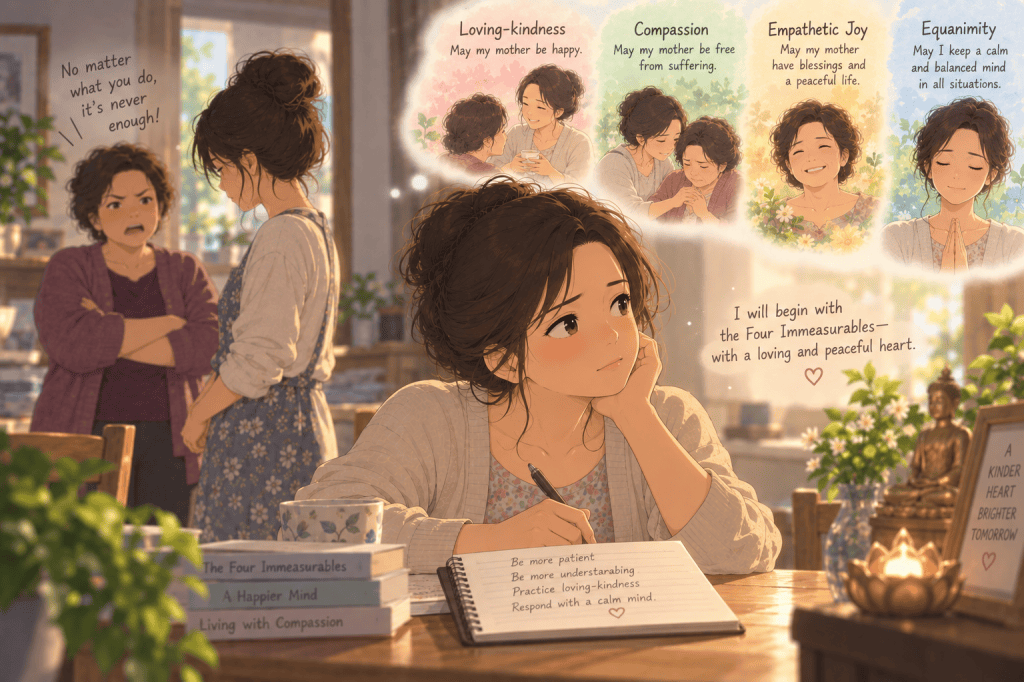
Through respectfully studying Expounding the Absolute Truth Through the Heart Sutra, I brought forth right mindfulness and finally came to understand how I should correctly practice the Four Immeasurables of loving-kindness, compassion, empathetic joy, and equanimity. I first needed to begin with equanimity and selfless giving—to be willing to devote my time to considering the needs of my family. Caring for them was not merely about making sure they had enough food, warm clothing, and money to spend. I also needed to learn to recognize and understand the suffering within their hearts.

I began to sincerely spend time with my mother, and gradually I discovered that the ice within her heart was beginning to melt. Instead of telling her, “Don’t be angry anymore” or “Don’t hold on to resentment,” I began placing the responsibility upon myself: I needed to understand the pain within my mother’s heart, listen to what her heart was trying to tell me, help heal her emotional wounds, and help her establish right understanding and right views.

When my mother complained, I became willing to set aside my time and sit quietly beside her, listening attentively. I no longer used the principle of “cause and effect” to argue with her until she had nothing left to say.

When she felt physically tired, I would take the time to massage the acupressure points on her feet and ask her whether the pressure was too light or too strong. When she felt bored, I would willingly spend time with her and chat about everyday family matters instead of lecturing her about principles and doctrines.

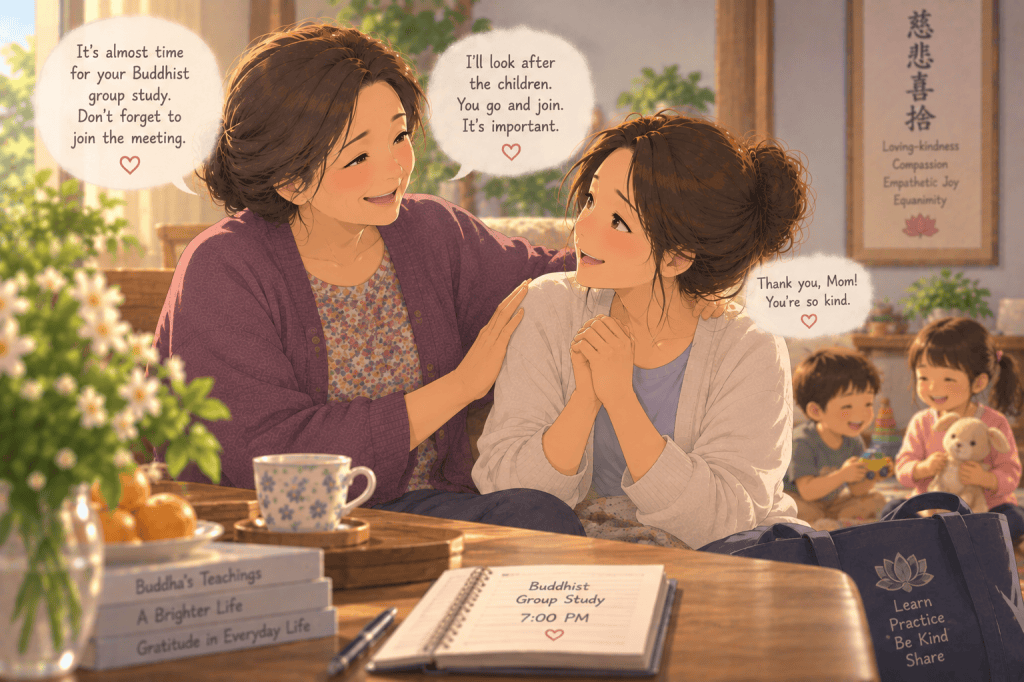
The more I tried to understand the pain in my mother’s heart, the more she began saying things like, “Don’t waste your time on me. I don’t need you to keep me company. Go take care of the children. Once you’ve taken care of everything for them, go do whatever you need to do.”

What surprised and delighted me even more was that my mother eventually began reminding me herself, “It’s almost time for your Buddhist group study. Don’t forget to join the meeting. I’ll help you look after the children.”

I had finally gained my mother’s support. And it happened simply because I had learned to recognize the pain within her heart and was willing to devote my time to sincerely being there for her.

This is exactly what the H.H. Dorje Chang Buddha III teaches in the Dharma discourses: we must put our cultivation into actual practice and cultivate ourselves with respect to the three karmas of body, speech, and mind. We must be sincere in our words and actions and in the way we interact with and treat others. Only by putting genuine effort into our conduct in everyday life can we truly touch the hearts of others.

Contributed by: Ji Cheng / Kui Xing

Link: https://myhappylifestyle.net/2026/09/06/dorjechangbuddhaiii-when-i-came-to-understand-the-pain-deep-within-my-mothers-heart/

Who Is His Holiness Dorje Chang Buddha III?

Who Is His Holiness Dorje Chang Buddha III?

Five Key Points about the Buddhist Spiritual Leader

Buddhism is among the largest religions in this world. The original founder of Buddhism and the religion’s highest spiritual leader in the universe is Dorje Chang Buddha. He is worshiped by all major sects and schools of Buddhism as the earliest primordial Buddha.

Buddhists belong to a religious belief that understands the universe’s nature of no-birth and no-annihilation and human beings’ original nature of true such-ness are one and the same. They believe in the cycle of transmigration driven by the law of cause and effect. They believe that after one’s biological death, the spirit or soul will incarnate and be reborn into a new being. In the case of the primordial Buddha, He has now incarnated to this world for the third time as His Holiness Dorje Chang Buddha III. The highest spiritual leader in Buddhism alive today currently lives in the United States of America.

His Holiness Dorje Chang Buddha III is not one who seeks publicity. Even when awarded the Presidential Gold Award, the Dr. Martin Luther King Legacy Award for International Service and Leadership, and many other prestigious prizes, He did not attend the award ceremonies to receive the prizes in person. He is well known for loving-kindness and compassion, and has made a vow of only helping others and never accepting any offerings from anyone.

However, His accomplishments and accolades are widely-reported. The following are five of the most interesting things that you may not have known about His Holiness the Buddha:

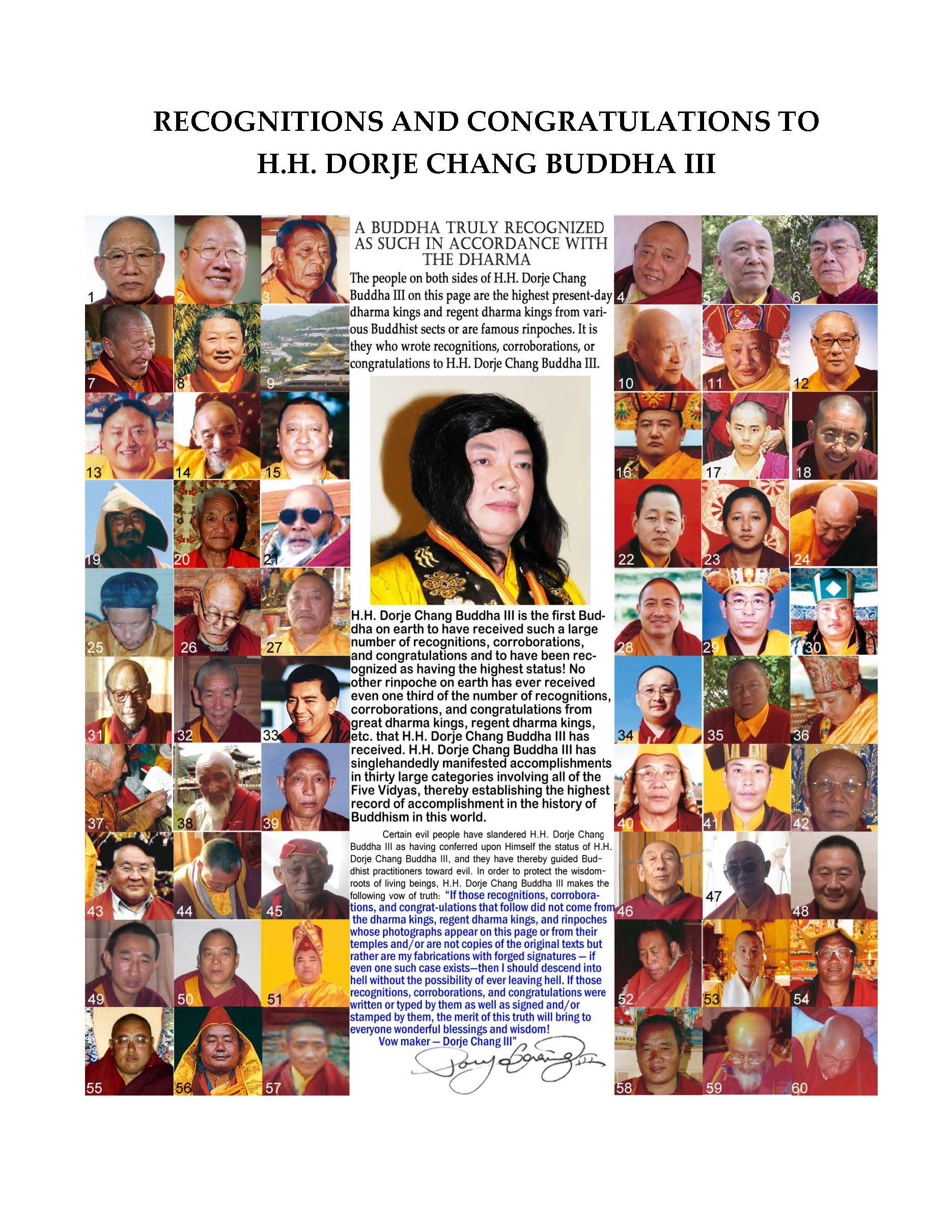
Recognitions & Congratulations to H.H. Dorje Chang Buddha III

International Buddhism Sangha Association

1. Buddhism classifies all material and spiritual matters and knowledge in the universe into five aspects. Complete mastery of these five aspects is called having realized the Five Vidyas (vidya is a Sanskrit word meaning brightness). Buddhas and Bodhisattvas must possess the Five Vidyas. The Five Vidyas include: the Vidya of Causality, the Vidya of Healing, the Vidya of Sound, the Vidya of Craftsmanship, and the Vidya of Inner Realization. Looking through the entire history of Buddhism, His Holiness Dorje Chang Buddha III is the first holy one to perfectly manifest real accomplishments in the Five Vidyas, meeting the highest standard of Buddhism. For this reason and more, His Holiness Dorje Chang Buddha III is the one and only individual in history to receive recognitions and corroborating recognitions from over 60 of the highest present-day dharma kings and regent dharma kings from various Buddhist sects.


2. His Holiness Dorje Chang Buddha III was awarded the Top Honor Prize during the World Peace Prize Ceremony at the U.S. Capitol on June 14, 2011. The World Peace Prize is an initiative to promote world peace and understanding between different nations, ethnicities, cultures and religions. His Holiness Dorje Chang Buddha III was recognized for receiving this Top Honor Prize by the 112th Congress in U.S. Senate Res. 614, commending His Holiness the Buddha for his role in advancing peace, justice and inter-religious collaboration.

3. His Holiness Dorje Chang Buddha III has long been an internationally renowned artist. His paintings are not limited by subject or themes and are of many types, from water-ink paintings to oil paintings. Specifically, the subject matters include human figures, animals, flowers and birds, mountain and water scenes, fish, insects, and so on. Within the wide range of styles, there is fine brushwork, drawing with lines and strings, splash-ink, bold freehand brushwork, small freehand brushwork, and others. Altogether, He created 16 unique painting styles or schools, representing an unprecedented pioneering achievement in the history of art. His paintings are on permanent exhibition at the International Art Museum of America in San Francisco, the H.H. Dorje Chang Buddha III Cultural and Art Museum in Los Angeles County, and other art museums. His Holiness Dorje Chang Buddha III’s paintings are extremely valuable and rare. As early as in 2000, His artworks were sold for more than two million U.S. dollars each. He became the artist whose paintings commanded the highest prices compared to the prices for paintings created by all ancient and modern Chinese artists. Last March, an ink painting of His was sold at the New York Spring Auction for $16.5 million, which was the highest price realized at the 2015 Spring Auction of all artworks by ancient and modern artists worldwide. He is the world’s first inventor to create a class of artworks that cannot be duplicated by anyone or with any method — Yun Sculpture. Only after that, the world now has un-duplicable artworks. Experts predict that His paintings will become increasingly valuable as His Holiness plans to focus solely on Buddhist activities.

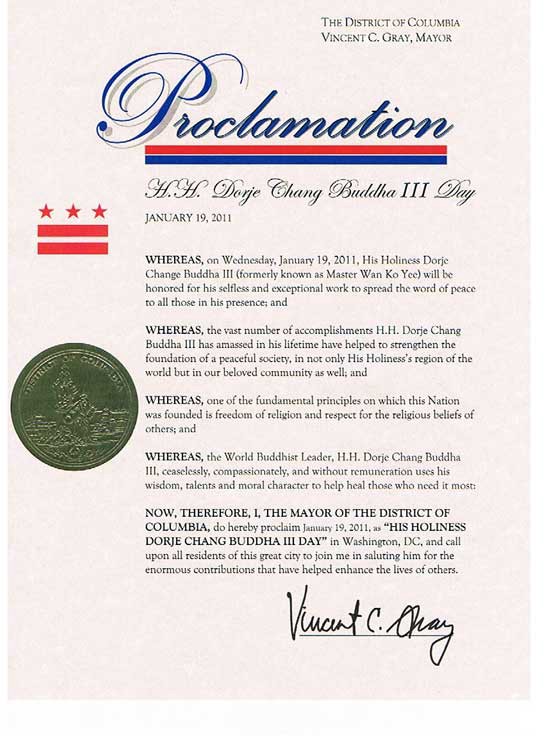
Proclamation of H.H. Dorje Chang Buddha III Day

4. In 2011, the then Mayor of Washington, D.C., Vincent Gray, proclaimed January 19th as “H.H. Dorje Chang Buddha III Day.” The mayor called on D.C. residents to join him in saluting “His selfless and exceptional work to spread the word of peace to all those in His presence.” The Unites States Postal Service also issued a commemorative cover in celebration of “His Holiness Dorje Chang Buddha III Day.”

5. His Holiness Dorje Chang Buddha is a Fellow of Britain’s Royal Academy of Arts, making Him the first internationally distinguished artist appointed to a Fellowship in the Academy’s history of more than 200 years. The title of Fellow was awarded by the Academy’s President, Phillip King, at a ceremony in the British Embassy in Washington.

Unless you are an astute follower of Buddhism, you may not have known that His Holiness Dorje Chang Buddha III has been recognized as the third incarnation of the original Buddha. His accomplishments clearly transcend religion, healing, art, philosophy, and literature. He continues to devote His time to a wide scope of cultural, religious, and various other domains directed at helping people in communities across the globe. His Holiness Dorje Chang Buddha III has made the following vow: “I will bear all of the karmic offenses committed by living beings, and I will give everyone all of the good karma and merit that I plant.” His Holiness the Buddha has been executing it exactly as is.

Steven Meyers received his bachelor’s degree in Chinese language from Brown University, where he graduated magna cum laude. After graduating, Mr. Meyers spent a year at the Stanford Center in Taiwan furthering his study of the Chinese language. Later, he received a Juris Doctor degree from the University of Michigan and is now an attorney licensed to practice law in the state of California. He has been providing legal advice to California non-profit corporations since 1996. His current focus is translating Buddhist material from Chinese into English.


Who Is His Holiness Dorje Chang Buddha III?


Source: https://dharma-hhdorjechangbuddhaiii.org/who-is-his-holiness-dorje-chang-buddha-iii/

Link: https://myhappylifestyle.net/2026/09/04/who-is-his-holiness-dorje-chang-buddha-iii/
 

#DorjeChangBuddhaIII #Buddha # Buddhism