COVID-19 struck with devastating force and became the final blow to my father, who was
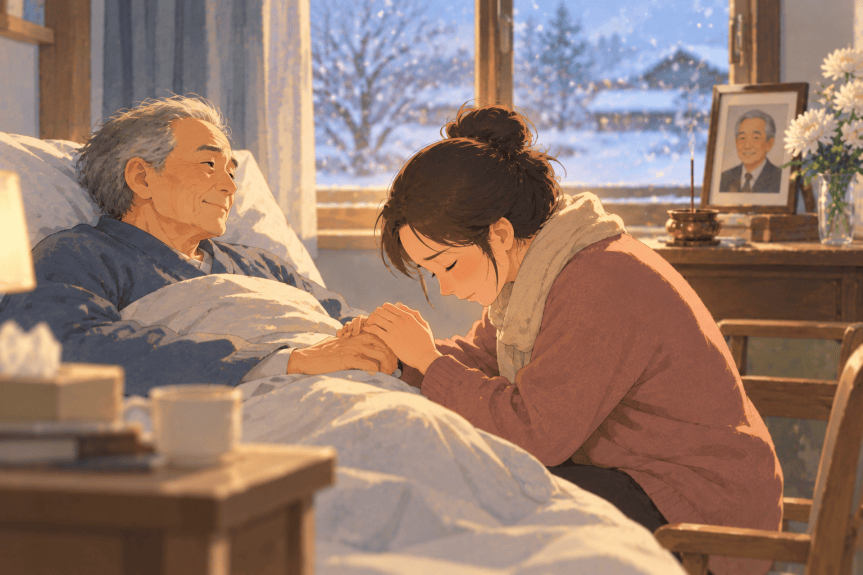
already suffering from lung cancer. That winter felt especially bleak and desolate. Snow
was falling, yet even the snowflakes did not feel as cold as my heart.
My father was the person I respected most in my life. He was the “backbone” of our family.
Born in a rural village in northeastern China, my father was not only the pride of my
grandparents but also the pride of the entire village. In those difficult times, for a boy from a
poor rural family to be admitted to a prestigious university was almost like becoming the
top scholar in the ancient imperial examinations—a promising young man had risen from
humble beginnings.
Yet my father had a very difficult childhood. He lost his mother at a young age when my
grandmother passed away. My grandfather had to be both father and mother, raising all six
children on his own.
Through perseverance and hard work, my father was able to leave the countryside behind.
He graduated from university with outstanding grades and was assigned to work in Tianjin.
In a city where he had no relatives or connections, he gradually established himself.
Through years of tireless effort, he achieved extraordinary results in an ordinary position
and eventually built a successful career.
Time passes so quickly, often catching us completely unprepared.
One day in July 2022, I noticed that my father, who had always been in good health, was
making a wheezing sound when he breathed. After medical examinations, he was
diagnosed with lung cancer.
We were utterly shocked.
We sought medical advice and treatment from various doctors and hospitals. In the end,
however, we had no choice but to opt for conservative treatment because the location of
his tumor made surgery unsuitable.
Tormented by the illness, my elderly father grew thinner by the day. Whenever I saw him
coughing so severely that he could barely catch his breath, I wished desperately that I
could bear his suffering for him. I would rather have been the one who was ill.
Yet no matter how deeply I loved my father, there was nothing I could do to take his
suffering away.
How small and powerless human beings can be in the face of illness!
Then, as if things were not already difficult enough, my father contracted COVID-19. His
already frail body suffered yet another devastating blow.
On December 25, 2022, while many people were celebrating Christmas, my father left us
forever.
I held my elderly mother in my arms and dared not shed tears, afraid that seeing my grief
would deepen her sorrow.
After comforting my mother, I softly recited the Kṣitigarbha Sutra beside my father, praying
that he would receive the blessings of the Buddhas and Bodhisattvas and be reborn in one
of the three higher realms or in a Pure Land.
According to local customs in Tianjin, the deceased may be transferred to a mourning hall,
where the family holds memorial rites. Traditionally, the body remains there for three days
so that relatives and friends can come and pay their respects.
After receiving the many relatives and friends who came to mourn my father, I remained
alone in the mourning hall.
Standing before my father’s portrait, I could no longer hold back my tears. I simply let them
flow.
One by one, I told my father all the things I had wanted to say to him over the years but
never had the chance to express.
Perhaps it was only my imagination, or perhaps it was because I missed him so deeply, but
I almost felt that he was right there in front of me, listening as I spoke.
Lament — A Regulated Verse
The desolate winter wind chills me to the bone;
Across the mournful sky, wild geese cry in sorrow.
Weary in both spirit and form of this cold mortal world,
The body now belongs beneath the pure white snow.
A loving father’s warmth has faded like a dream;
Could a child’s devotion ever be in doubt?
A lone chrysanthemum stands by the fence, as though on a distant riverbank.
I gaze sorrowfully into the hazy distance as a thin mist drifts in.
This poem could express only a fraction of the grief within my heart.
No matter how reluctant I was to let him go, my father’s body was eventually reduced to a
bag of ashes and placed inside a small urn.
I could not even be certain whether those ashes truly belonged to the physical body that
had once been my father. But in fact, whether they did or did not no longer mattered. The
body was merely a temporary combination of the four great elements. The “soul” of the
father I had known had already gone somewhere beyond my knowledge.
At that moment, I could not help recalling an impartation from Namo H.H. Dorje Chang
Buddha III in Philosophical Sayings About Worldly Matters:
“A person grows wiser by learning from the setbacks he suffered. True knowledge
comes from one’s own experience. Secondhand experience is worth little.”
On the journey of life, how can we truly understand the truth of something or gain genuine
insight into our own state of being?
The essential point is that understanding cannot come merely from what we hear, nor
merely from what we see. Beyond seeing and hearing, we must learn to draw experience
and lessons from repeated setbacks and failures. Through practical experience,
verification, and sincere reflection upon our failures, we can gradually develop an inward
understanding of things and come to comprehend the truth.
Therefore, we must personally undergo experiences before we can truly understand them.
If we merely rely on hearsay without personally putting things into practice, what we gain is
not an understanding of their true nature. Only the experience gained through what we have
personally undergone, witnessed, and practiced can lead us to genuine understanding and
truth.
“Life is impermanent” was something I used to say often.
One day, I would talk with someone about how quickly time passes; the next day, I would
speak with someone else about how everything can change in an instant.
But in reality, I had never truly developed a deep awareness of impermanence.
It was not until my father passed away that I was finally awakened to it.
My father had truly given me a profound and painful lesson in impermanence.
Written by: Zai Lu Shang
Edited by: Yuese
#DorjeChangBuddhaIII #Spirituality #Buddha #Buddhism