
My Personal Experience: The High Price of Saving Face
From ancient times to the present, many people have placed great importance on “saving face,” often associating it with reputation and social status. Outwardly, they want to maintain a favorable image in the eyes of others; inwardly, they want to satisfy their own vanity. So, if someone causes them to “lose face,” serious trouble may follow.
Think about it carefully. It can be something as minor as a group of people scrambling to pay the bill at a restaurant, or something as serious as a tragedy caused by someone desperately trying to protect a fragile sense of pride. So many conflicts arise simply because people care too much about “face.”
When I was a child, I too once paid a price for wanting to save face.
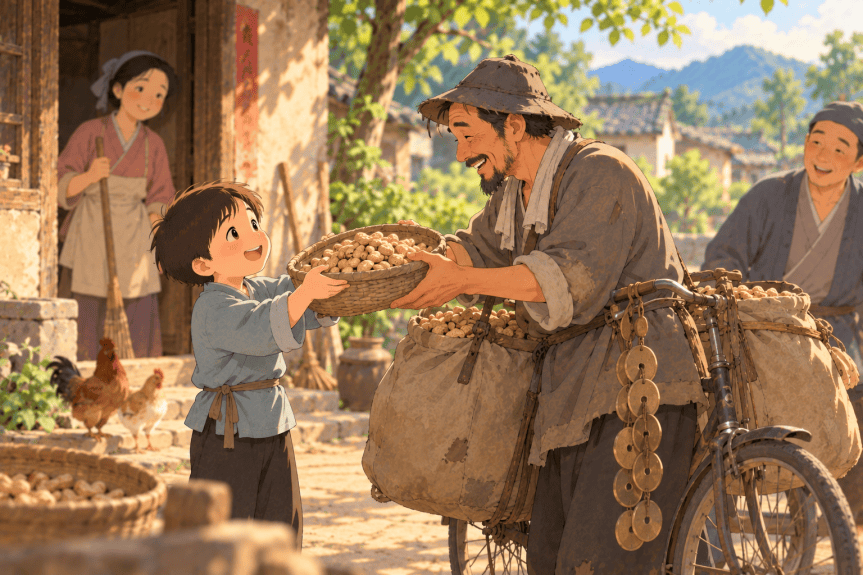
In the 1970s, everyday necessities were relatively scarce. Toothpaste tubes were made of aluminum, and itinerant peddlers often traveled from village to village collecting used tubes. Every so often, someone would also come to the village to castrate roosters and collect empty toothpaste tubes and the inner linings of chicken gizzards, known in traditional Chinese medicine as Ji Nei Jin.
Not many people did this kind of work. They traveled either on foot or by bicycle, carrying a long string of copper pieces fastened together somewhat like traditional Chinese clappers. As they walked, the copper pieces swung and struck against one another. Their distinctive clattering could be heard from far away, inevitably setting the chickens squawking and dogs barking in the otherwise quiet village.
One day, one of these peddlers became thirsty and stopped by our house for some water. After greeting him, my mother went to work at the threshing ground beside our house.
The man kept talking to me, trying to win me over. “What a good child!” “What a clever little one!” Compliments cost him nothing, and they came pouring out one after another. Before long, I was completely carried away by his flattery.
He asked me to bring him some peanuts to taste, and I obediently did as he asked. I brought him a large scoop filled to the brim with peanuts.
He showed no hesitation whatsoever. He dumped all the peanuts straight into the two large bags hanging from either side of his old-fashioned bicycle—and even remarked that it was not very much.
Just then, a fellow villager happened to pass by.
The peddler deliberately raised his voice and said, “What a hospitable child—so very generous!”
The villager gave me an amused smile and replied, “Yes, very generous indeed!”
At that moment, I actually felt terrible. After all, this was a time when food and clothing were scarce. Yet once I had been praised as an “especially generous child,” my concern for saving face made it difficult for me to stop. I had already given away a large scoop of peanuts, and the man still thought it was too little.
Gritting my teeth, I went and found a large bag and filled it to the top with peanuts for him.
Once again, he deliberately said in a loud voice, “You don’t need to give me so much! What a generous and sensible child you are!”
He then filled the two large bags on his bicycle with the peanuts and rode off without looking back.
Later, when my mother found out what had happened, she said to me, “Our family wasn’t doing business with him. It would have been enough to offer him a little something out of courtesy. Giving him such a large bag was far too much—that was enough to serve his whole family! Well, let’s just consider this your first time playing host and entertaining a guest.”
Although my mother did not criticize me, I knew very well how hard my parents labored in the fields to put food on our table. I deeply regretted what I had done. Our own family often did not have enough to eat, so how could I have given away our food so easily?
That incident taught me an important lesson: It can be very difficult to resist when someone showers you with flattering praise.
As I gained more life experience, I came to realize that sometimes people defend their pride and “face” even at the cost of their lives.
Take Xiang Yu, for example. After suffering defeat in the Chu-Han Contention, he fled to the Wu River. The chief of Wu River Pavilion told him, “Although the region east of the Yangtze is small, it spans a thousand li and has hundreds of thousands of people. It is still enough territory for you to rule as king.”
Xiang Yu laughed and said, “Heaven intends to destroy me. What would be the point of crossing the river?”
He would rather take his own life than continue living in defeat. What a tragic and lamentable end!
In fact, when Xiang Yu felt that he had “no face to see the elders of Jiangdong again,” concern for his pride and reputation was still at work deep within him. Had he been able to put aside the issue of saving face, cross the river, and regroup his forces, history might conceivably have unfolded differently.
Another example was a 2021 case in which a man killed his wife following an argument that began over an onion.
A man surnamed Li was drinking at home with several friends. After they had been drinking for some time and were in high spirits, one of his friends suddenly wanted some onion as a palate cleanser. Li called for his wife, Su, to cut some onion for them.
But Su was busy caring for their three young children and already had more than she could handle. Her husband not only failed to appreciate how overwhelmed she was, but also ordered her around. Already unhappy about his drinking, she replied in frustration, “If you want it, cut it yourself. If you don’t want to do that, then forget it. I’m not here to wait on all of you!”
That single remark, spoken with resentment and frustration, turned what had been a small gathering into a scene of violence.
After being refused by his wife, Li felt that he had lost face in front of his friends and that his authority as the “head of the household” had been undermined. He began arguing fiercely with Su. Under the influence of alcohol, Li picked up a sharp kitchen knife and stabbed his wife.
Su collapsed and lost consciousness. She later died from severe blood loss and damage to her internal organs. Li was subsequently sentenced to life imprisonment.
Just like that, a once-intact family was shattered.
Li’s attachment to saving face cost his wife her precious life and sent him into the depths of imprisonment. Trying to save face for a moment can result in a lifetime of regret.
This also serves as a warning to us: Why cling to something as hollow as “face”? Face itself is worth nothing.
Put another way, protecting one’s “face” is really a way of protecting one’s attachment to self. When everything revolves around “me,” human weaknesses such as selfishness, greed, anger, and ignorance can flourish, leading to one problem after another.
If a person truly wishes to earn dignity and respect, that person should strive diligently to accomplish something worthwhile and then share the benefits, care, and warmth with others, working for the well-being of the public. In this way, people will naturally respect that person from their hearts.
As Namo H.H. Dorje Chang Buddha III imparted in Philosophical Sayings About Worldly Matters :
“What makes the sun the greatest thing man has ever known? It is admired for providing light and warmth for all the beings under it. A truly great person is one who is willing to sacrifice his own benefit for the well-being of others.”
Why is the inherent nature of the sun considered great? It is because the sun consumes itself to bring light, warmth, and energy to the world. It enables plants to grow and humans and animals to survive, providing the conditions that sustain life in our world. In other words, the sun bestows benefits upon all things in the world. That is why everyone praises its greatness.
By the same principle, if we are free from selfish motives, quietly devote ourselves to others, and even make personal sacrifices to serve the interests of the public and bring benefits to others, people will naturally respect us and praise what we have accomplished. In doing so, we ourselves become great.
But if we merely put on appearances and do things for show—whether to impress ourselves or others—without genuine kindness and compassion arising from within, then ultimately it will all be nothing more than flowers reflected in a mirror and the moon reflected on water: beautiful illusions without substance.
Written by: Mingxun
Edited by: Yuese
Link: https://myhappylifestyle.net/2026/10/04/my-personal-experience-the-high-price-of-saving-face/
#DorjeChangBuddhaIII #Spirituality #Buddha #Buddhism

