
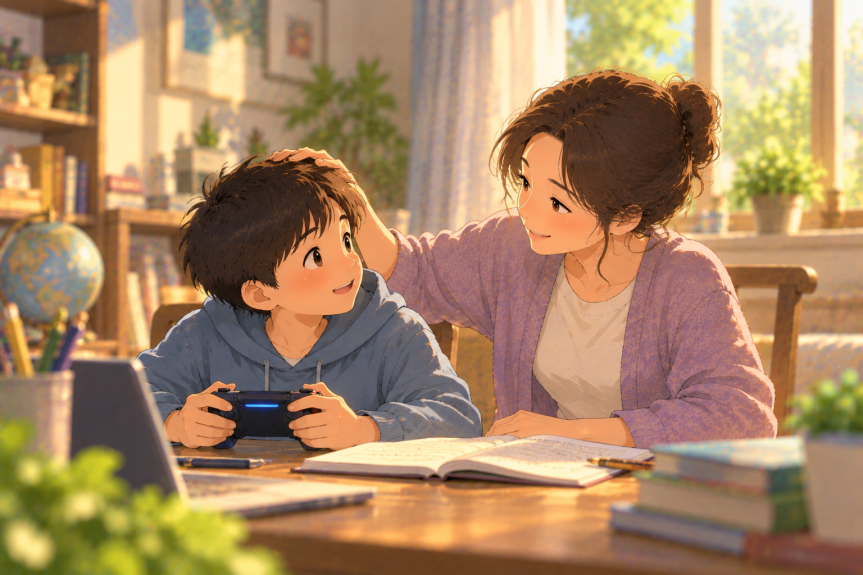
Did My Child’s Gaming Spark a “Family War”? The Experience That Reshaped My Approach to Parenting
From time to time, we come across news stories online about mothers who become so stressed while helping their children with homework that they develop health problems, fathers who become so angry while tutoring their children that they suffer heart attacks, and parents whose efforts to supervise homework end up triggering a full-blown “family battle.”
Without exaggeration, I recently experienced a “family war” of my own. It truly brought to mind the saying: “When there’s no homework, mother and child are loving and harmonious; once homework begins, the whole household is thrown into chaos!”
Due to local COVID-19 prevention measures, the school notified students that classes would be conducted online from home. On the first day, my son followed his teacher’s instructions very well. By the second day, however, he had begun doing as he pleased. Before finishing his homework, he started playing video games and did not submit his assignment until 10 p.m.
When I saw the teacher’s message reminding him to turn in his homework, my anger immediately flared up. I raised my voice and scolded my son, “Why can’t you be more responsible? Do you know how much I trust you? Is this how you’re going to deal with your homework?!”
He immediately raised his voice in return and protested, “Why do you have to control everything? As long as I finish my homework that day, it should be fine!”
How dare he yell at me like that? It seemed utterly disrespectful! I was deeply hurt and extremely angry. In a moment of impulse, I slapped him and took away his phone. My son cried and made a scene, throwing the whole household into turmoil. When I tried to speak with him again, he slammed the door, locked it, and refused to let me come near him.
For a moment, I did not know what to do. Almost without realizing it, I went to the Buddhist altar, opened a Buddhist book, and began reading respectfully. I came across this teaching by Namo H.H. Dorje Chang Buddha III:
“When someone criticizes or slanders you, there must be some mistakes you have made in handling things inappropriately, or at least you have failed to win people’s approval and respect for what you did. What you must do in this case is to make full criticism of yourself.”
This means that whenever someone criticizes or slanders you, you should carefully reflect upon yourself and recognize that there must be something you have done wrong, because people do not accuse others entirely without cause.
In our interactions with others or when handling various matters, conflicts may inevitably arise for many different reasons. Perhaps something in our words or actions has offended or wronged the other person, or perhaps our attitude has made them feel that they have been treated unfairly. At the very least, we have failed to gain their recognition, respect, or admiration. In other words, we have failed to earn their goodwill toward us.
This alone shows that we are not yet perfect and that there are shortcomings on our part. Therefore, we should sincerely examine ourselves from within, recognize our own faults, and engage in more self-criticism and self-reflection.
The more I read, the more ashamed I felt, and gradually my mind became calm again. It was certainly wrong for my son to become absorbed in video games to the point that they interfered with his studies, but my own mistake was even greater. I should not have lost my temper, much less hit him. Violence cannot solve problems. I should treat my son as an equal and communicate with him more. Resorting to physical force would only intensify the conflict and make him even more rebellious.
How could my words and actions that day reflect those of a loving mother? How could they reflect the conduct of someone cultivating herself?
As I thought about this, I became deeply remorseful. At that moment, my entire approach to parenting was reshaped. I realized that I should not use parental authority to suppress my son. Instead, I needed to communicate with him on an equal footing.
Afterward, I changed my attitude and spoke with my son calmly. I took the initiative to apologize to him, acknowledged my mistake, and promised that I would no longer resort to violence. When problems arose, we would communicate with each other instead.
At the same time, we reached an agreement: he could use his phone, but only after completing his homework and provided that he had enough free time. He could play games for no more than half an hour a day. My son accepted these conditions.
At last, the conflict was resolved. Our “family war” came to an end, and we made peace with each other.
My son’s “rebelliousness” taught me a valuable lesson. It prompted me to reflect on myself and correct my attitude. It also led me to think more deeply: Life is filled with ups and downs, favorable and adverse circumstances. Greed, anger, ignorance, attachment, joy, sorrow, and all kinds of emotions accompany us along the way. What should we do so that we can withstand the tests and trials of life?
Look Inward Rather Than Seeking Outward
In the past, whenever conflicts arose between me and my family members, colleagues, or classmates, I habitually blamed others. I failed to recognize my own faults and always believed that I was right.
Yet when one finger points at another person, the other fingers point back at oneself.
Looking back, I realized how often I had complained. I had complained that my parents favored my brother and did not care enough about me. I had complained that my husband made reckless decisions and accumulated debts, leaving me constantly worried and anxious. I had complained that my son was playful and disobedient. I had complained that my family failed to appreciate everything I did for them.
But complaining, blaming, and becoming angry only make matters worse; they do not solve the actual problem. Ultimately, the better approach is to examine matters from the perspective of cause and effect, analyze the situation, uncover the root of the problem, and find a way to resolve it.
Strengthen Our Vows and Resolve to Fulfill Them
Afflictive hindrances are among the great obstacles we face. They arise from karmic forces rooted in beginningless ignorance. When the power of our vows arises, it can overcome the force of karma.
If we do not have the great vow and determination to attain liberation in this lifetime, do we really want to continue wandering through the six realms of reincarnation in our next life? We may never again encounter the wonderful Dharma conditions that we have in this lifetime.
Since we have already had the opportunity in this lifetime to hear the True Dharma and learn and practice Buddhism, we should follow the teachings and put them into practice, relinquish our attachments, and no longer allow ourselves to be swept away by the Eight Winds—gain and loss, defamation and praise, acclaim and ridicule, suffering and pleasure.
We must cultivate ourselves amid the circumstances we encounter, sincerely and steadfastly fulfill our vows, and resolve to bring them to completion. This serves as a compass guiding us forward.
The Family Is Our Training Ground
The path of cultivation is like a difficult journey, and I too am a traveler upon it.
Cultivation is reflected in every thought that arises in our minds, every movement we make, every word we speak, and every way in which we interact with people and handle matters. It is reflected in whether we have truly learned from the Buddha’s thoughts, speech, and conduct and whether we actually put what we have learned into practice in our daily lives.
The family is our training ground.
A happy family does not come from constantly thinking about how to change the other person. Rather, it comes from continually examining our own shortcomings, correcting them, improving ourselves, and becoming better people—while also bringing comfort and happiness to those around us.
I believe that a heart filled with gratitude and appreciation for the affinities we share will bring greater joy, ease, and peace to both ourselves and our families.
Written by: Haohe
Edited by: Sayi / Bodhizi
Link: https://myhappylifestyle.net/2026/10/14/dorjechangbuddhaiii-did-my-childs-gaming-spark-a-family-war/
#DorjeChangBuddhaIII #Spirituality #Buddha #Buddhism

