
The Wisdom of Life: Neither Arrogant in Prosperity nor Panicked in Adversity
During the Qingli era of the Northern Song Dynasty, there were two porcelain merchants in the capital city of Bianjing, named Zhao Qian and Sun Wang. Both entered the trade in the same year, each opening a shop selling Jingdezhen bluish-white porcelain.
For the first three years, Zhao Qian’s business struggled. The goods he purchased always seemed to be out of season—he stocked thick-walled warming vessels in summer and thin-walled tea cups in winter. The neighbors laughed at him, calling him “Foolish Zhao.”
Yet Zhao Qian was never upset. Whenever business was slow, he would close his shop for half a month and travel alone to the kilns, observing craftsmen shaping clay and mixing glazes. He carefully recorded which glaze colors required which firing temperatures and which vessel shapes best complemented different kinds of tea.
Upon returning, he did not rush to sell his goods. Instead, he shared what he had learned with his customers, teaching them how thick-walled vessels could be used to store ice in summer and warm wine in winter. Although these efforts brought him little profit, they earned him goodwill and lasting relationships. Life was difficult, but he remained grounded and managed to make ends meet.
Sun Wang, however, was quite different.
Thanks to his uncle’s connections in the grain transport system, he could always obtain highly sought-after merchandise ahead of his competitors. During the Mid-Autumn Festival of his third year in business, he acquired a shipment of shadow-blue porcelain teapots decorated with carved floral patterns. As tea competitions were flourishing in the capital, he made more than a thousand strings of cash almost overnight.
Overjoyed, Sun Wang immediately leased three additional storefronts, hired numerous assistants, and boasted everywhere, “Sun family porcelain is known throughout the land!”
When someone advised him to slow down and proceed cautiously, he laughed and replied, “I have shipping routes, suppliers, and connections. What is there to fear?”
Zhao Qian, meanwhile, continued at his own steady pace.
Hearing that new techniques had emerged at the Yue kilns, he packed some provisions and traveled on foot for half a month to learn them.
During his journey, he stopped to rest at a mountain monastery. There, he noticed an elderly monk drinking tea from a cracked bowl, holding it with remarkable steadiness.
Zhao Qian asked, “Master, aren’t you afraid the cracked bowl might burn your hands?”
The old monk smiled and replied, “What you should fear is not the crack in the bowl, but the trembling of your own mind as you hold it. When your mind is steady, even a broken bowl can serve you well.”
These words suddenly awakened Zhao Qian to a profound understanding.
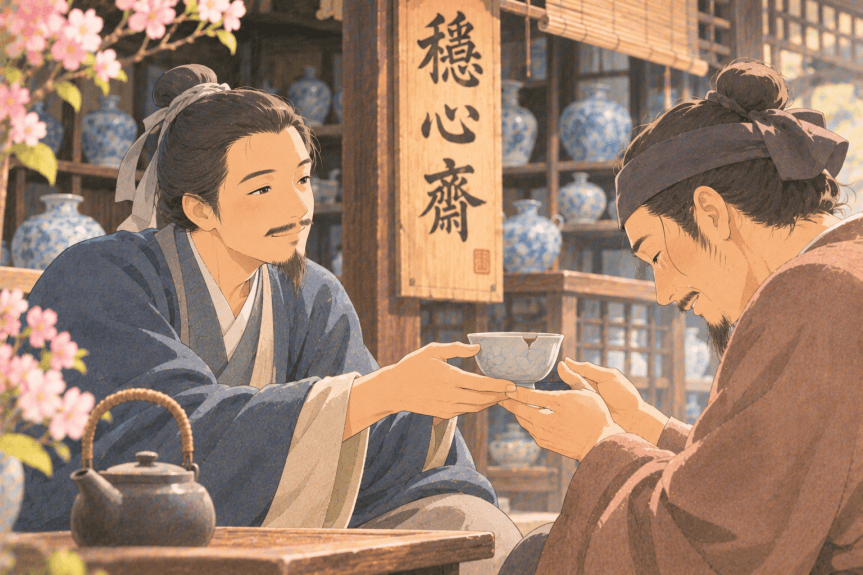
After returning home, he renamed his shop “Steadfast Heart Studio” (Wen Xin Zhai). No longer chasing trends or following every wave of popularity, he sold only utensils he had personally tested and knew to be genuinely useful.
The following spring, the Yellow River flooded, disrupting waterborne transportation for six months.
Sun Wang could no longer obtain new merchandise. Meanwhile, his reckless expansion had left his warehouse overflowing with unsold, antique-style decorative vases.
He had originally intended to hoard these items and sell them later at higher prices. But when disaster struck, wealthy households began selling off precisely these beautiful yet impractical possessions.
Creditors came knocking, and his employees gradually departed. Sun Wang was left alone in his empty shop, staring blankly at the signs hanging on the walls.
Zhao Qian’s small shop, on the other hand, maintained modest inventory and steady cash flow. Moreover, his longtime customers remembered his kindness in teaching them about tea and repairing their porcelain. Many voluntarily offered financial assistance.
As a result, he weathered the difficult year with relative stability.
One evening, Sun Wang came to bid Zhao Qian farewell.
Zhao Qian poured him a bowl of ordinary tea and said:
“When my business was struggling, what I learned was not how to sell merchandise, but how to remain at peace when no one was buying. If you can discover tranquility in this bowl of tea, you will still have a chance to rebuild your life.”
With tears in his eyes, Sun Wang accepted the bowl. Its rim was chipped, but it had been carefully washed and was perfectly clean.
Suddenly, he remembered the advice someone had given him years earlier: to slow down and proceed cautiously. Yet at the height of his success, he had been too proud to listen.
Later, Sun Wang started over as a street vendor. With every item he sold, he carefully recorded something he had learned.
He eventually opened another shop and inscribed Zhao Qian’s words on its wall:
“When your mind is steady, even a broken bowl can serve you well.”
As H.H. Dorje Chang Buddha III teaches in Philosophical Sayings About Worldly Matters:
“Exercise caution when everything goes your way; persevere in what you do when nothing goes your way. In the former case, lack of caution results in disasters; in the latter case, perseverance will never go unrewarded.”
This teaching reminds us that whenever we find ourselves on a smooth and fortunate path in life, we must never become reckless or careless. Instead, we should live with humility, vigilance, and caution.
After all, no one’s circumstances remain unchanged forever. Impermanence governs the lives of all beings, and everyone is subject to change. This is an unchanging truth.
Only by remaining humble and cautious can we prepare ourselves for the unexpected challenges that may arise at any moment.
When confronted with hardship and adversity, we should summon our courage, strengthen our determination, and address our problems calmly and carefully, striving with perseverance to overcome them.
If we abandon caution during prosperous times, misfortune will eventually come upon us. Conversely, when we face difficulties with courage, determination, and persistent effort, we can ultimately overcome adversity, achieve success, and attain happiness.
The Buddha’s teaching strikes directly at the heart of the matter.
Everyone wishes for favorable circumstances, yet few realize that prosperity itself is a profound test of one’s character.
When the waters are calm, people easily begin to believe they can command the wind and waves. When struggling against the current, they may instead feel that they will never reach the shore.
In reality, favorable and unfavorable circumstances are both natural parts of life.
When things go well, do not become arrogant, for prosperity is merely a temporary favorable current. When adversity strikes, do not panic, for hardship may simply be a necessary turning point along life’s journey.
The true field of blessings is not found in reckless indulgence during times of prosperity. Rather, it lies in maintaining the inner steadiness to hold that bowl of tea firmly, even when the winds and waves of adversity rage around us.
Zhao Qian’s shop was passed down through three generations, and its signboard continued to bear the same three Chinese characters: “穩心齋”—Steadfast Heart Studio.
When the mind is steady, difficulties can be resolved. When the mind is overwhelmed by panic, even manageable problems may seem insurmountable.
May everyone who reads these words remain true to their conscience in times of prosperity and never abandon their determination in times of adversity.
The field of blessings is not somewhere far away. It is found in every moment when you steady your breathing, calm your mind, and face life with composure.
By A Humble Scholar
Link: https://myhappylifestyle.net/2026/11/23/dorje-chang-buddha-iii-the-wisdom-of-life/
#DorjeChangBuddhaIII #Spirituality #Buddha #Buddhism

