
From Listening to the Buddha’s Dharma Discourses to Caring for the Elderly: Experiencing True Compassion
Looking back on the time when I accompanied fellow Buddhist practitioners to visit and care for the elderly at a nursing home, the memories remain deeply etched in my heart.
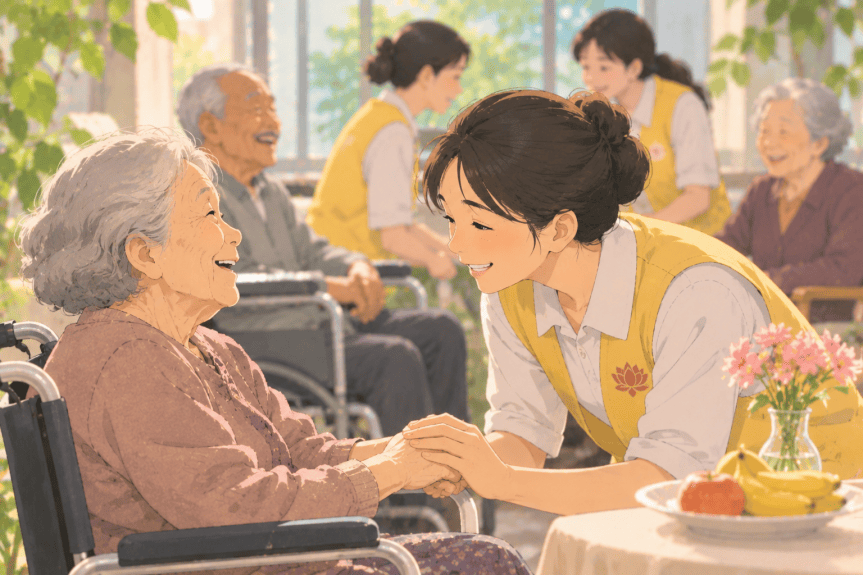
I still remember walking into the nursing home that day and seeing some elderly residents sitting quietly in their wheelchairs, staring blankly ahead. It was truly heartbreaking. I couldn’t help but think that, when they were young, they might have worked tirelessly to support their families and devoted themselves to raising their children. Now, in their old age, with their mobility limited, perhaps all they longed for was someone to visit them and spend some time talking with them.
That day, we recited the Buddha’s name together and brought some food to share with the elderly residents. As the sound of the Buddha’s name filled the room, I noticed that the expressions on some of their faces gradually softened, and gentle smiles began to appear. I was deeply moved. I came to realize that, for someone experiencing loneliness, simply knowing that someone cares and is willing to offer companionship is a precious source of happiness.
This experience reminded me of the Dharma principles I had learned from listening respectfully to the Dharma discourses of Namo H.H. Dorje Chang Buddha III.
In the teachings presented in What Is Cultivation?, Namo H.H. Dorje Chang Buddha III teaches us to cultivate compassion and bodhicitta, to learn to consider the needs of others, and to genuinely benefit living beings.
Among these teachings, the Dharma principle of “Exchanging Self and Others through Bodhicitta” gave me an even deeper understanding. When we feel lonely or distressed, don’t we also wish for someone to accompany and comfort us? Since we ourselves long to be cared for, shouldn’t we make an even greater effort to understand the needs of others?
In the past, when listening to the Dharma discourses, I felt that I understood these principles. However, it was not until I personally witnessed the loneliness of the elderly residents that I truly realized that understanding the Buddha Dharma is one thing, while putting it into practice is another.
Compassion is not merely feeling sympathy for others. It means being willing to reach out to them and bring a little warmth into their lives.
That visit also deepened my awareness of the impermanence of life. Today, we may still be healthy, able to live independently, and surrounded by family and friends. Yet everyone will grow old someday. Today, we are the ones visiting and accompanying the elderly, but perhaps one day, we too will become the people hoping that someone will come to visit us.
With this realization, I feel an even greater need to cherish the people around me and make good use of the time when I am still able to help others.
In fact, doing good deeds does not necessarily require accomplishing anything extraordinary. Spending time talking with an elderly person, showing greater patience toward our parents, offering more care to our family members, or taking the initiative to help someone in need—these are all simple acts of kindness that we can practice in everyday life.
When helping others, we should not always be thinking about how much merit or good fortune we might accumulate. What matters most is sincerity. When we genuinely wish for others to suffer less and experience more happiness, our actions take on true meaning.
Looking back on that day, all we brought with us was a little food, some of our time, and our companionship. Yet what we took away was a deeply moving experience that has remained in our hearts.
I am grateful for the teachings of Namo H.H. Dorje Chang Buddha III, and I am also grateful to the fellow Buddhist practitioners who accompanied me. They gave me the opportunity to put the principles I had learned from respectfully listening to the Dharma discourses into practice, following the teachings and applying them in daily life.
I know that I still have many shortcomings on my path of learning Buddhism. Nevertheless, I hope to always remember the feelings that arose from that visit and constantly remind myself to be less concerned with personal gains and losses, to show greater understanding toward others, and to willingly offer whatever help I can whenever I see someone in need.
True Buddhist practice is not measured by how many Dharma discourses we have listened to or how many teachings we understand. Rather, it is reflected in whether we can begin with the small things around us and transform compassion into concrete actions.
Buddhist Disciple Qiu Huangren
With palms joined in reverence
October 19, 2026
Link: https://myhappylifestyle.net/2026/11/04/dorjechangbuddhaiii-experiencing-true-compassion/
#DorjeChangBuddhaIII #Spirituality #Buddha #Buddhism

