
Say No to Mental Exhaustion: There Is No Standard Answer to Life
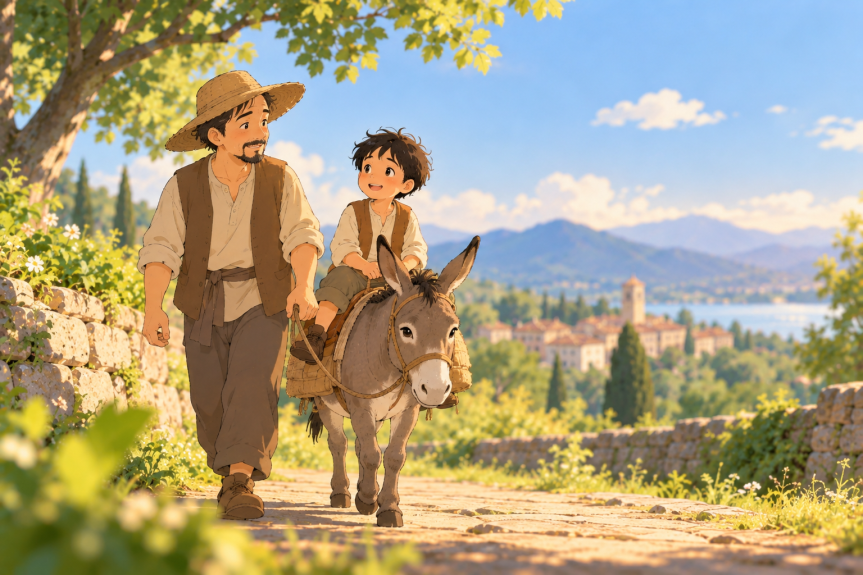
In Aesop’s Fables, there is a humorous and thought-provoking story called The Father, the Son, and the Donkey.
A father and his son were leading a donkey to the market to sell it. Along the way, a group of young girls saw them and laughed at their foolishness, saying that they had a donkey but did not even know enough to ride it.
Thinking that they had a point, the father let his son ride the donkey while he walked alongside it.
Before long, an elderly man passed by and lamented the decline of moral values. He criticized the son for being unfilial, allowing his father to walk while he rode the donkey. Hearing this, the father and son switched places, with the father riding and the son walking.
After traveling a little farther, they encountered a woman who mocked the father for being heartless, riding comfortably while making his son walk. The father quickly invited his son to ride with him.
However, after continuing for some distance, another passerby criticized them, saying that two people riding such a thin donkey would surely exhaust it to death.
Upon hearing this, the father and son immediately dismounted. They found some rope, tied the donkey’s four legs together, and carried it on a pole.
As they were crossing a bridge, the donkey struggled violently, fell into the river, and drowned. The father and son could do nothing but embrace each other and weep bitterly.
After reading this story, most people would instinctively criticize the father and son: How could they be so foolish? Why did they immediately change their actions whenever someone made a comment? They had no firm convictions of their own!
Yet, upon deeper reflection, the story reveals a profound lesson: No matter what choices you make, you can never satisfy everyone.
From the young girls’ perspective, the donkey should have been put to good use, and riding it was better than walking alongside it. From the elderly man’s perspective, a son should respect and care for his father, so the father should have priority. From the woman’s perspective, a father should care for his child, so the son should have priority. From the passerby’s perspective, the donkey should be treated with compassion, so its well-being should come first.
Were any of them wrong? From their respective perspectives, their opinions were not necessarily right or wrong.
The crucial question is: What did the father and son actually want?
Returning to their original intention, all they wanted was to take the donkey to the market, sell it, and earn some money.
However, by repeatedly listening to others and trying to please everyone, they abandoned their independent judgment and their original convictions. In the end, they lost everything.
If we behave like the father and son in this fable, constantly seeking others’ approval and repeatedly questioning our own decisions, everything we pursue may ultimately prove to be nothing more than an illusion, like flowers reflected in a mirror or the moon reflected in water.
In reality, we do not need to please everyone. We can make our own choices because there is no single standard answer to life.
Life does not follow a fixed path, either. Each of us is given a different script. Our opportunities are unequal, our choices differ, and our outcomes are not necessarily the same.
Those who are “born in Rome”—children from wealthy families—may enjoy privileged access to resources, graduate from prestigious overseas universities, and return home to start businesses.
Children of celebrities may have exceptional advantages and opportunities, with easier access to the spotlight and public recognition.
Gil Perez, a longtime doorman at Christie’s auction house, worked for 35 years welcoming and assisting visitors, eventually retiring with benefits reportedly comparable to those of a vice president and an annual income reaching one million.
Meanwhile, students from small towns who have spent more than a decade studying diligently may overcome the limitations of their backgrounds through perseverance and hard work, eventually finding their place at the forefront of a changing world.
Although we all begin life from different starting points, with some getting an early start and others beginning later, our starting point does not determine our destination. The effort and perseverance we demonstrate along the journey remain deeply inspiring.
Life is full of examinations, and every experience presents a question to be answered. None of the paths we have traveled are meaningless; every step counts. Whether we find ourselves in a valley or at the summit, each offers its own scenery. Whether we encounter storms or sunshine, every experience can become a source of enrichment.
True redemption lies in personal growth and the refinement of one’s character. We need not glorify suffering, but the resilience and determination developed through adversity are certainly worthy of admiration.
As H.H. Dorje Chang Buddha III teaches in Philosophical Sayings About Worldly Matters:
“A tree exposed to the fury of the elements will grow tall and strong. A tree kept indoors will be too weak to survive any harsh environment even when its top touches the ceiling. A life of ease and comfort produces only weaklings.”
This means that trees worthy of becoming great structural pillars are those that have undergone extensive trials and refinement. Standing beneath heaven, the sun, and the moon, they endure the harshness of wind, cold, heat, and moisture as they grow.
In remote mountains and wilderness, these trees withstand countless hardships, storms, and years of exposure to the elements. Through such prolonged trials, they eventually grow into tall, strong, and sturdy trees.
However, if a tree is planted indoors, no matter how much it grows—even if it reaches the roof—it remains tender and underdeveloped. Without sufficient sunlight, rain, and exposure to the natural elements, it lacks the necessary conditions for proper growth and strengthening. As a result, its wood remains soft and immature, unsuitable for practical use.
The same principle applies to human beings.
If a person merely studies behind closed doors, never experiences hardship, never undergoes various forms of training, and remains completely disconnected from society and practical life, that person will never truly understand the full range of life’s experiences—the bitterness, sourness, spiciness, sweetness, and saltiness of life.
Without such experiences, one cannot become a strong and capable individual. And without developing such strength and capability, one cannot become a truly outstanding and useful person.
Therefore, to become a person of genuine ability, one must undergo the kinds of trials described by the ancients: having one’s muscles and bones tested through hard work, experiencing hunger and physical hardship, enduring poverty and deprivation, and facing difficulties that challenge one’s actions and resolve.
None of these forms of training can simply be overlooked if one wishes to develop genuine ability. Only through diverse experiences, practical training, and personal refinement can a person ultimately become someone of true value and capability.
Written by: Yue Se
#DorjeChangBuddhaIII #Spirituality #Buddha #Buddhism

