
Starting with Puyi’s Appraisal of an Ancient Painting: Seeing Is Not Always Believing
A couple of days ago, I came across an interesting video about a collector who showed one of his treasured possessions to Puyi, the last emperor of China. I would like to share this story with everyone.
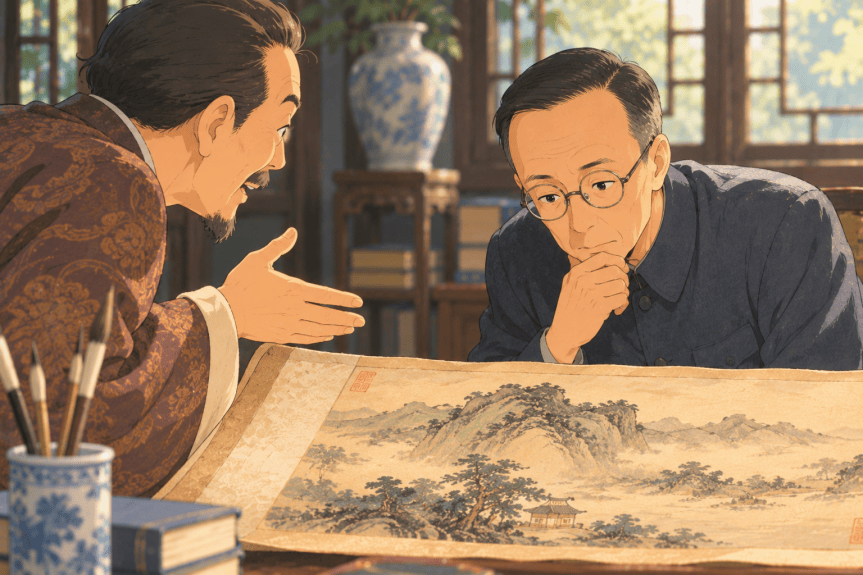
One day, a collector invited Puyi to his home and presented an ancient painting that he had treasured for many years, asking Puyi to appraise it. The painting was believed to be the work of a renowned artist from the Ming Dynasty and had already been authenticated by two or three highly respected art experts. It was considered a national-treasure-level collectible.
At that time, Puyi had undergone labor reform and had long since shed the glory of his imperial status, becoming an ordinary citizen of Beijing. Unexpectedly, after examining the painting, he made a surprising remark: “There is something wrong with this painting!”
Upon hearing this, the collector’s expression immediately darkened. In the collecting world of that era, this man enjoyed a reputation comparable to that of Ma Weidu, a well-known Chinese antiques collector and cultural commentator today. If even someone of his standing had made such a serious mistake, how could he maintain his reputation in the collecting community? Therefore, Puyi was not merely questioning the authenticity of the painting; he was also challenging the collector’s professional knowledge and discerning eye. It was a direct blow to the collector’s pride!
The collector challenged Puyi, saying, “Tell me, what exactly is wrong with it? Look at the artist’s signature, the texture of the paper, the painting style, the ink, the colors—look at all these details…” He went on and on, using one technical term after another.
Puyi listened and nodded repeatedly. Then, in an unhurried manner, he replied, “Everything you have said is correct, but there is still something wrong with this painting.”
The collector pressed further, “Why do you say that?”
Puyi then gave an answer that left the collector speechless:
“Because it doesn’t look like the paintings I used to see in the imperial palace!”
Puyi did not attempt to refute the collector using specialized knowledge, nor did he cite any formal standards of authentication that he had learned in the palace. Instead, he relied on his firsthand experience. According to the story, he had never encountered counterfeit works while growing up because there were supposedly no fakes in the imperial palace! All the antiques and works of art he had seen since childhood were genuine masterpieces.
Thus, when he encountered a forgery, he might not have been able to explain, from an academic perspective, exactly which techniques had been used to create it. But he knew one thing: It was different from what he had seen in the imperial palace.
After seeing enough authentic masterpieces, one naturally develops an eye for recognizing counterfeits. This is similar to the Chinese saying, “After reading three hundred Tang poems, one can recite poetry even without knowing how to compose it.”
The collector, however, was confined by what he had learned and mistakenly identified a forgery as an authentic work based on his accumulated knowledge and experience. This illustrates that seeing is not always believing.
He had fallen into the trap of the obstacle of knowledge—clinging to his existing understanding and allowing it to prevent him from recognizing something beyond it. Like a frog at the bottom of a well that mistakes the small patch of sky above for the entire heavens, he had confined himself within the boundaries of his own experience, resulting in an embarrassing mistake.
Namo H.H. Dorje Chang Buddha III stated in Philosophical Sayings About Worldly Matters:
“What one has learned may dull one’s sensitivity to new knowledge and throw one into the darkness of ignorance. If such ignorance is not broken, one cannot hope to become intelligent, still less reach the realm of wisdom.”
This means that anyone who regards the knowledge they already possess as the only correct understanding or as absolute truth, refuses to absorb new knowledge, and treats new knowledge and insights as erroneous views has fallen into the obstacle of knowledge.
Such a person uses their existing knowledge as the standard by which everything else is judged, rejecting anything new that does not conform to what they already know and labeling it as false or heretical. This is precisely what it means to be obstructed by one’s own knowledge. In other words, the knowledge one possesses has itself become an obstacle to acquiring new knowledge.
Once a person develops this obstacle of knowledge, they will inevitably fall into a state of ignorance. One could even say that such a person has already become ignorant. They cannot truly become intelligent, much less attain wisdom.
This is because intelligence refers to understanding and knowledge within the worldly realm, whereas wisdom refers to a higher level of understanding associated with the state of non-action (wu wei).
Why, then, should a person avoid falling into the obstacle of knowledge?
Consider someone who is extraordinarily intelligent and begins reading books from the moment they are born. Suppose this person reads one book every day and lives to be one hundred years old. Even then, they would acquire the knowledge contained in only about 36,000 books throughout their lifetime.
But does all the knowledge in our world exist within those 36,000 books?
What if additional knowledge emerges beyond what is contained in those books? If you dismiss everything that does not agree with the knowledge you have acquired from those 36,000 books as false teachings or heresy, can you really claim to have grasped the truth?
In reality, the knowledge in this world is boundless and inexhaustible. To believe that one has understood the entire universe merely through the knowledge contained in 36,000 books is truly absurd and laughable.
Therefore, no one should fall into the obstacle of knowledge. We should never use the knowledge we already possess as a defensive weapon to resist new knowledge.
Instead, we should remain open to learning whatever new knowledge we encounter and ultimately subject it to the test of practice and experience. Only through such verification can we determine whether what we learned previously was the truth or whether we have only now encountered the truth.
Only by adopting this approach can a person become truly intelligent and eventually enter the realm of wisdom.
This is an immutable truth.
Link: https://myhappylifestyle.net/2026/11/01/dorjechangbuddhaiii-seeing-is-not-always-believing/
#DorjeChangBuddhaIII #Spirituality #Buddha #Buddhism

